Duke Kunshan University students learn with museums and local communities in Jinxi, a historic water town in Kunshan, China, connecting cultural heritage, digital innovation, and public service.
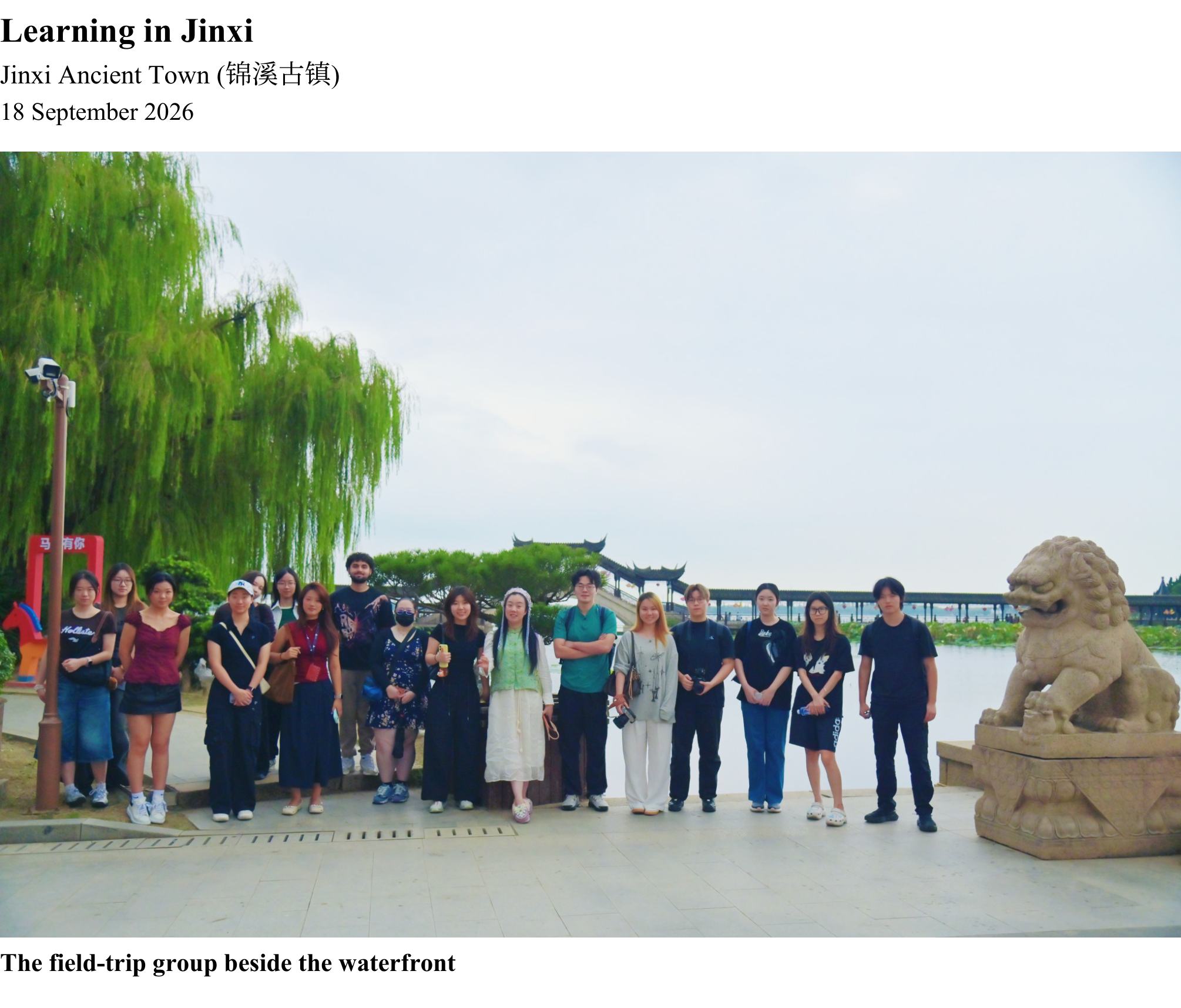
On September 18, 2026, students in Duke Kunshan University’s INFOSCI 301: Data Visualization and Information Aesthetics, instructed by Prof. Luyao Zhang, visited Jinxi Ancient Town (锦溪古镇) in Kunshan, China. Prof. Zhang represented the Digital Technology and Society Cluster at the Center for the Study of Contemporary China (CSCC) and the SocioTech Future Lab in DKU’s Social Science Division. Students explored how data visualization can communicate local communities’ histories, knowledge, and everyday lives. The itinerary linked the waterfront around Wenchang Square (文昌广场) with visits to the Jinxi Intangible Cultural Heritage Museum (昆山锦溪非遗博物馆) and the China Ancient Brick and Tile Museum (中国古砖瓦博物馆). The field trip formed part of Prof. Zhang’s community-based learning innovation activities supported by the Office of Student Experience, with Jiawen Cai and Isaac Zhu providing support for the visit. By connecting living heritage with digital innovation, the experience invited students to learn with China’s water-town communities and pursue a shared purpose: advancing technology for humanity.
From technological innovation to living heritage
On September 4, 2026, the same autumn-session INFOSCI 301 cohort joined students from four other courses at Tencent’s Shanghai Office (腾讯上海办公室) and the Shanghai Science and Technology Museum (上海科技馆). As reported in the related CSCC newsletter, the visit brought together Prof. Fan Liang, Prof. Charles Chang, Prof. Ken Rogerson, and Prof. Luyao Zhang, connecting culture, computation, policy, economics, and public science. With participation from the Digital Technology and Society Cluster and the SocioTech Future Lab, the exchange examined technology’s place in social life. The September 18 Jinxi visit extended the study of technology and society to cultural heritage: how can advanced digital technology help people understand a community and serve local priorities?
Following the waterways and the people who use them
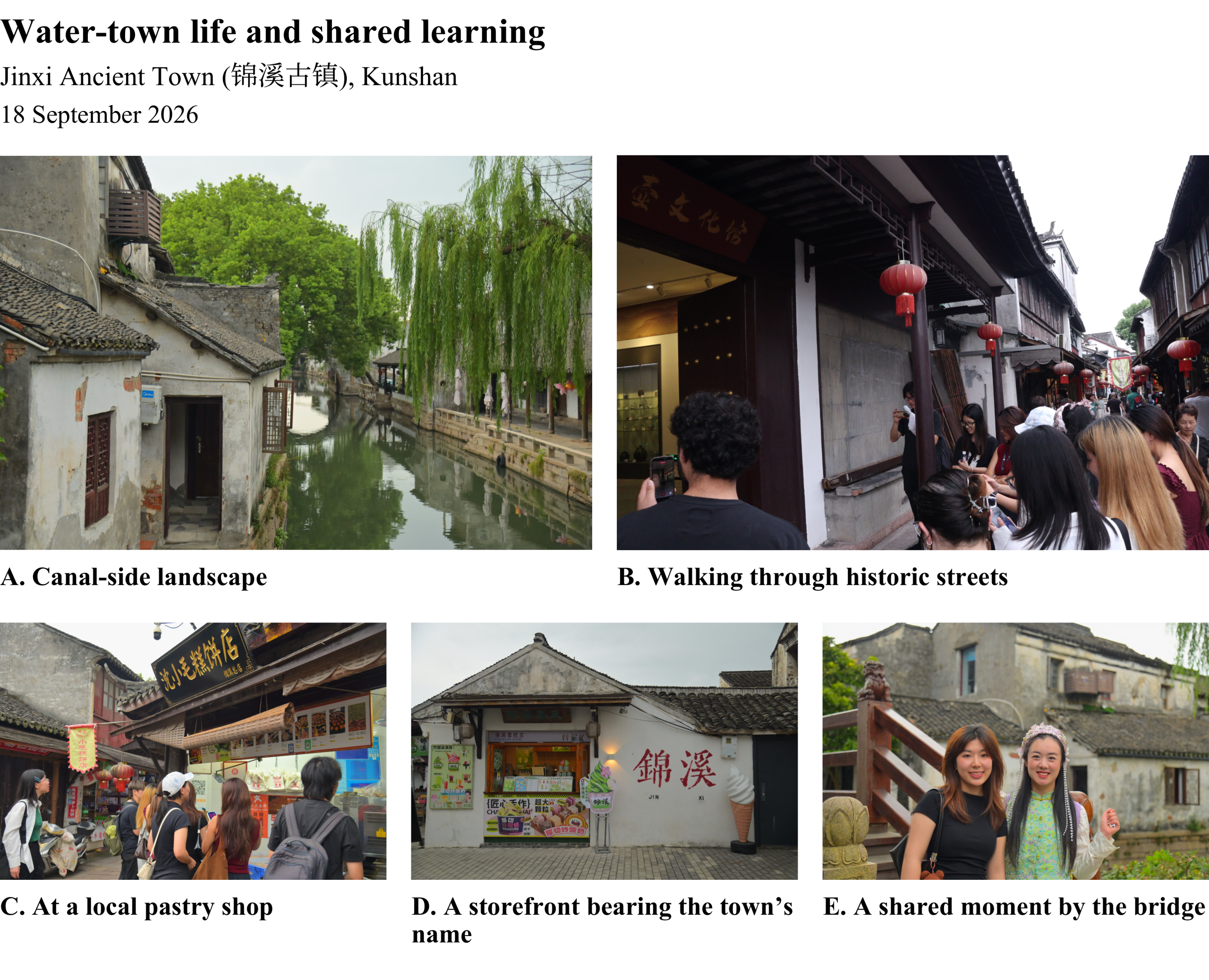
Jinxi’s waterways offered a setting for considering how places are represented. Around Wenchang Square (文昌广场), tiled roofs, stone paths, bridges, and canal-side homes invited students to compare town-wide views with details encountered on foot. Kunshan’s official town profile describes more than 2,500 years of history and the traditional expression “thirty-six bridges and seventy-two kilns.” The bridges and kilns connect Jinxi’s waterways with the history of building-material production.
Jinxi’s streets and waterways raise practical design questions. How could a map help newcomers locate museums and understand the town? Which details need photographs, and which need explanations from local people? Students can distinguish direct observation, interpretation, and questions requiring verification when turning field records into visualizations.
Kunshan water towns and an international heritage conversation
The study of water-town heritage connects Jinxi Ancient Town (锦溪古镇) with Zhouzhuang Ancient Town (周庄古镇), another water town in Kunshan. Zhouzhuang is included in China’s World Heritage Tentative List entry, The Ancient Waterfront Towns in the South of Yangtze River, submitted in 2008 and published by the UNESCO World Heritage Centre. UNESCO’s published Tentative List entry describes relationships among waterways, settlement, production, and everyday life, offering an international frame for studying regional water-town culture through local field learning.
The earlier CSCC newsletter on the Zhouzhuang Mystery of Life Museum (周庄生命奥秘博物馆) documented another Kunshan setting where students connected digital humanities with public education and community exchange. For community learning in Jinxi and Zhouzhuang, multilingual interactive maps, 3D documentation, AI-assisted translation, and multimedia storytelling offer possible ways to communicate human heritage across languages and places. Creating digital heritage resources requires accurate sources, practitioner participation, and community feedback to ground wider public access in local knowledge.
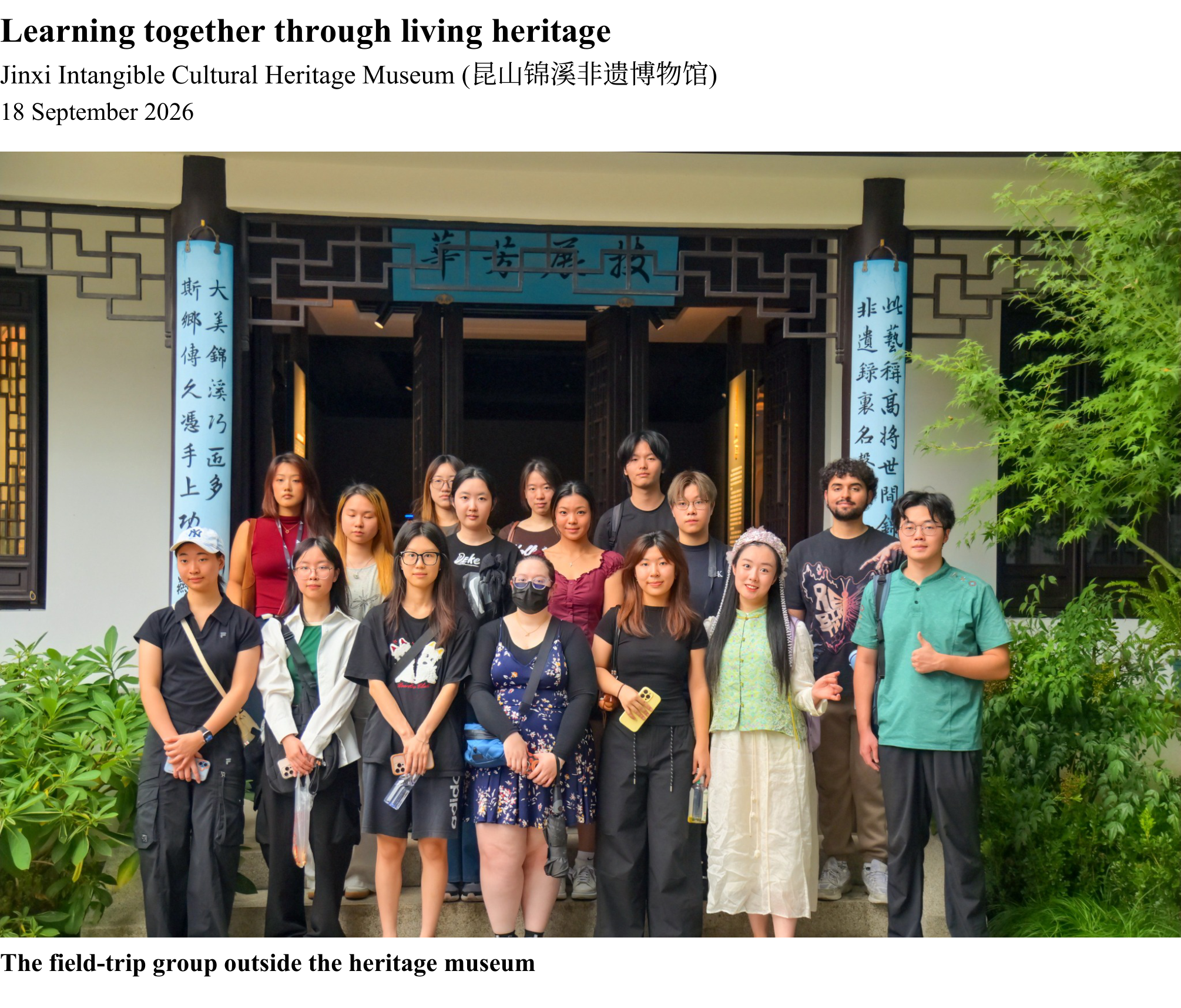
Meeting Jinxi through living traditions
At the Jinxi Intangible Cultural Heritage Museum (昆山锦溪非遗博物馆), displays of water-town clothing, traditional wooden vessels, boat building, and food crafts drew attention to the skills behind everyday objects. The exhibits connected finished pieces with the people and practices through which cultural knowledge is sustained. A digital catalogue alone cannot settle questions of authorship and community participation: who should explain a tradition, and who should be able to correct or expand a museum’s account?
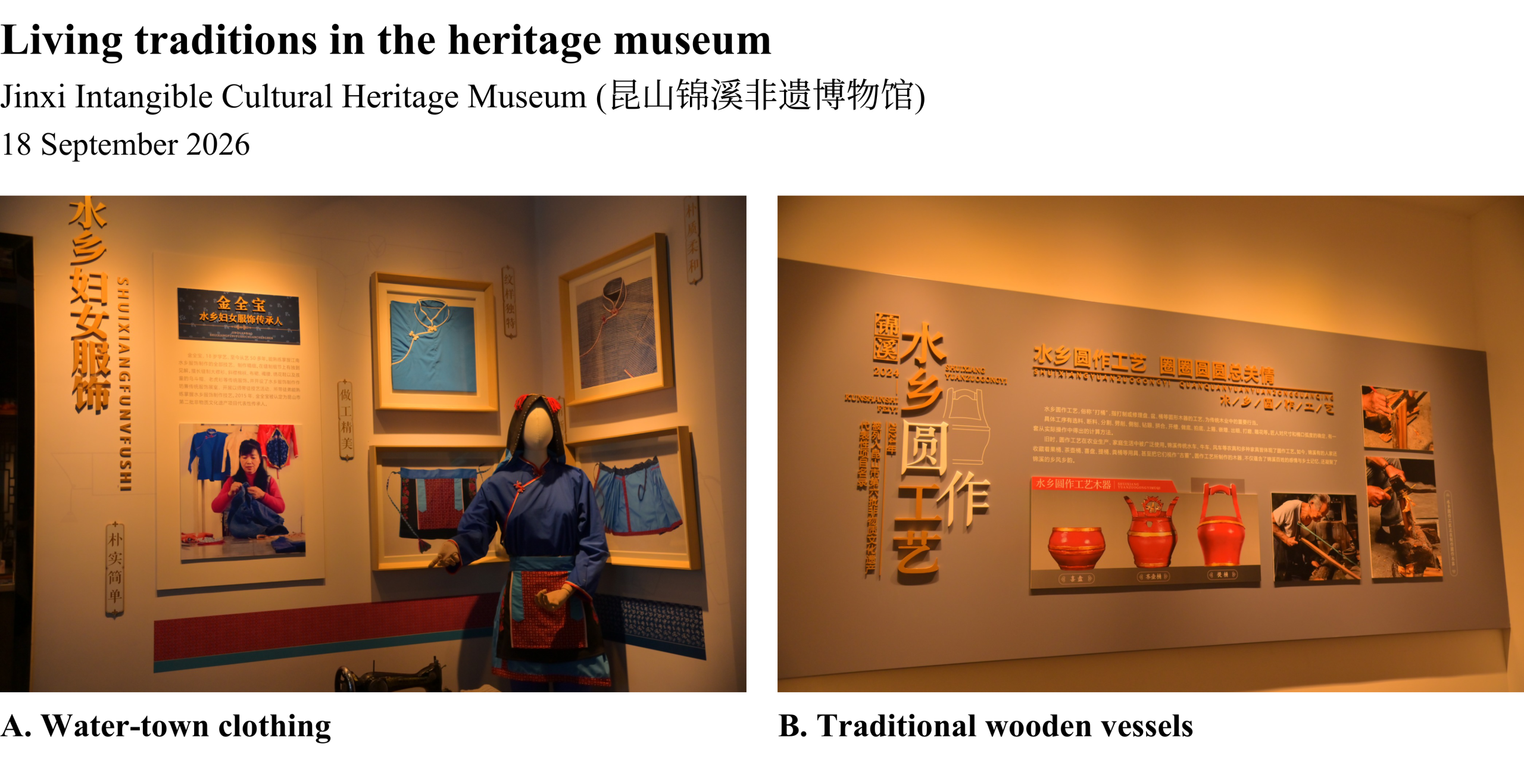
Jinxi xuanjuan (锦溪宣卷), a local storytelling tradition combining singing and spoken narration, shows why cultural practitioners need a voice in digital interpretation. A Kunshan government account identifies Jinxi xuanjuan as part of the Wu-region baojuan tradition recognized nationally in 2014. A photograph can document clothing or an instrument, but conveying a dialect, a performance, or a practitioner’s interpretation may require sound, translation, and contextual explanation. A future multimedia guide to Jinxi xuanjuan would require collaboration with cultural practitioners and permission to use recordings, photographs, and explanatory material.
INFOSCI 301 connects community-based heritage learning with three interdisciplinary strategies: open science and data governance, scientific communication for emerging technologies, and human-centered spatiotemporal intelligence. Applying the three strategies involves recording sources and permissions, making complex material understandable to a public audience, and examining how human experience changes across places and over time. The Jinxi field records give students opportunities to apply all three strategies, with local people and cultural knowledge central to the design process.
The street photographs extend the field record beyond the museum galleries. A local pastry shop, canal-side storefronts, and encounters along the walking route place cultural learning within everyday community life. Mapping shops, storefronts, and walking routes would help visitors understand the places between the itinerary’s formal stops, as well as the relationships between local livelihoods and cultural traditions.
Looking closely at brick and tile
At the China Ancient Brick and Tile Museum (中国古砖瓦博物馆), students examined decorative tile ends, carved architectural elements, a landscape model, and displays explaining roof structures. Objects that can be difficult to see on a building became available for close comparison. The galleries connected material, skilled production, and visual ornament with the built environment outside.
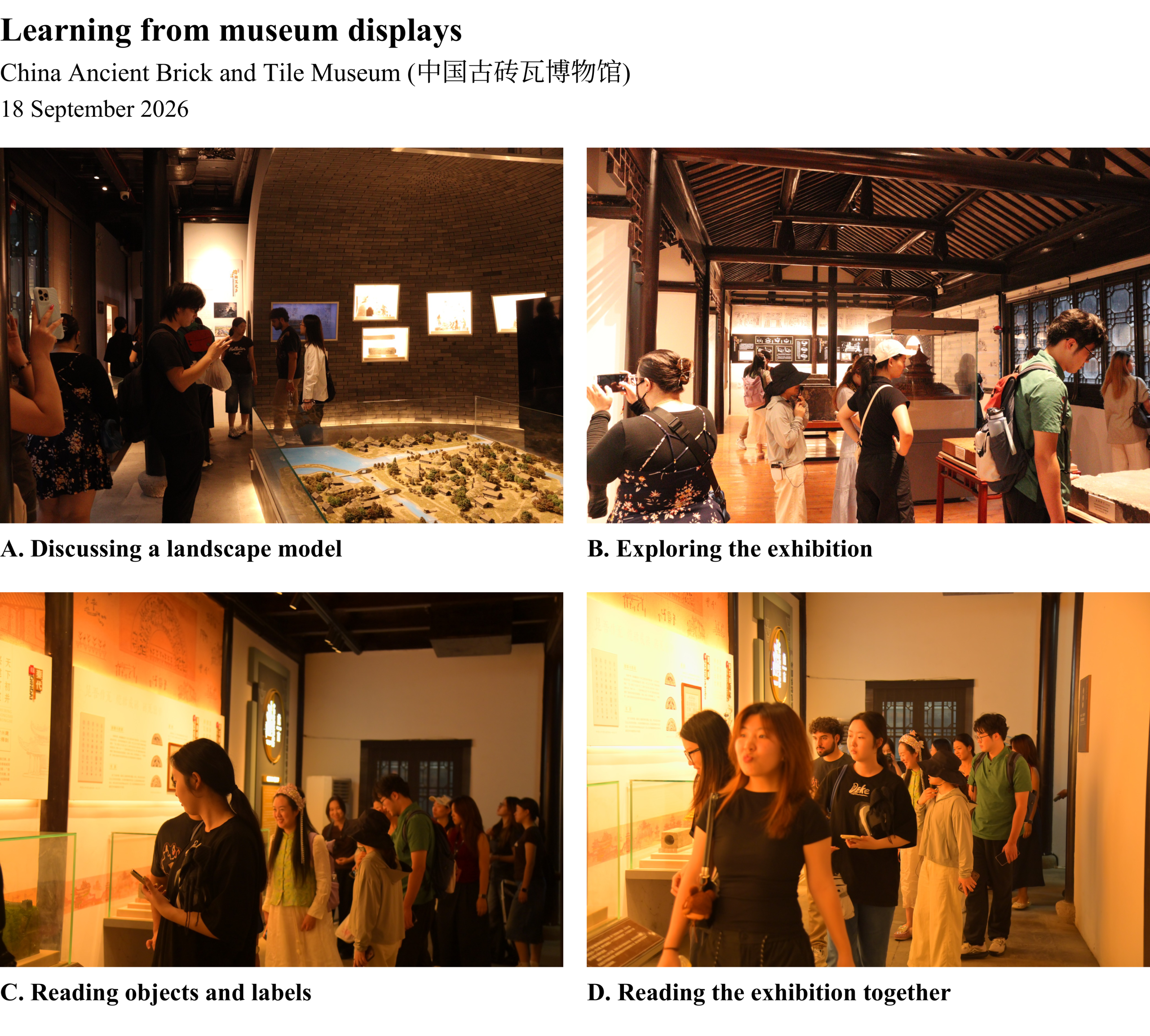
The museum displays also demonstrated several visualization choices. Grouping related objects makes similarities and differences easier to see. A drawing can clarify the structure of a roof. A landscape model places buildings and waterways in relation to one another. Object groupings, drawings, and models offered students concrete examples of how selection, grouping, scale, and explanation guide a viewer’s understanding.
Turning field observations into public understanding
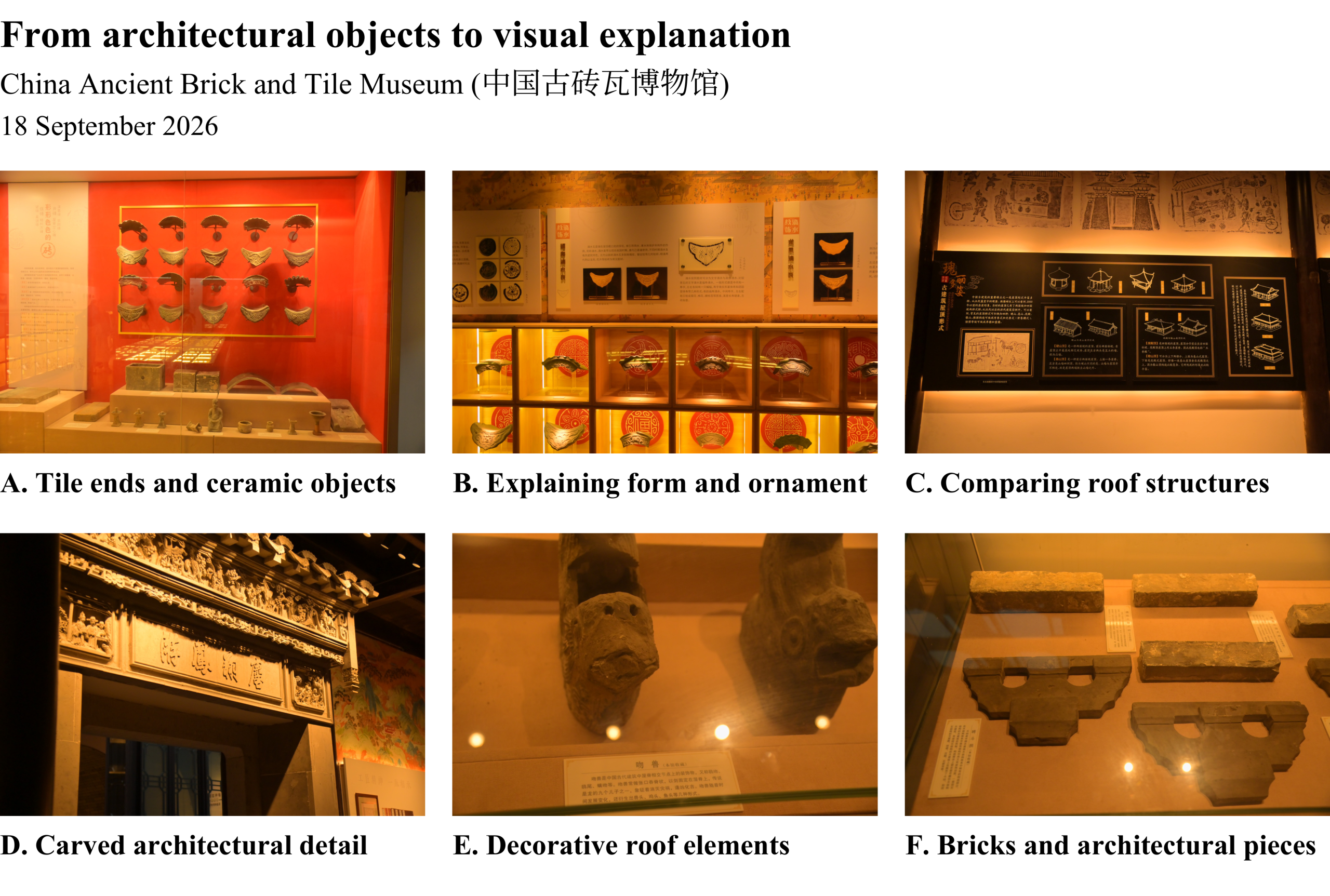
The Jinxi photographs will contribute to the INFOSCI 301 interactive world map assignment, connecting observations with locations. Moving from a world map to a particular street or museum object gives viewers a way to explore Jinxi across different scales. Useful captions identify the photographed object or scene, the location, and remaining uncertainties. Locations, historical claims, attribution, and reuse permissions need to be documented carefully enough for readers to check.
The Jinxi field records suggest future projects to explore with community input: a catalogue comparing tile motifs and functions, a map linking cultural sites with accessible explanations, or a visual history of brickmaking. Project development would begin by identifying an audience and a research question, then selecting the evidence and medium needed to communicate an answer. Designing the digital interface would also require decisions about whose knowledge appears and how viewers can respond or suggest corrections.
Connecting Spring 2026 experiences with the present visit
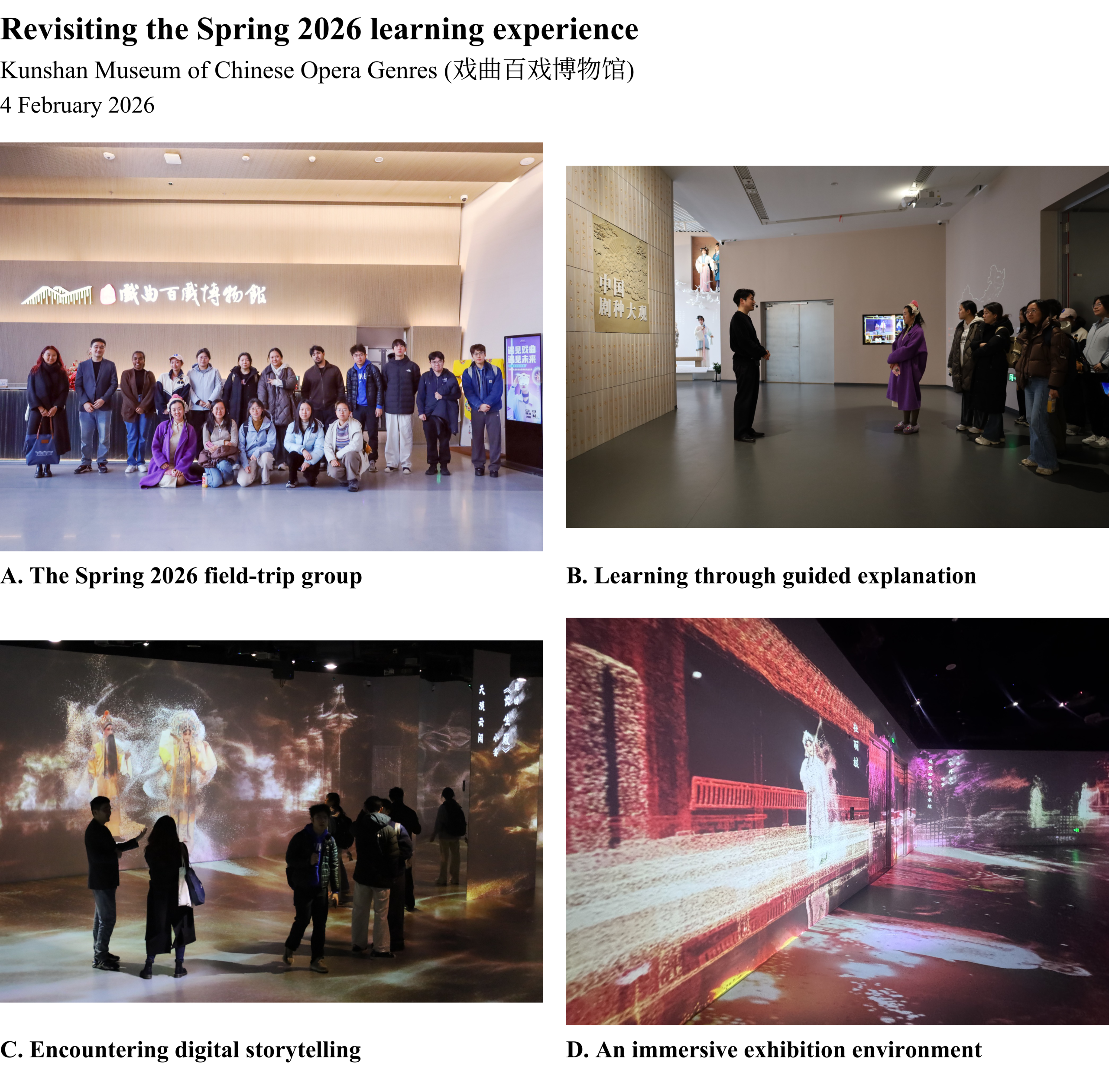
The Jinxi visit builds on a learning pathway extending across semesters. In Spring 2026, INFOSCI 301 explored urban planning and public imagination at the Jiading District Urban Planning Exhibition Hall (嘉定区规划展示馆) and the Fengxian Waving Cube Sci-Fi Immersive Museum (奉贤浪在水一方科幻沉浸馆). Prof. Zhang also organized a February 4, 2026, visit to the Kunshan Museum of Chinese Opera Genres (戏曲百戏博物馆), with support from Jiawen Cai of the Office of Student Experience.
The visit to the Kunshan Museum of Chinese Opera Genres connected traditional performance, material culture, and digital exhibition design. Kunqu Opera (昆曲) was originally proclaimed by UNESCO in 2001 and inscribed on the Representative List of the Intangible Cultural Heritage of Humanity in 2008. Kunqu’s local roots and international recognition offered students a way to consider how cultural knowledge can reach wider audiences while remaining connected to the communities and practitioners who sustain the tradition.
Student reflections across semesters
As a former INFOSCI 301 student returning to Jinxi, Polina Postnikova connects the Spring 2026 sites with a course project and ongoing signature work on digital nomads:
“My final project for INFOSCI 301 in Spring 2026 grew out of our community-based field trips. The Jiading District Urban Planning Exhibition Hall showed a polished story of the city’s future but not the data behind it, while the Waving Cube Sci-Fi Immersive Museum and the Kunshan Museum of Chinese Opera Genres showed how storytelling and cultural symbols make ideas easy to grasp. My team built an interactive framework that shows how data becomes policy, with every dataset linked to its source. When I visited Jinxi this semester as a former student, I looked at the China Ancient Brick and Tile Museum as a visitor would, and I kept asking what a newcomer needs to understand a place. That question now drives my signature work on digital nomads, who move between cities and often meet local heritage only briefly. I want to build interactive visualizations that help them understand where they are, while local communities keep a say in how their culture is shown. These trips taught me that community-based learning continues beyond one semester, and that a visualization should start from the needs of the people who will use it.”
— Polina Postnikova
Xinrong Sun’s reflection connects the earlier visit to the Kunshan Museum of Chinese Opera Genres (戏曲百戏博物馆) with questions about cultural representation, community participation, and AI for social good. The quotation refers to the museum as the “Kunqu Opera Museum”:
“My visit to the Kunqu Opera Museum made me think more carefully about what it means to preserve cultural heritage: documenting an art form also means understanding the people, local knowledge, and relationships that keep it alive. Together with earlier field-based learning and course projects, this experience has changed the questions I bring to this semester’s Jinxi visit. When looking at traditional crafts and architectural details, I now ask whose stories are being told and what context a digital representation might leave out. It also shapes how I approach AI4Good through the DKU AI Club of which I am the current President: I am interested in how AI could help make cultural knowledge more accessible, while keeping practitioners’ voices and community priorities central. As I develop future projects, I want to begin by listening and observing before choosing a technical solution. Across these experiences, I am learning to see leadership as taking responsibility for how we represent others and building projects that communities can help shape.”
— Xinrong Sun
Rooted inquiry and wider connections
Polina’s and Xinrong’s reflections show how field-based learning can continue beyond an individual assignment or semester. Polina’s attention to newcomers’ experiences and Xinrong’s emphasis on practitioners’ voices bring different perspectives to a shared responsibility: designing with the people whose lives and knowledge give meaning to a visualization. The Jinxi visit opens opportunities to return student work to local museums and cultural practitioners for feedback as projects develop. Further collaboration will depend on the museums’ and practitioners’ interests and priorities.
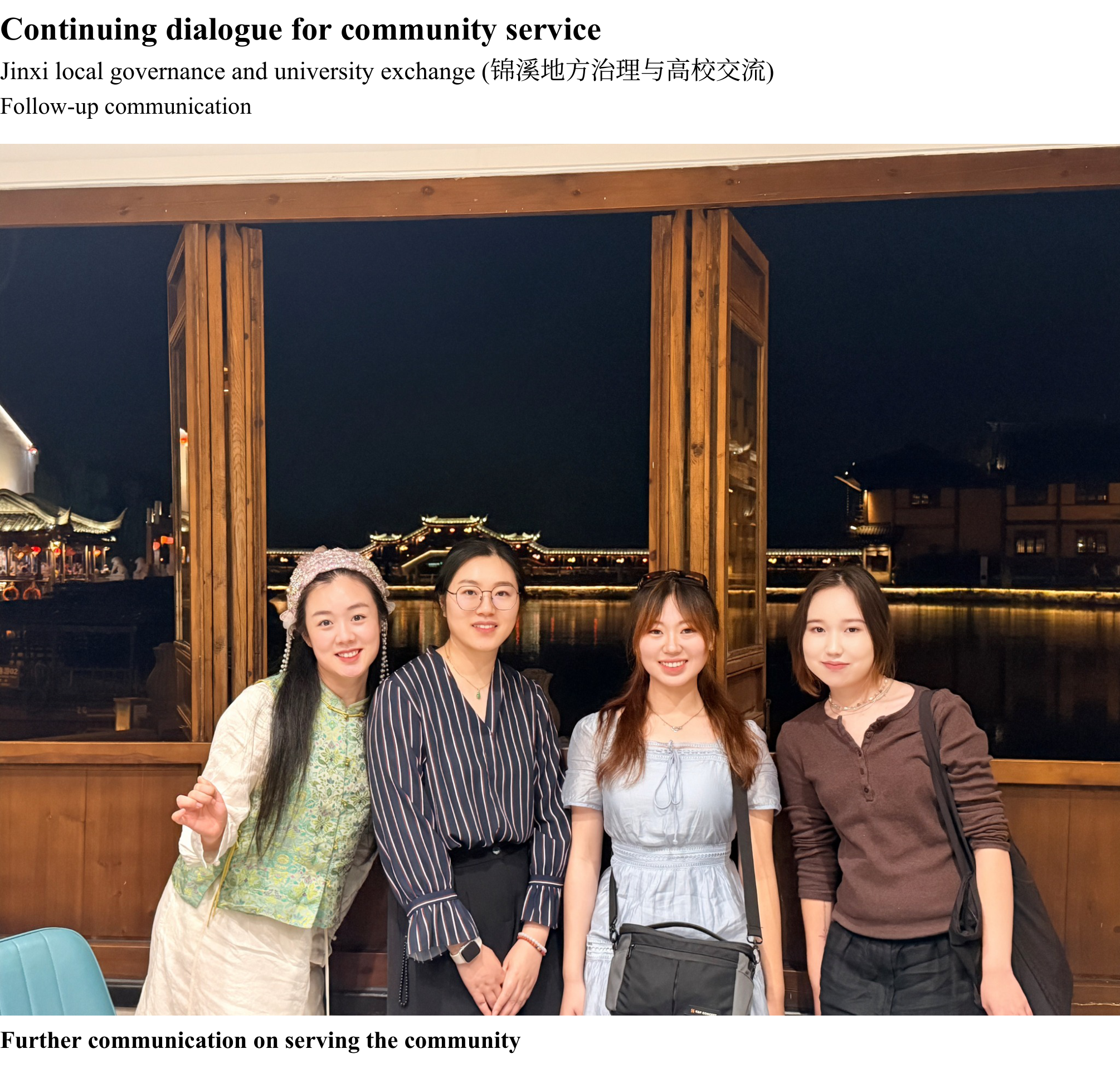
Xinrong Sun and Polina Postnikova, together with Prof. Zhang, continued communication with a representative of Jinxi local governance about how joint efforts could serve local residents and bring Jinxi’s cultural knowledge to wider audiences. The discussion with the Jinxi representative extends the field trip into a continuing conversation about public service. Potential next steps include listening to residents and cultural practitioners, developing accessible digital explanations together, and returning student prototypes for community feedback. Collaboration guided by community feedback would place local priorities at the center of a broader ambition to advance technology for humanity.
Learning to serve across cultures
Confucius offers a philosophical basis for connecting individual learning with community service. In The Analects 6.30 (《论语·雍也》), Confucius says, “己欲立而立人,己欲达而达人。” Translated here: “Seeking to establish oneself, one helps others establish themselves; seeking to advance oneself, one helps others advance.”
From a different tradition, the English poet John Donne writes, “No man is an island, entire of itself,” in Devotions upon Emergent Occasions, Meditation XVII. Donne’s image of human interdependence offers a poetic companion to the course’s emphasis on reciprocal community learning. The passages by Confucius and Donne invite students to connect personal intellectual development with opportunities for others, and to carry local understanding into a wider sense of responsibility.
Community-based cultural learning and future digital heritage projects connect with the United Nations Sustainable Development Goals: Quality Education (Goal 4), through cultural learning and accessible explanation; Sustainable Cities and Communities (Goal 11), through attention to cultural heritage; Peace, Justice and Strong Institutions (Goal 16), through access to information and opportunities for correction; and Partnerships for the Goals (Goal 17), through reciprocal university–community relationships. The goals provide a framework for developing and evaluating future community projects.
CSCC’s mission connects rigorous research on contemporary China with undergraduate learning and international scholarly exchange. By grounding digital inquiry in Kunshan’s living traditions and sharing carefully documented work with wider audiences, INFOSCI 301 advances a common educational purpose: technology for humanity, grounded in local service and connected through global learning. CSCC’s guiding aspiration remains rooted in China, impact globally.
Credits and acknowledgments
Drafted by: Xinrong Sun and Polina Postnikova.
Advised and edited by: Prof. Luyao Zhang, representing the Digital Technology and Society Cluster at the Center for the Study of Contemporary China (CSCC) and the SocioTech Future Lab in the Social Science Division, Duke Kunshan University.
Course: INFOSCI 301: Data Visualization and Information Aesthetics.
Staff Support: Jiawen Cai, Isaac Zhu, Chi Zhang, and Shuqian Xu.
Related CSCC newsletters
CSCC Newsletter: Where Scholarship, Industry, and Public Science Meet: Field-Based Learning and Interdisciplinary Dialogue for Future Global Leaders — Read the newsletter
CSCC Newsletter: Rooted in Kunshan, Connected to the World: From a Student Capstone to Culturally-Aware AI at the Festival of Learning 2026 — Read the newsletter
CSCC Newsletter: Our Journey from DKU Classroom to National Service-Learning Forum — Read the newsletter
CSCC Newsletter: Digital Humanities Zhouzhuang Mystery of Life Museum Field Trip — Read the newsletter