

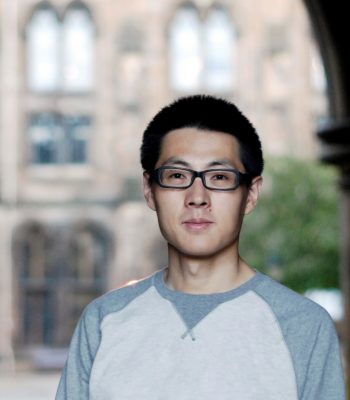
Fan Liang is an Assistant professor of Media at Duke Kunshan University. His research and teaching explore how new communication technologies construct social and political changes, and how social and political powers shape and regulate the design and operation of such technologies. His research has received recognition and support from British Foreign, Commonwealth and Development Office, American Council of Learned Societies (ACLS), Volkswagen Foundation, International Communication Association, and other institutions. His studies have appeared in peer-reviewed journals including Policy & Internet, Social Media + Society, International Journal of Communication, New Media & Society, Communication Research, and Journal of Communication. Liang has a B.A. in public administration from Shanghai Jiao Tong University, an M.Sc. in political communication from the University of Glasgow, and a Ph.D. in communication from the University of Michigan. Before entering academia, he was a journalist in Chengdu, China.
Charles Chang is an Assistant Professor of Environment and Urban Studies at Duke Kunshan University. His research interest hinges on the intersections between computation and design. With the rise of smartphones and other internet-connected devices, design choices become increasingly data-driven and dependent on information's credibility in the construction of the human habitat. Chang's research focuses on human habitat's design, environmental impact, and information's credibility in the big-data age. His teaching interests at Duke Kunshan include computational social science, digital humanities, and urban informatics. Chang has a B.A. in geography from Beijing Normal University, and a M.Sc. and Ph.D. in environmental studies from the University of Wisconsin, Madison. Before joining Duke Kunshan, he served as the 2016-2017 postdoctoral fellow in Chinese studies at Stanford University and the 2018-2019 postdoctoral associate in Asian studies at Yale University.

Luyao (Sunshine) Zhang is Assistant Professor of Economics and Senior Research Scientist at the Data Science Research Center at Duke Kunshan University (DKU). She has an abiding passion for interdisciplinary collaborations, especially for cutting-edge research of both profound insights and practical impacts, including Computational Economics (Algorithmic Game Theory and Mechanism Design), Artificial Intelligence (Machine Learning, AI Trust, Human-Computer Interaction), Cryptoeconomics (Blockchain for social good, Consensus Algorithms, DeFi), Behavioral Science (Bounded Rationality, Trust, and Cooperation), and Interdisciplinary Big Data (Social Media, Sustainability, and Global Health). Her current research interests are around the application scenarios of "Blockchain +." Her publications appear in economic journals for general interest and beyond, including American Economic Review: Papers and Proceedings, the Review of Economics and Statistics, the World Economy, Nature Scientific Data, Nature Social Indicators Research, ACM CCS, AAAI/ACM AIES, IEEE International Conference on Blockchain Proceedings, Remote Sensing, Journal of Digital Earth, Data and Information Management, etc. She received Ph.D. in Economics at Ohio State University, supported by Presidential Fellowship and NSF dissertation grant. She graduated from Peking University with a B.A. in Economics and a B.S. in Math and Applied Math.

Chen Zhang is an Assistant Professor of Urban Planning and Public Policy at Duke Kunshan University. Dr. Chen Zhang is a scholar of urban transformation and planning. Her research investigates both internal and transnational rural-to-urban migration and the urbanization processes through the lens of “urban informality”. Integrating perspectives from political sociology, urban planning, and geography, Zhang’s work probes the emergence, operations, socio-political implications, as well as environmental and behavioral impacts of two types of urban informality: (1) rural-to-urban migrants’ informal practices and (2) state-led informalization. Dr. Zhang’s work is globally comparative with a geographic focus in China and India and draws a blend of qualitative, quantitative, and geospatial methods. This multi-pronged approach has resulted in two book manuscripts and a number of peer-reviewed articles published in journals of Management Studies, Global Environmental Changes, Transportation Letters, and Transport and Land Use, and articles under revision & resubmission or review at Cities, Journal of Planning Literature, and Urban Climate. Dr. Zhang has secured research support from numerous institutions, including the Houtu Foundation for Urban Anthropological Research, joint funds from Wuhan University and Duke University, and the Suzhou Municipal Research Council.
Mengtian Chen is an Assistant Professor of Applied Linguistics at Duke Kunshan University. She has been teaching Chinese as a foreign or second language at various institutions in the United States and China since 2011. Her research explores the intersection between linguistics, psychology, and education, particularly 1) the cognitive mechanisms of speech processing, including its perception, production, and communication through sound, and 2) use of digital technologies such as artificial intelligence for teachers' continuing professional development in the workplace. Her interdisciplinary studies have been recognized by Headquarters of the United Nations as well as leading journals in psycholinguistics and education. She earned a B.A. in teaching Chinese as a second language and a M.A. in linguistics and applied linguistics from Beijing Language and Culture University, and a Ph.D. in second language acquisition from the University of Iowa.

Paula Ganga is an Assistant Professor of Political Economy at Duke Kunshan University. Her research and teaching explore the economic consequences of illiberalism, the developmental impact of foreign aid, corruption, and the role of technology. She is currently working on a book manuscript that explores the connection between economic nationalism and populism in Europe. Her interest in how the interaction between state policy and market investment influences technological innovation has led to research examining the development of quantum technologies and the AI supply chain. She holds a Bachelor of Arts in Political Science from Alexandru Ioan Cuza University in her hometown of Iași, Romania, as well as an M.Sc. in Global Governance and Diplomacy from Oxford University, where she was a Chevening Fellow. After completing her Ph.D. at Georgetown University, she was a postdoctoral research fellow at Columbia University's Harriman Institute, and the Skalny Center for Polish and Central and Eastern European Studies at Rochester University, as well as a George F. Kennan short-term scholar at the Woodrow Wilson Center for International Scholars.

Seongkyung Cho is an Assistant Professor of Public Policy at Duke Kunshan University. Her research centers on housing policy and policy implementation, examining how program design and institutional contexts shape the behavior of policy actors. One strand of her research focuses on digital housing policy, including how online platforms, public data, and AI reshape housing systems and the provision of housing across East Asia, particularly in China and South Korea. She also studies digital governance, public-sector technology adoption, and citizen trust and participation. She holds a Ph.D. in Public Administration and Policy from Arizona State University and degrees in economics, political science, and sociology from Korea University.

Valerie Li is an Assistant Professor of Computational Social Science at Duke Kunshan University. Her research brings computational methods, including text-as-data, network analysis, and statistical modeling, to the study of politics and society in China. Substantively, she uses large-scale data to examine how Chinese citizens engage with government in everyday life and what these interactions reveal about state responsiveness, political behavior, and quasi-democratic institutions under authoritarian rule. At DKU, she teaches computational and statistical methods.