By Jiaojiao Zhao and Weisheng Zhang, Class of 2026 | Advised by Professor Luyao Zhang
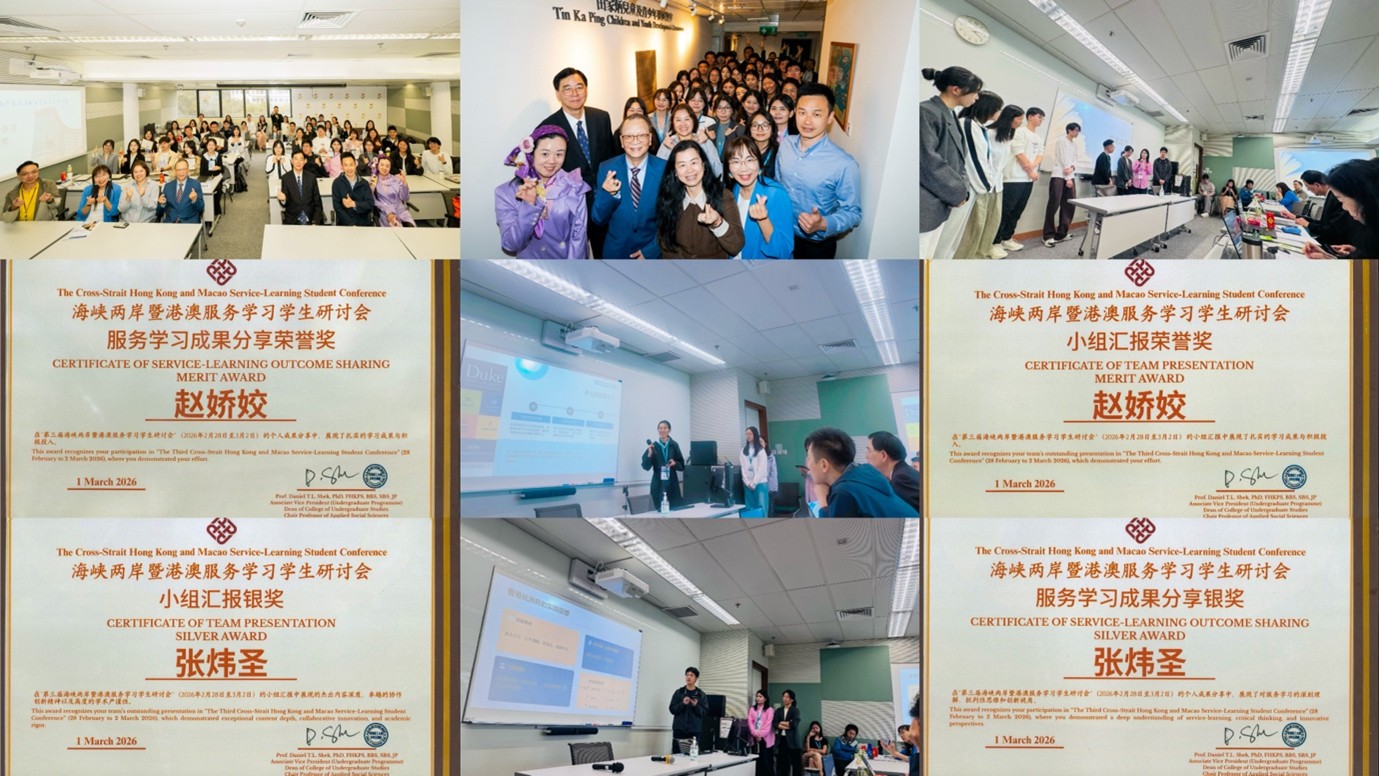
We are Jiaojiao Zhao and Weisheng Zhang, both Applied Mathematics and Computer Science majors from the Class of 2026 at Duke Kunshan University. During the Chinese Spring Festival for the Year of the Horse, by the recommendation of our mentor Professor Luyao Zhang, Co-lead of the Digital Technology and Society Cluster at the Center for the Study of Contemporary China (CSCC), we were invited to present our research project at the Third Cross-Strait Hong Kong and Macao Service-Learning Student Conference held at The Hong Kong Polytechnic University from February 27 to March 1, 2026. Competing against scholars from 38 universities across across different regions of China, we were honored to receive Silver Awards and Merit Awards for both our Team Presentation and Service-Learning Outcome Sharing.
From Course Assignment to Community Impact
Our journey began in Professor Luyao Zhang’s INFOSCI 301 course, Data Visualization and Information Aesthetics. What started as a classroom assignment evolved into something far more meaningful—a community-benefiting digital artifact that bridges technology with local cultural heritage. Our project, “Discover Kunshan: An AI-Enabled Interactive Platform for Cultural and Culinary Exploration,” was born from a simple yet profound question: how can we use data visualization to help both international students and local residents discover the rich cultural tapestry of Kunshan through its everyday food spaces?
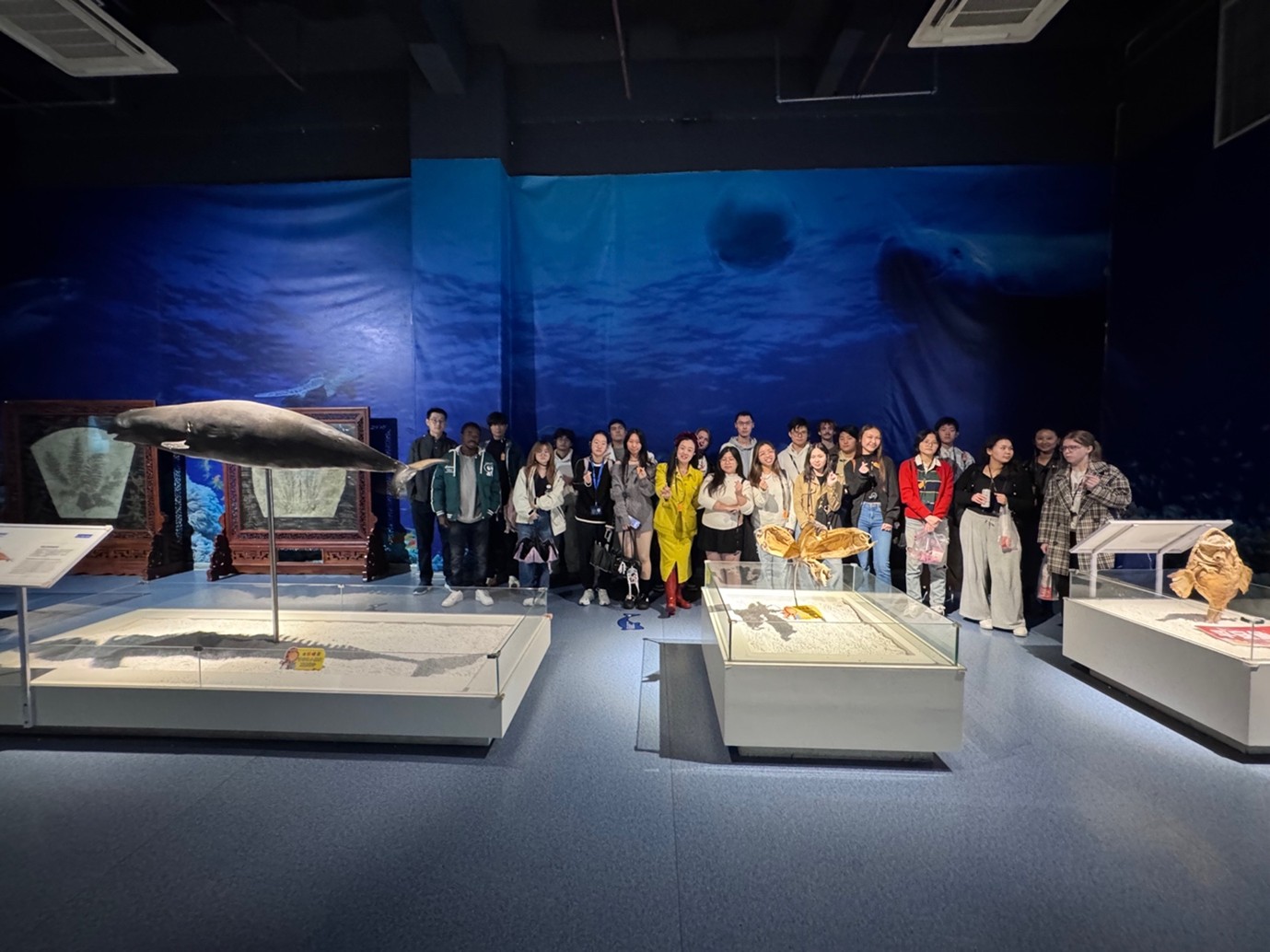
The inspiration came during a field visit to the Zhouzhuang Mystery of Life Museum, where we observed how the museum transformed abstract cultural and scientific knowledge into intuitive learning experiences through spatial arrangement and visual storytelling. We began to wonder: if a museum can guide people to understand culture through movement and observation, could a city itself be designed as an exploratory learning interface?
We observed that while popular commercial platforms provide restaurant listings, they often prioritize highly commercialized venues and rarely incorporate cultural narratives or community knowledge. Smaller neighborhood eateries and the cultural contexts surrounding local dishes are frequently underrepresented. This fragmentation creates challenges for users, particularly international students, visitors, and new residents, who seek reliable and culturally meaningful guidance when exploring the city’s food landscape.
Our Presentation Journey: From DKU to Hong Kong
The Final Course Symposium
Our first major presentation opportunity came on December 3, 2025, at the final symposium of INFOSCI 301, titled “Visualizing Life, Community, and Possibility.” Held at DKU’s AB Ballroom, the event brought together our classmates, Professor Zhang, and our community partner, Dr. Haibin Gao, Director of the Zhouzhuang Mystery of Life Museum. During the open exhibition, we presented our “Discover Kunshan” interactive map alongside other student teams showcasing projects ranging from endangered species mapping to gamified museum experiences.
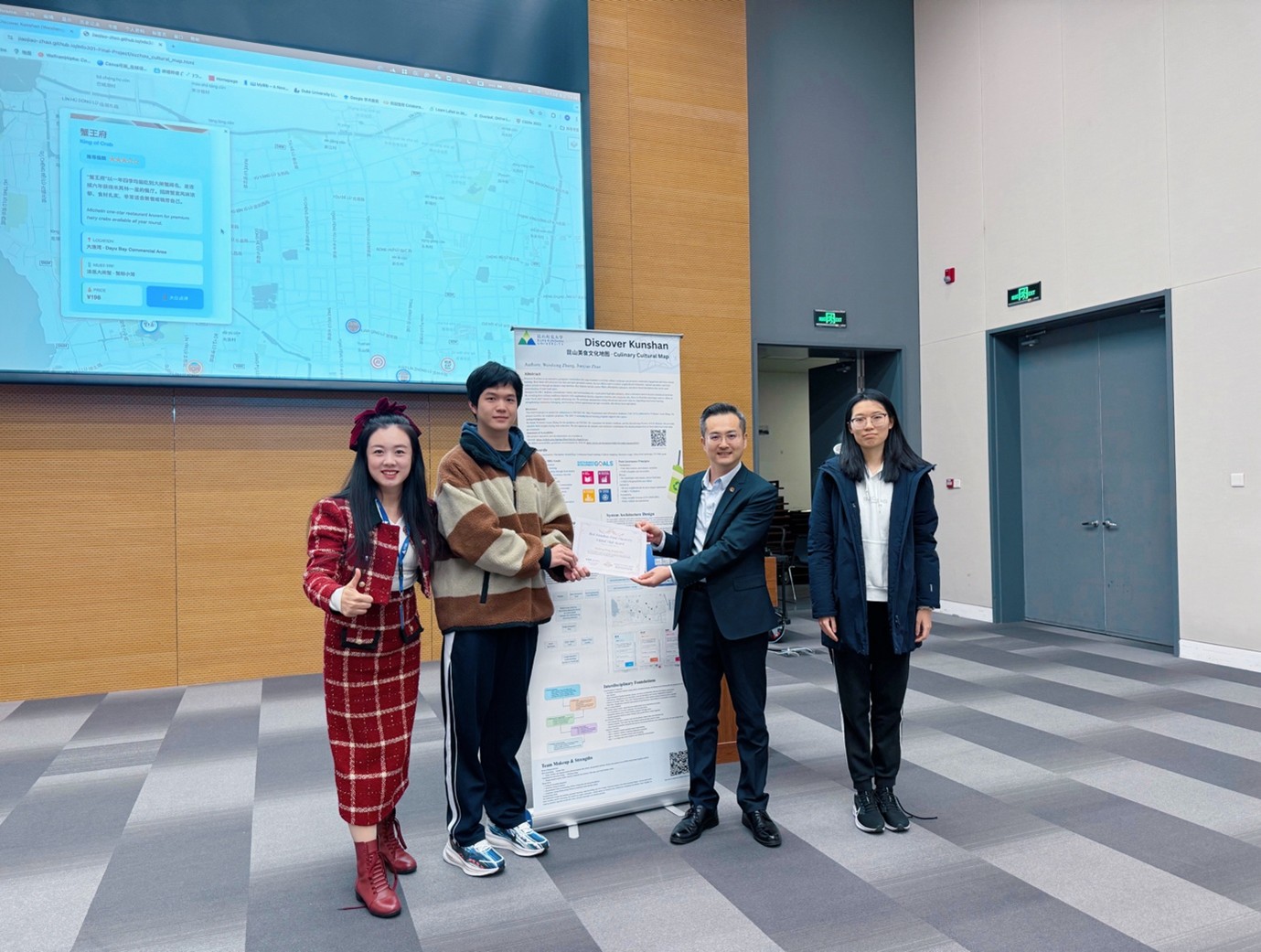
The conversation with Dr. Gao proved invaluable. He shared insights about how the museum approaches public education and engaged with us on how our digital platform might advance the museum’s mission of science communication and cultural preservation. His feedback helped us refine our understanding of how technology can serve community needs without imposing technical complexity. The symposium concluded with community-driven voting, and we were deeply encouraged by the recognition our project received.
The DKU CTL Teaching and Learning Showcase
Building on our symposium experience, Jiaojiao had the privilege of presenting on behalf of our team at the DKU Annual Teaching and Learning Showcase on December 5, 2025. The session, titled “Digital Humanity in Action: An Immersive Exhibition Connecting Community-Based Learning, Frontier Technology, and Global Sustainable Future,” was part of the broader “Mind the Gap” themed showcase. Joined by fellow students Matvey Izmaylov, Jiahe Chen, and Zihan Chen, along with Jiawen Cai from the Student Experience Office, we presented TED-style collaborative talks alongside our community and industry partners.
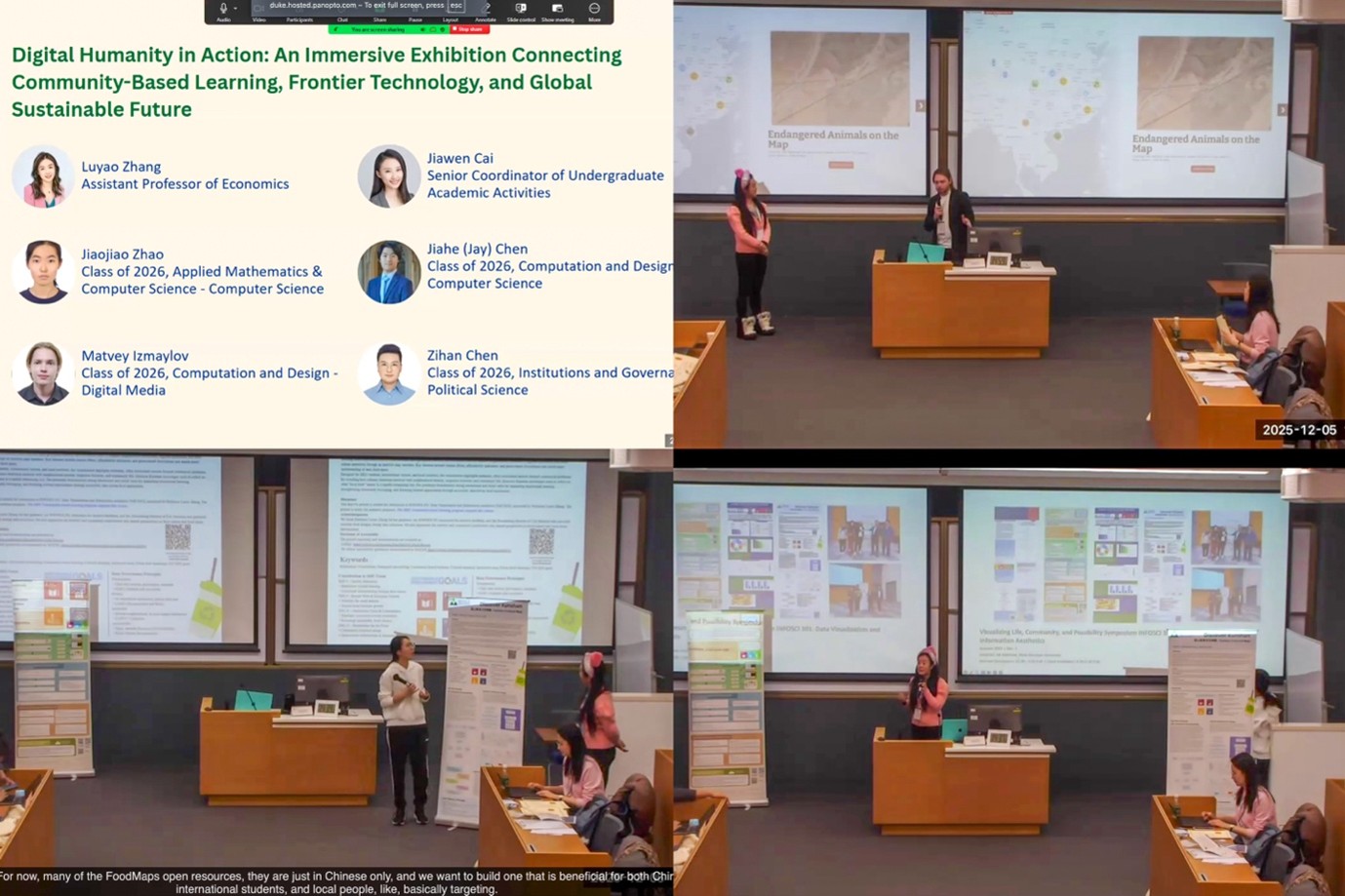
The showcase featured interactive demonstrations of our visualization projects, including the global endangered-species map with multilingual educational media and our Discover Kunshan culinary exploration platform. This experience taught us how to communicate complex technical work to diverse audiences and how to articulate the connections between our classroom learning and real-world community impact. The session emphasized bridging gaps between classroom learning and community expectations, between individual academic performance and contributing to shared global goals.
The International Conference at PolyU
Our journey culminated in the invitation to present at the Third Cross-Strait Hong Kong and Macao Service-Learning Student Conference at The Hong Kong Polytechnic University. Over three days, we shared our work through video presentations and participated in group discussions with students from across the region. The conference format allowed us to engage deeply with peers who brought diverse perspectives on service learning, from traditional tutoring programs to technology-enabled community engagement initiatives.
What We Learned: Perspectives from the Conference
Rethinking Service Learning with Peers
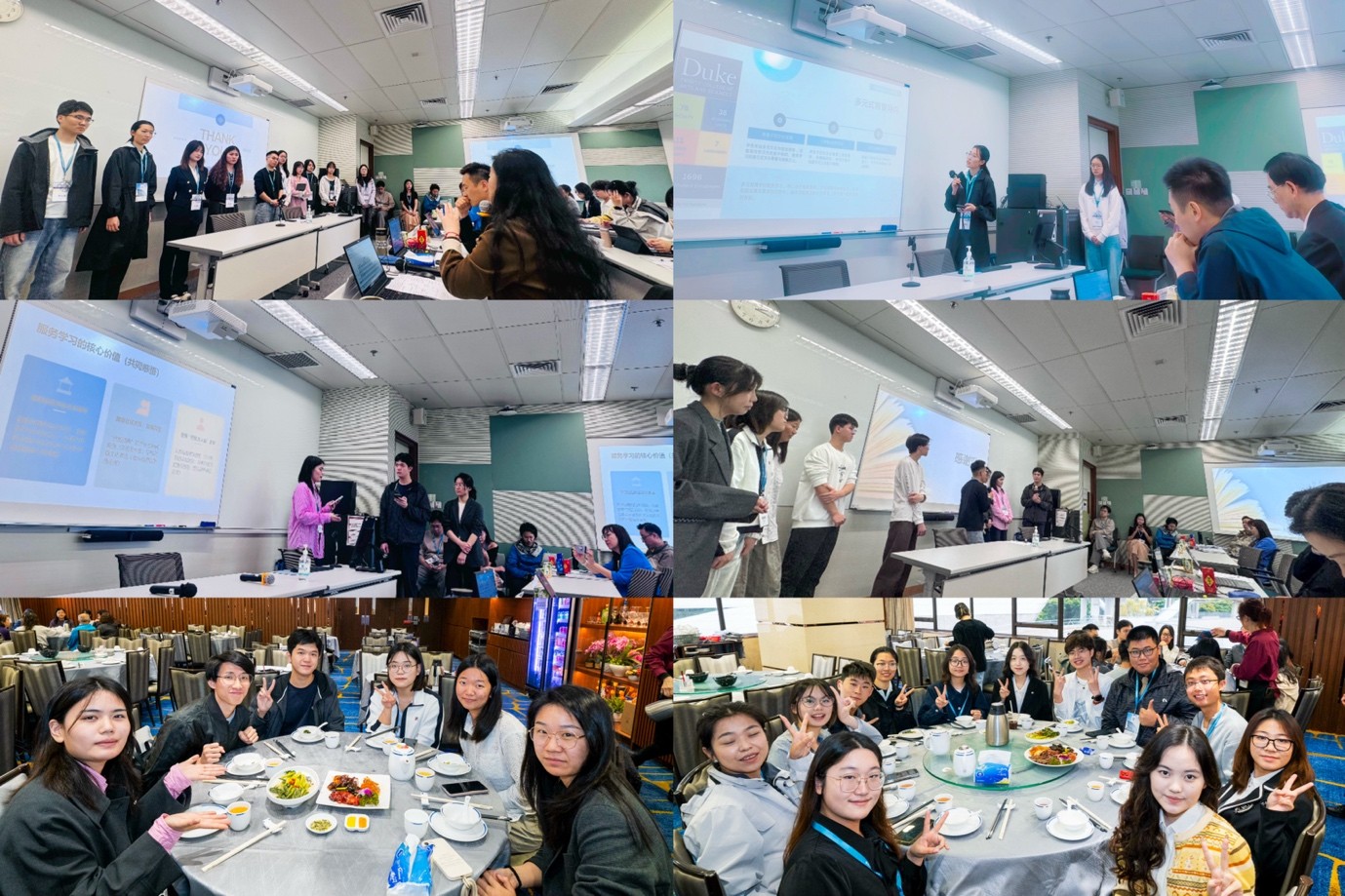
Our Award-winning team presentations brought together students from over a dozen institutions across different regions of China, with backgrounds in education, social work, computer science, and cultural studies. Jiaojiao’s team focused on rethinking service-learning as a reflective and relational process—viewing it not as volunteer work, but as a pathway for students to reconsider their relationship with society. We emphasized that meaningful service-learning should begin with real community needs rather than pre-designed assumptions. Weisheng’s team applied service-learning principles to Cheung Chau Island in Hong Kong—a case addressing tourism pressures, aging population, fishing culture preservation, and balancing economic development with cultural sustainability. We examined how service-learning could activate community cultural capital and reshape relationships from one-directional assistance to reciprocal partnerships. Through collaborative discussions in both teams, we discovered how different disciplines approach service uniquely.
Conversations with students from other universities prompted us to reflect deeply on the nature of service learning. Many projects we encountered focused on traditional volunteer activities, where university students were positioned as providers of help and community members as recipients. This hierarchical model, we realized, risks reinforcing distinctions between “givers” and “receivers” and may unintentionally reproduce unequal roles.
In contrast, our experience with the Discover Kunshan project encouraged us to view service learning as a reciprocal process. Through our engagement with the Zhouzhuang Museum and our fieldwork in Kunshan, we came to understand that sustainable community engagement requires both sides to participate as contributors to knowledge creation. Service providers and recipients should be partners operating on equal footing. When integrated thoughtfully, AI can serve as a platform that facilitates shared exploration, collective storytelling, and mutual learning between universities and communities.
Insights from Professor Daniel Shek
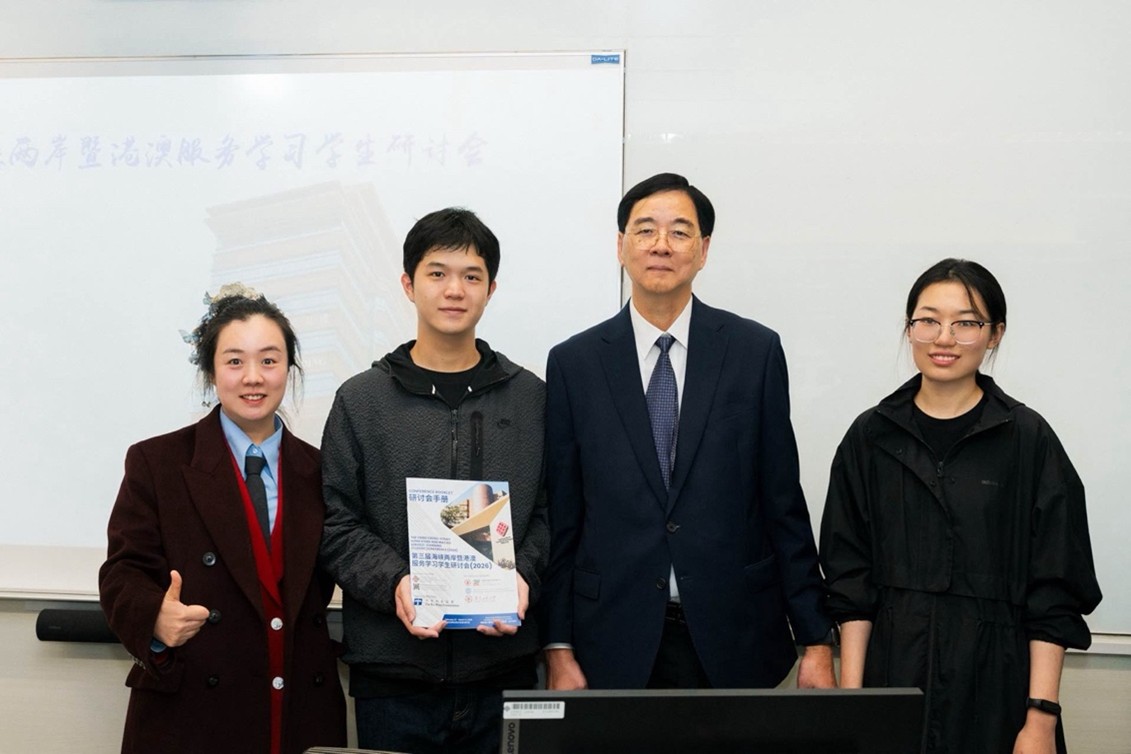
We were honored to interact with Professor Daniel Shek, Vice President of PolyU and a leading scholar in service leadership and positive youth development. His research emphasizes that service learning should not only provide short-term assistance but also contribute to the long-term development of students’ leadership capacities and social responsibility.
From a computer science perspective, this discussion prompted us to consider how technological tools can be integrated into service-learning projects without overshadowing the human relationships at the core of community engagement. Professor Shek’s emphasis on sustainability and leadership provided an important counterbalance to a purely technical lens. We realized that AI-enabled systems can support sustained community engagement by creating platforms that extend the reach of local knowledge beyond the duration of a single course or project.
The Philanthropic Perspective
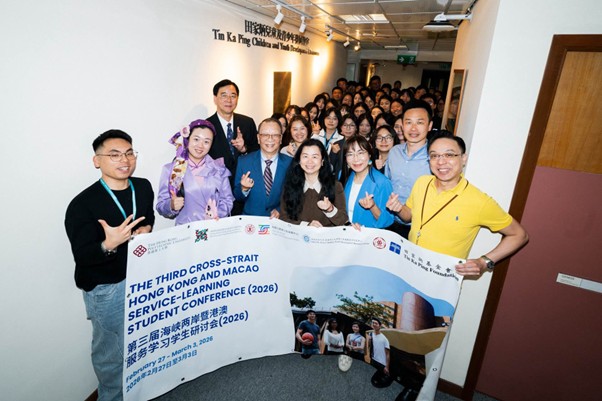
Our conversations with representatives from the Tin Ka Ping Foundation highlighted how service-learning projects are evaluated not only from an academic perspective but also through a broader lens of social impact and sustainability. Foundations like Tin Ka Ping emphasize values such as character education, social responsibility, and community development. This perspective encouraged us to think about the scalability and long-term value of our project—how can digital tools extend the lifespan of community initiatives by preserving knowledge and cultural narratives in accessible formats?
Gratitude and Acknowledgments
None of this would have been possible without the guidance and support of many individuals and institutions. First and foremost, we extend our deepest gratitude to our mentor, Professor Luyao Zhang, whose vision and dedication to community-based learning shaped every aspect of our project. Professor Zhang taught us that data visualization is not merely a technical skill but a form of “digital humanity”—a bridge between analytical rigor and aesthetic storytelling that serves the public good. We are profoundly grateful to Jiawen Cai, Senior Coordinator at the Student Experience Office, whose coordination efforts facilitated our community partnerships and fieldwork opportunities. Our sincere thanks go to Dr. Haibin Gao, Director of the Zhouzhuang Mystery of Life Museum, who welcomed us into his institution, shared invaluable insights about public education and cultural preservation, and engaged with us as true partners in this work. His willingness to collaborate with students demonstrated the reciprocal spirit that makes community-based learning meaningful.
We also extend our heartfelt thanks to the many individuals we met at the PolyU conference whose insights enriched our understanding of service learning. We are deeply grateful to Professor Daniel Shek, Vice President of PolyU, for sharing his wisdom on service leadership and positive youth development—his emphasis on cultivating students’ leadership capacities through community engagement has profoundly shaped how we view the long-term impact of our work. We also sincerely thank the representatives from the Tin Ka Ping Foundation for their generous perspective on the philanthropic evaluation of service-learning projects; their insights on character education, social responsibility, and the sustainability of community initiatives encouraged us to think more deeply about how digital tools can preserve cultural knowledge for future generations. The conversations with peers from 38 universities across the region challenged us to reconsider the reciprocal nature of service learning and inspired us to see our project as part of a broader movement toward collaborative, community-centered innovation.
Finally, we thank Duke Kunshan University for fostering an environment where interdisciplinary, community-engaged learning can flourish. The institutional commitment to bridging classroom education with real-world impact provided the foundation for our journey from a course assignment to international recognition.
Connecting with CSCC: China-Centered Innovation
Our project exemplifies the mission of the Center for the Study of Contemporary China (CSCC) to leverage Chinese approaches to innovation for addressing global challenges. Through Professor Zhang’s leadership in the Digital Technology and Society Cluster, we learned how community-based learning rooted in Chinese contexts can contribute to global conversations about AI in education and sustainable development.
The Discover Kunshan platform benefits communities in China directly by providing digital infrastructure that enhances public engagement with cultural heritage while supporting local businesses. At the same time, it demonstrates how Chinese innovation approaches—characterized by reciprocal learning, collective intelligence, and human-centered design—can inform global best practices. Our project aligns with multiple United Nations Sustainable Development Goals: SDG 4 (Quality Education), SDG 8 (Decent Work and Economic Growth), SDG 11 (Sustainable Cities and Communities), and SDG 17 (Partnerships for the Goals).
As Professor Zhang often reminds us, the goal is to transform students from tool-operators into civic innovators capable of ethical reasoning and cross-cultural communication. This philosophy guided our work on Discover Kunshan and will continue to shape how we approach technology and community engagement in the future.
As we reflect on our journey from the DKU classroom to the national service-learning forum at PolyU, we are filled with gratitude and renewed purpose. The opportunity to share our work with peers from across the region validated our belief that technology, when developed with and for communities, can create meaningful, sustainable impact. We return to DKU with new insights, lasting connections, and a commitment to continuing this work. Our hope is that our experience inspires fellow students to pursue community-engaged research and to see their education as a pathway to contributing to the world around them.
About the Conference:
The Third Cross-Strait Hong Kong and Macao Service-Learning Student Conference (第三届海峡两岸暨港澳服务学习学生研讨会) brought together students and faculty from 38 universities to celebrate service-learning excellence and sustainable development initiatives. The conference was hosted at The Hong Kong Polytechnic University’s Tin Ka Ping Classrooms.
Drafted by: Jiaojiao Zhao and Weisheng
Advised by: Prof. Luyao Zhang
Supported by: Jiaowen Cai and Chi Zhang