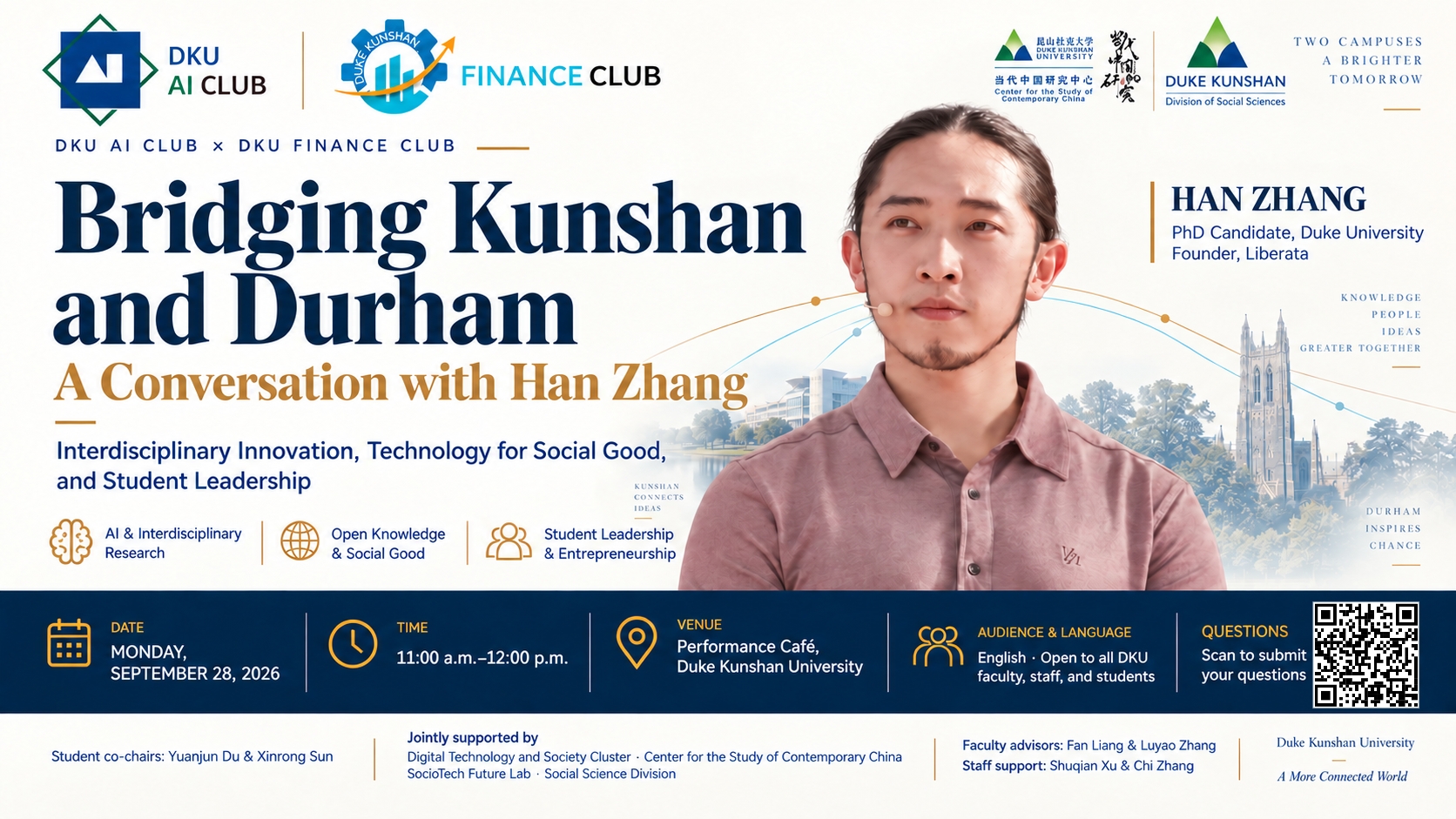
Date: Monday, September 28, 2026
Time: 11:00 a.m.–12:00 p.m.
Venue: CCT Performance Café, Duke Kunshan University
Speaker: Han Zhang, PhD Candidate at Duke University and Founder of Liberata
How can emerging technologies contribute to social good? What can China’s rapidly evolving innovation landscape teach us about the relationship among research, entrepreneurship, institutions, and society? Following his participation in the 2026 Kunshan–Durham Sister-City New-Generation Entrepreneurs Camp, Han Zhang will join the DKU community for a student-led conversation about interdisciplinary research, responsible innovation, and the social purposes of technology. The event places Han’s experience within the broader context of contemporary China. His visit to Kunshan creates an opportunity to consider how scientific ideas move among universities, industries, cities, and international knowledge networks. Participants will explore how China’s local innovation ecosystems connect technological development with talent cultivation, entrepreneurship, public institutions, and global collaboration.
Drawing on his journey from artificial intelligence and metamaterials research to the development of Liberata, an open-access academic publishing and research-discovery initiative, Han will discuss how ideas cross disciplinary boundaries and become collaborative platforms. Liberata also provides a practical case for examining technology for social good: how might digital systems expand access to knowledge, recognize different forms of intellectual contribution, improve research quality, and build greater trust in scientific institutions? The conversation will move beyond the question of what technology can do to consider who benefits from it, whose contributions are recognized, what values are embedded in its design, and how innovation can create lasting public value.
Co-chaired by DKU students Yuanjun Du and Xinrong Sun, the event places student leadership at the center of international exchange. Faculty, staff, and students from across the university are invited to consider how young researchers can connect technical knowledge with social questions, build teams across disciplinary and cultural boundaries, and develop entrepreneurial initiatives that are rooted in China while contributing to global communities.
Discussion Themes
Speaker Bio
Han Zhang is a PhD candidate at Duke University working at the intersection of artificial intelligence and metamaterials. His research combines uncertainty quantification, neural operators, and generative models to develop concept-aware AI systems for modeling and designing metamaterial structures. During his doctoral studies, his interests expanded to game theory and graph theory, which now inform his work on scientific collaboration, incentives, and knowledge networks.
Drawing on this interdisciplinary research and his experience in entrepreneurship and academic publishing, Han founded Liberata, a diamond open-access platform for academic publishing, discovery, and scientometrics. He currently leads a team of more than 70 contributors across Duke University and Silicon Valley. Before beginning his PhD, Han worked as a senior engineer at Neuralink, Celldom, and Atomic Machines, developing experimental hardware and software systems and contributing to early brain–machine-interface prototypes. His entrepreneurial work is featured in the documentary Utopia: A Vision in Silicon Valley, alongside technology, policy, and investment leaders including Jaron Lanier, Chris Anderson, Margrethe Vestager, and Frances Haugen. Han has also conducted research at Canada’s National Institute for Nanotechnology, Germany’s Max Planck Institute, and Nanyang Technological University in Singapore. These international experiences shape his view of scientific research as a global system influenced by technology, institutions, and incentives.
About Liberata
Liberata is a diamond open-access academic publishing platform with incentive-aligned quality controls and graph-based scientometrics. The platform replaces conventional authorship order with transparent contribution shares that researchers can exchange for peer-review and replication services, helping align incentives among authors, reviewers, and other quality contributors.
Liberata’s contribution, marketplace, and citation data support richer measures of research impact, reliability, collaboration, risk, and academic behavior. Institutional subscriptions to these scientometric services sustain a publishing model that is free to read, free to publish, and allows authors to retain their copyright.
Organization
Jointly supported by
Hosted by
DKU Finance and AI Club
Student co-chairs
Yuanjun Du and Xinrong Sun
Faculty advisors
Fan Liang and Luyao Zhang
Staff support
Shuqian Xu and Chi Zhang