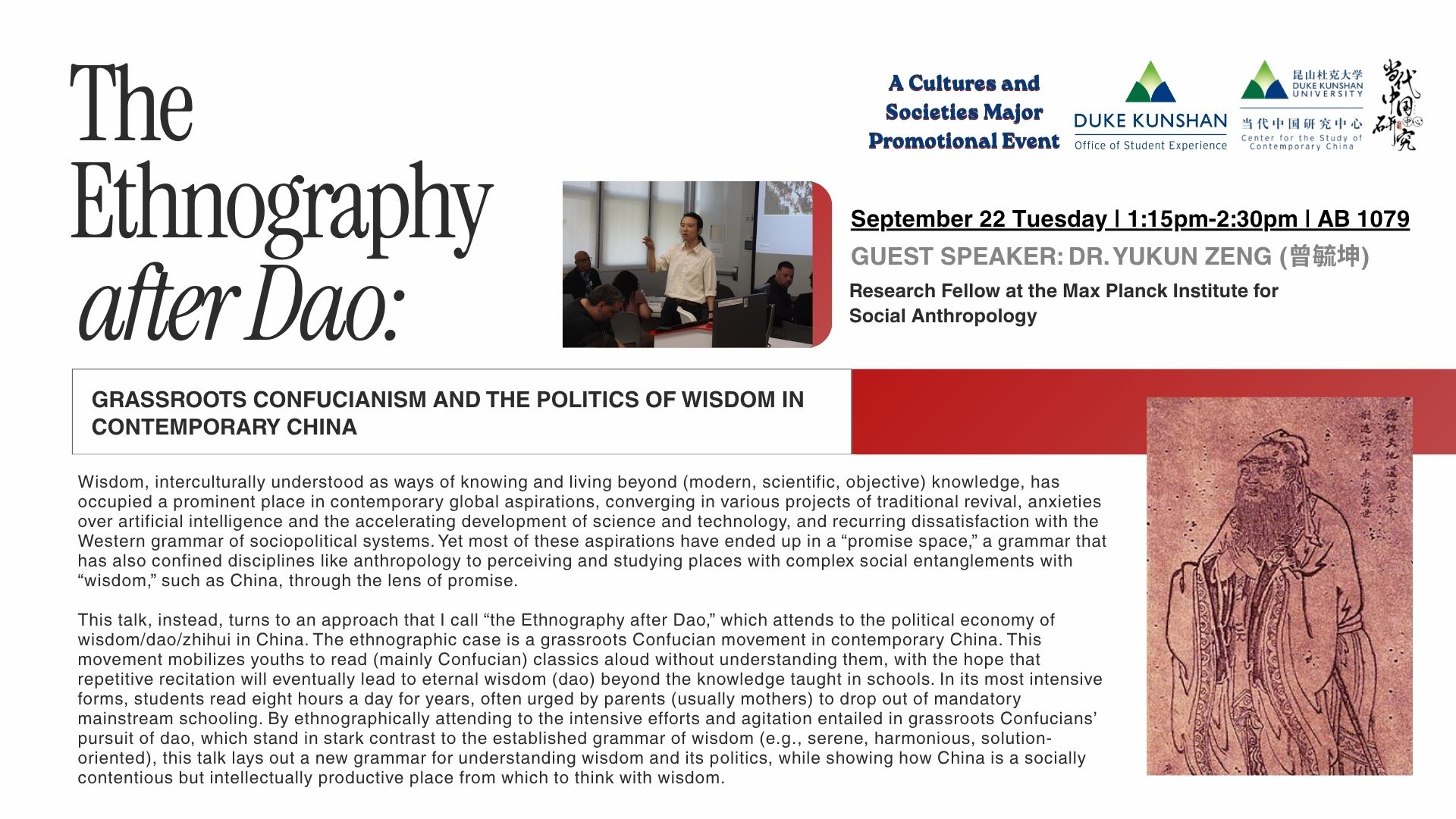
Date: Tuesday September 22, 2026
Time: 1:15pm-2:30pm
Location: AB 1079
Speaker: Yukun Zeng, Research Fellow at the Max Planck Institute for Social Anthropology
Abstract
Wisdom, interculturally understood as ways of knowing and living beyond (modern, scientific, objective) knowledge, has occupied a prominent place in contemporary global aspirations, converging in various projects of traditional revival, anxieties over artificial intelligence and the accelerating development of science and technology, and recurring dissatisfaction with the Western grammar of sociopolitical systems. Yet most of these aspirations have ended up in a “promise space,” a grammar that has also confined disciplines like anthropology to perceiving and studying places with complex social entanglements with “wisdom,” such as China, through the lens of promise.
This talk, instead, turns to an approach that I call “the Ethnography after Dao,” which attends to the political economy of wisdom/dao/zhihui in China. The ethnographic case is a grassroots Confucian movement in contemporary China. This movement mobilizes youths to read (mainly Confucian) classics aloud without understanding them, with the hope that repetitive recitation will eventually lead to eternal wisdom (dao) beyond the knowledge taught in schools. In its most intensive forms, students read eight hours a day for years, often urged by parents (usually mothers) to drop out of mandatory mainstream schooling. By ethnographically attending to the intensive efforts and agitation entailed in grassroots Confucians’ pursuit of dao, which stand in stark contrast to the established grammar of wisdom (e.g., serene, harmonious, solution-oriented), this talk lays out a new grammar for understanding wisdom and its politics, while showing how China is a socially contentious but intellectually productive place from which to think with wisdom.
Bio
Yukun Zeng (曾毓坤) is currently a Research Fellow at the Max Planck Institute for Social Anthropology. He conducts ethnographic research on education, labor, language, morality, grassroots movements, state sociocultural engineering, and the social lives and political economy of “Chinese thought” in the global contexts. He is now completing his book manuscript Radical Wisdom: Reading Classics and Staking Morality in Contemporary Chinese Confucianism, and conducting research on the new project of migrant workers’ self-study examination He also engages in a variety of public anthropology projects, including the platform Tyingknots.