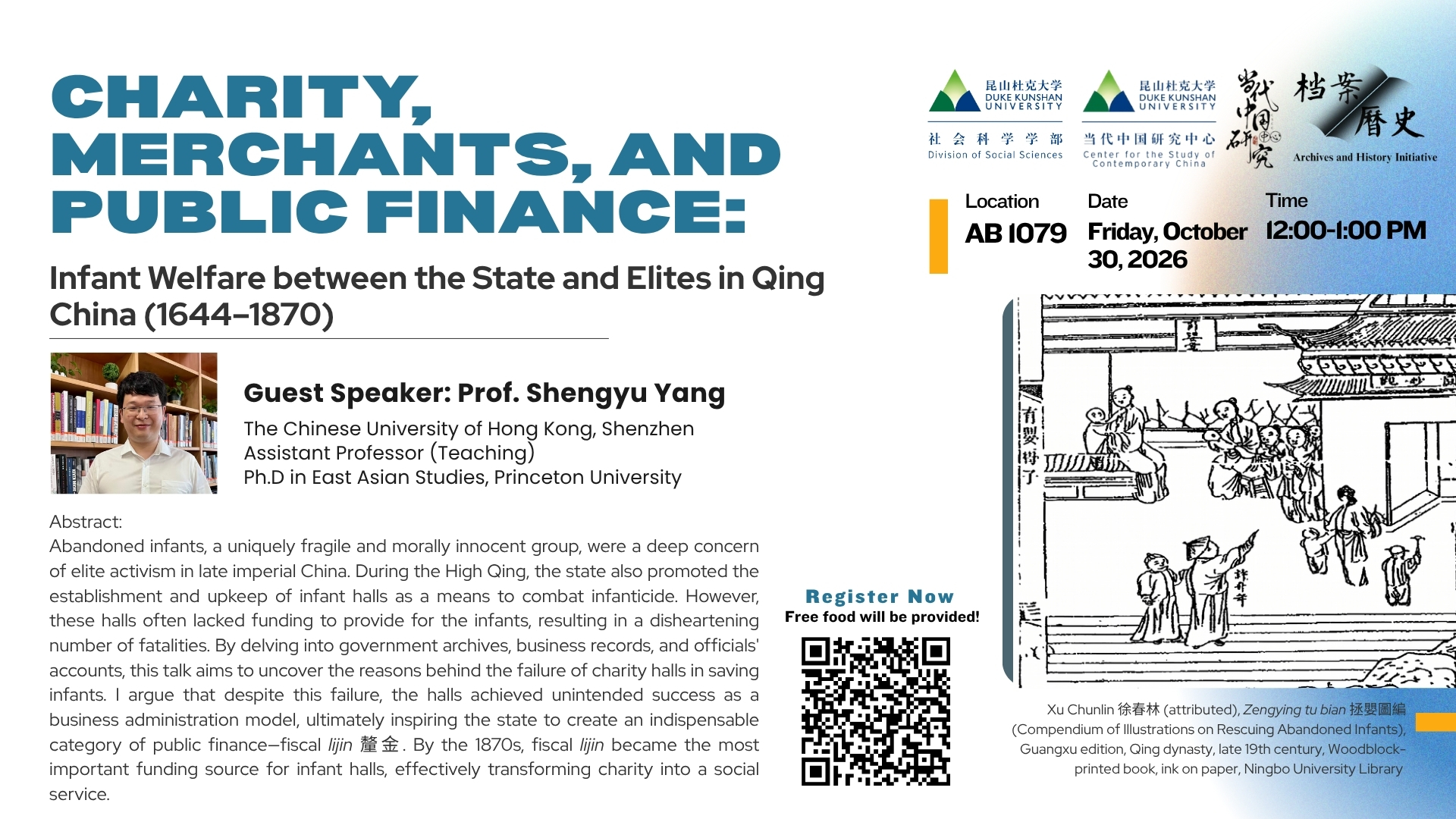

Time: 12:00-1:00 PM, Friday October 30, 2026
Location: AB 1079
Speaker: Prof. Shengyu Yang, The Chinese University of Hong Kong, Shenzhen, Assistant Professor (Teaching);
Ph.D in East Asian Studies, Princeton University
This event is co-sponsored by Center for the Study of Contemporary China, History of Economics Series, and Archive and History Initiative.
Abstract
Abandoned infants, a uniquely fragile and morally innocent group, were a deep concern of elite activism in late imperial China. During the High Qing, the state also promoted the establishment and upkeep of infant halls as a means to combat infanticide. However, these halls often lacked funding to provide for the infants, resulting in a disheartening number of fatalities. By delving into government archives, business records, and officials’ accounts, this talk aims to uncover the reasons behind the failure of charity halls in saving infants. I argue that despite this failure, the halls achieved unintended success as a business administration model, ultimately inspiring the state to create an indispensable category of public finance—fiscal lijin 釐金. By the 1870s, fiscal lijin became the most important funding source for infant halls, effectively transforming charity into a social service.
Bio
Dr. Shengyu Yang is an Assistant Professor in the General Education Division of the School of Humanities and Social Science at the Chinese University of Hong Kong, Shenzhen. He earned his Ph.D. in East Asian Studies from Princeton University, and specializes in the socio-economic history of the Qing Dynasty. As an awardee of the Peacock Talent Program, Dr. Yang is supported by a research grant from the Shenzhen Municipal Government. He also held a visiting fellowship at the National Institute for Advanced Humanistic Studies of Fudan University.