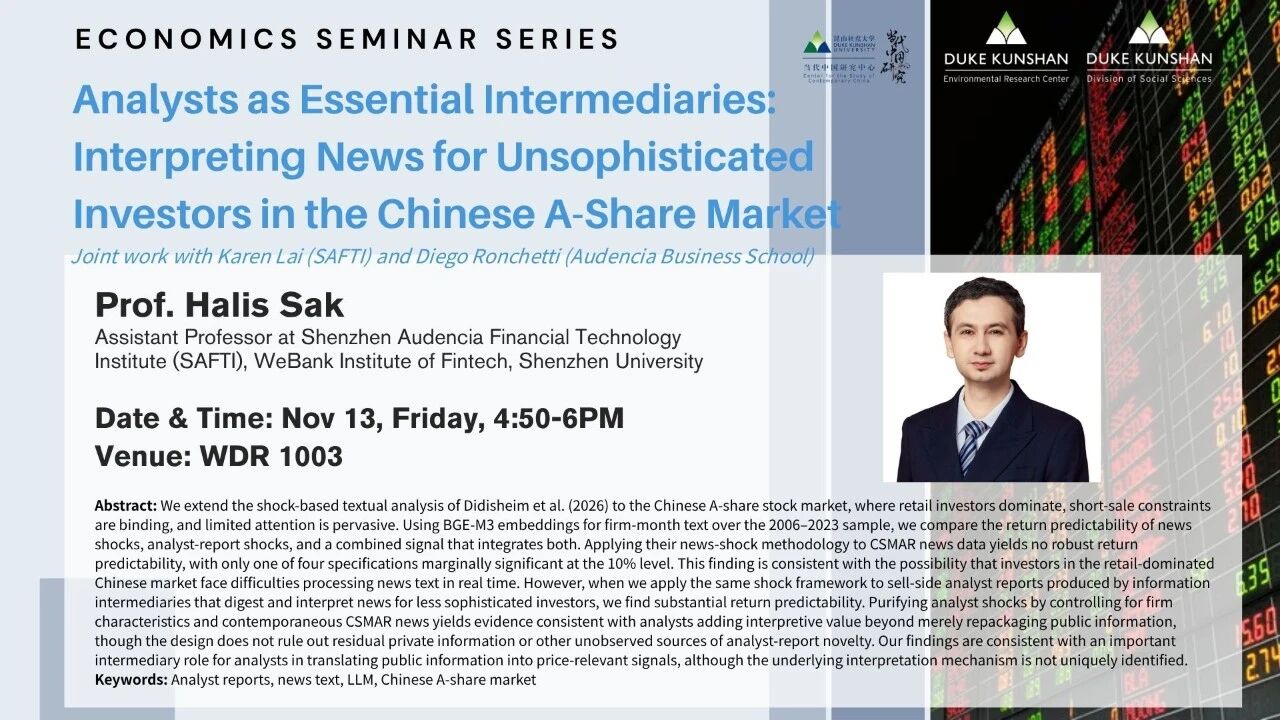

Time: 4:50-6PM, Friday, Nov 13
Venue: WDR 1003
Speaker: Prof. Halis Sak, Shenzhen University
Speaker’s bio: Halis Sak is an Assistant Professor at Shenzhen Audencia Financial Technology Institute (SAFTI), WeBank Institute of Fintech, Shenzhen University. Before joining the institute, he was a Visiting Assistant Professor at the Department of Finance of HKUST. His research and teaching address machine learning, empirical asset pricing, risk management, and Monte Carlo simulation. His academic works appeared in journals such as Review of Finance, Quantitative Finance, and European Journal of Operational Research.
Abstract: We extend the shock-based textual analysis of Didisheim et al. (2026) to the Chinese A-share stock market, where retail investors dominate, short-sale constraints are binding, andlimited attention is pervasive. Using BGE-M3 embeddings for firm-month text over the 2006–2023 sample, we compare the return predictability of news shocks, analyst-report shocks, and a combined signal that integrates both. Applying their news-shock methodology to CSMAR news data yields no robust return predictability, with only one of four specificationsmarginally significant at the 10% level. This finding is consistent with the possibility that investors in the retail-dominated Chinese market face difficulties processing news text inreal time. However, when we apply the same shock framework to sell-side analyst reports produced by information intermediaries that digest and interpret news for less sophisticated investors, we find substantial return predictability. Purifying analyst shocks by controlling for firm characteristics and contemporaneous CSMAR news yields evidence consistent with analysts adding interpretive value beyond merely repackaging public information, though the design does not rule out residual private information or other unobserved sources of analyst-report novelty. Our findings are consistent with an important intermediary role for analysts in translating public information into price-relevant signals, although the underlying interpretation mechanism is not uniquely identified.