By Violet Nguyen, Class of 2028
On August 26, 2026, the Center for the Study of Contemporary China’s Digital Technology and Society Cluster hosted Dr. Yu Sun, Lecturer in Media and Sociology at the University of Glasgow, for a talk titled Morality Calculable for Social Governance. Drawing on fieldwork in Jiande, Zhejiang Province, Dr. Sun examined how digital technologies are transforming the ways morality is defined, measured, and governed in rural China. Her presentation focused on the Xiangcun Ding (乡村钉), or “Village App,” a digital platform that incorporates a data-based scoring system into everyday rural governance.
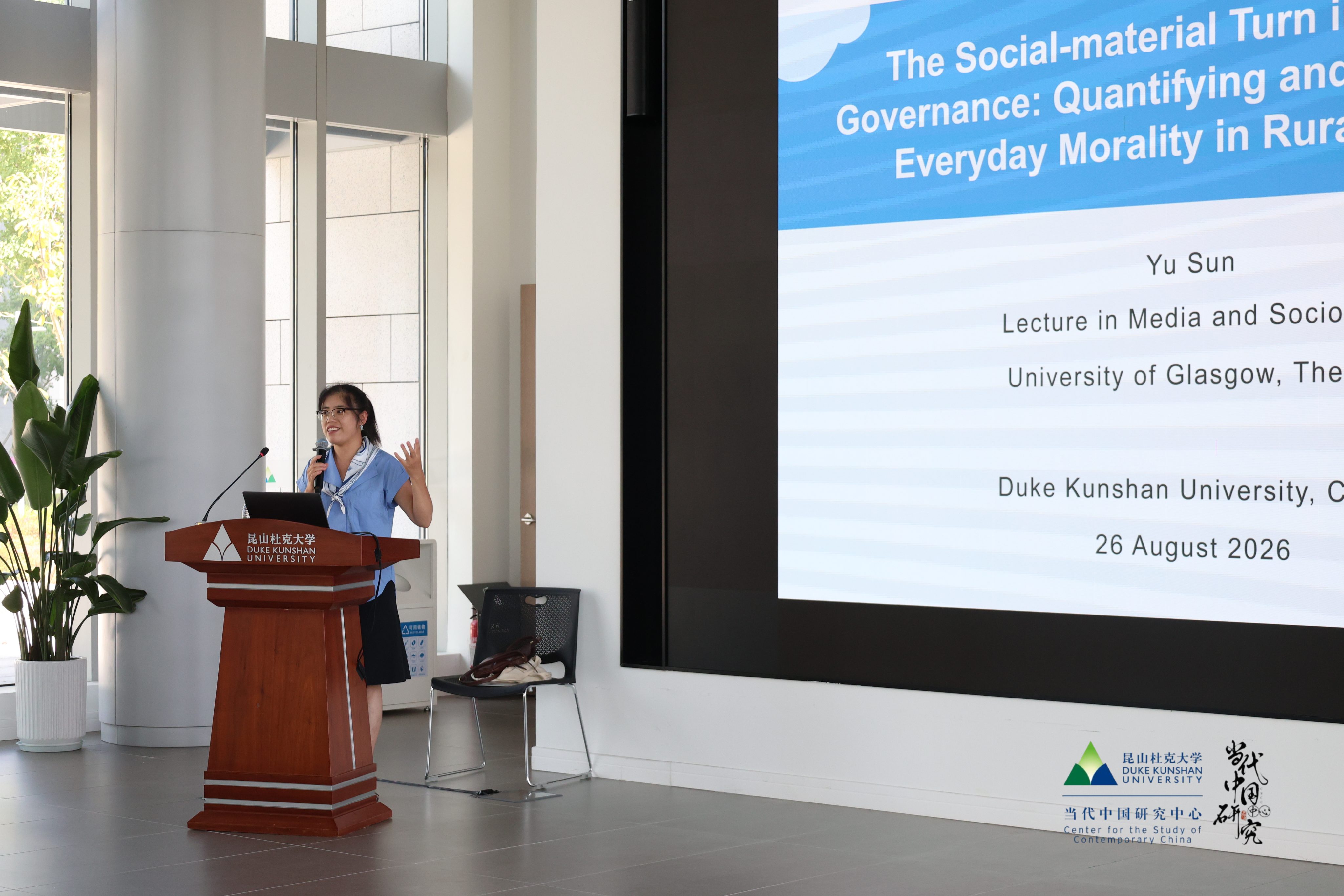
Dr. Sun began by situating her research within Michel Foucault’s theory of moral governance. Rather than understanding governance as external discipline, she explained how modern forms of governance can encourage individuals to regulate and construct themselves according to particular moral expectations. This involves not only observable behaviours, but also the internalization of values and norms. In the Chinese context, however, Dr. Sun argued that moral governance has developed through a distinctive relationship between the state, social institutions, and individuals. Morality has long been used as a cultural resource for addressing social challenges, and in recent decades, digital platforms have increasingly become mechanisms through which these moral expectations are communicated and implemented.
Dr. Sun described this emerging system as “techno-moral governance.” Unlike traditional forms of governance that rely primarily on discourse and symbolic communication, techno-moral governance is embedded in the operational and material functions of digital platforms. Applications do not simply tell citizens what constitutes desirable behaviours; they structure how people act, record their activities, evaluate their performance, and distribute rewards. In this sense, technology becomes part of the governing process itself.
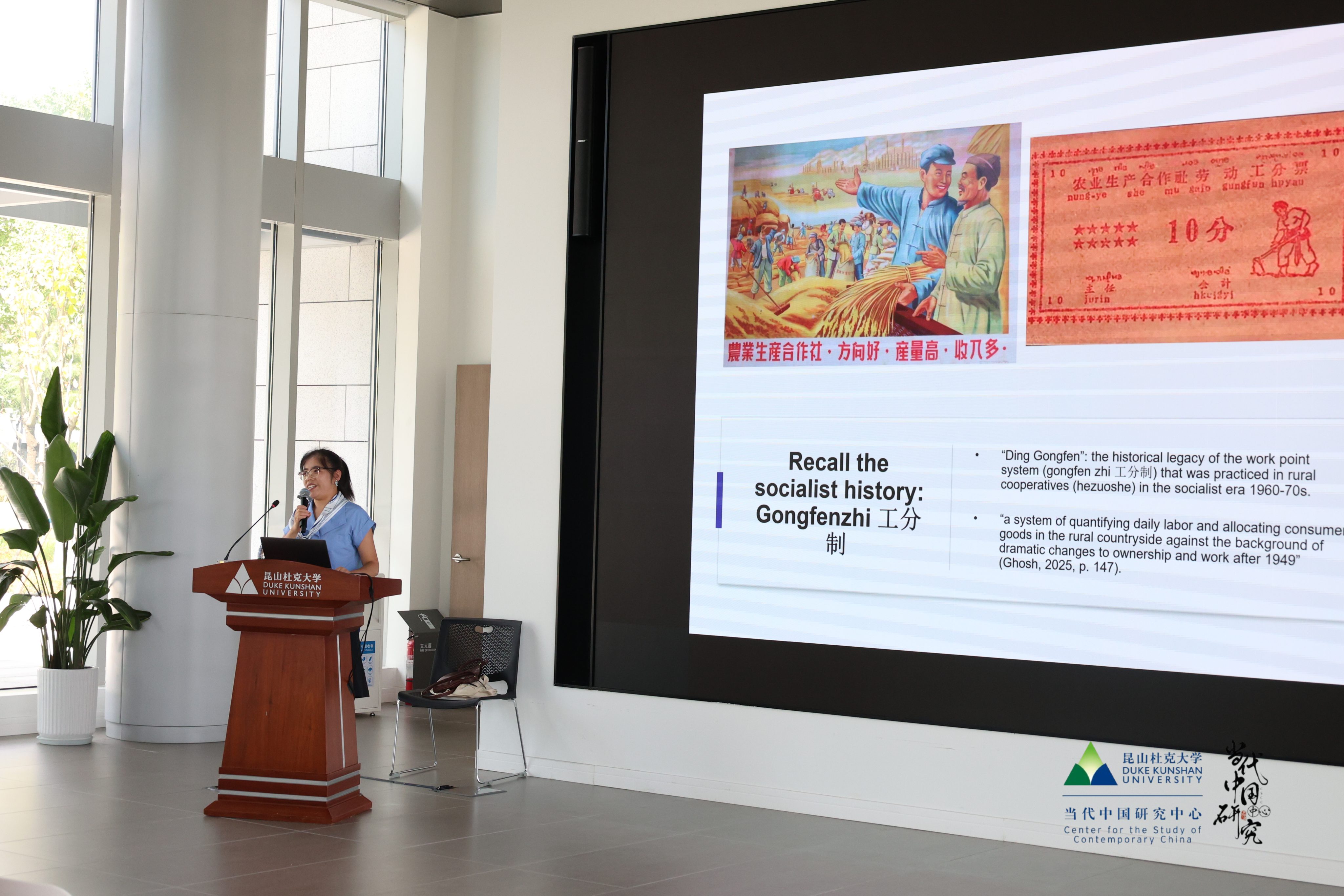
The Xiangcun Ding app provides a particularly revealing example. Developed jointly by the Jiande municipal government and Alibaba and deployed in rural areas beginning in 2020, the platform combines administrative functions with a data-scoring system known as Ding Gongfen (钉功分). The name invokes the idea of “doing good deeds and building virtue,” while also recalling the historical gongfen work-point system used in rural China during the socialist period. Under that earlier system, labor was quantified through work points that could be exchanged for necessities. Dr. Sun showed how this historical logic has been incorporated into a contemporary digital system in which everyday behaviours can be quantified and rewarded.
The app evaluates villagers according to a broad definition of morality. Four major categories include family morals, social morals, professional ethics, and participation in village affairs. Behaviors range from caring for elderly parents and maintaining family harmony to managing household waste, participating in village activities, supporting charity, and maintaining employment. All sort of actions can affect a person’s score. Some behaviors can result in deductions, including certain forms of petitioning or social conflict. At the village level, local governments can also add criteria reflecting particular local concerns, meaning that the definition of “good” behavior is simultaneously standardized and locally adapted.
The consequences of these scores extend beyond abstract digital ranking. Villagers can submit evidence of their activities through the app, such as photographs documenting garbage sorting or participation in community affairs. Local moderators review these submissions and give out points, which can be used to buy rewards such as food, life necessities, and other material needs. Higher-scoring residents may receive household necessities, access to benefits such as low-interest loans and recognition as “model” villagers. Rankings are also publicly displayed, creating a combination of material incentives and social recognition.
At the same time, Dr. Sun emphasized that this system is not fully automated. There are human moderators such village officials and local volunteers who remain deeply involved in reviewing submissions and administering rewards. The resulting system therefore combines formal administrative power with informal and participatory governance. Villagers themselves become participants in monitoring and managing the system, reflecting the collective mobilization associated with the historical work-point system.
Dr. Sun concluded by proposing a “social-material turn” in rural governance. Rather than operating primarily through political discourse, techno-moral governance increasingly works through the material conditions of everyday life, including access to resources, services, recognition, and economic benefits. Yet she also stressed an important limitation of her research: because researchers were unable to conduct conventional interviews with residents, they cannot determine whether villagers genuinely internalize the moral values embedded in the platform. Residents may comply superficially, ignore the system, or develop subtle forms of resistance. This gap between institutional design and individual subjectivity, Dr. Sun suggested, opens important questions for future research on digital governance and everyday agency in contemporary China.