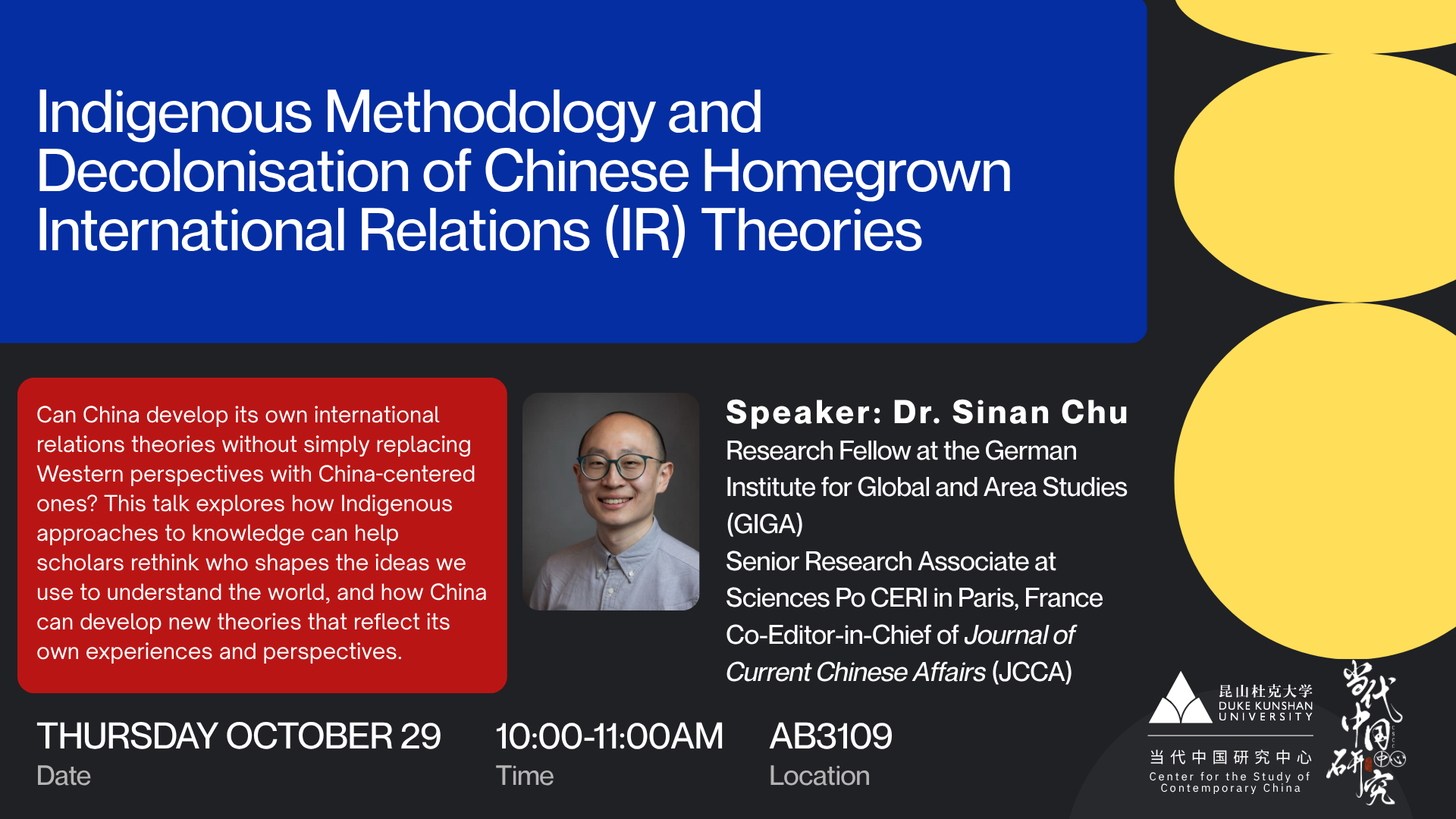
Time: 10:00-11:00AM, Thursday October 29
Location: AB3109
Speaker: Dr. Sinan Chu
Research Fellow at the German Institute for Global and Area Studies (GIGA)
Senior Research Associate at Sciences Po CERI in Paris, France
Abstract
Debates over Chinese homegrown international relations (IR) theories have yet to identify a meaningful solution that allows scholars to decolonize knowledge production in China studies and IR while steering clear of both Eurocentrism and Sinocentrism. This talk explores a novel approach inspired by lessons from the broader field of comparative indigeneity. To make the case, I situate Chinese homegrown IR in the post-socialist and post-colonial context of contemporary China to show the limitations of extant critique. Based on this discussion, the talk argues that a more effective knowledge decolonization requires reflexive thinking about how power structures shape knowledge creation in China and elsewhere, and that developing a fit-for-purpose approach grounded in indigenous methodology offers a promising solution. To that end, the talk advocates a new Chinese indigenous methodology for developing homegrown IR theories. It shall also discuss practical considerations and caveats.
Bio
Dr. Sinan CHU 储司南 is a Research Fellow at the German Institute for Global and Area Studies (GIGA), Institute for Asian Studies, in Hamburg, Germany, and a Senior Research Associate at Sciences Po CERI in Paris, France. He received his PhD from Syracuse University, specializing in comparative politics and international relations. He primarily researches the politics of contemporary China, focusing on ethnic politics, ideology, knowledge production, and intellectual discourse, as well as international relations theory. Currently, he is the principal investigator of the DFG-funded project “Intellectual Contestation over China’s Multiethnic Regime.” He is also the co-editor-in-chief of Journal of Current Chinese Affairs (JCCA).