Duke–DKU friendship and the Kunshan–Durham sister-city partnership came to life through interdisciplinary innovation, technology for social good, student leadership, and entrepreneurship during Han Zhang’s September 28, 2026 visit to Duke Kunshan University (DKU). [1] The exchange brought his sister-city entrepreneurs’ camp experience into a dialogue on frontier research and the common good. Han, a Duke University PhD candidate and founder of Liberata, explored open science—making research accessible and open to scrutiny—at the CCT Performance Café and in Prof. Luyao Zhang’s Computational Microeconomics classroom symposium. Student capstone pitches, research defenses, and questions about practical applications opened possibilities for reciprocal learning and future collaboration. The event was hosted by the DKU AI Club and DKU Finance Club, jointly supported by the Digital Technology and Society Cluster at the Center for the Study of Contemporary China and the SocioTech Future Lab in the Social Science Division. Student co-chairs were Yuanjun Du and Xinrong Sun; faculty advisors were Profs. Fan Liang and Luyao Zhang; staff support was provided by Shuqian Xu and Chi Zhang. We thank Han Zhang for sharing his experience and contributing to the classroom symposium, and Profs. Andrew Cheon and Mengtian Chen for joining the public discussion.
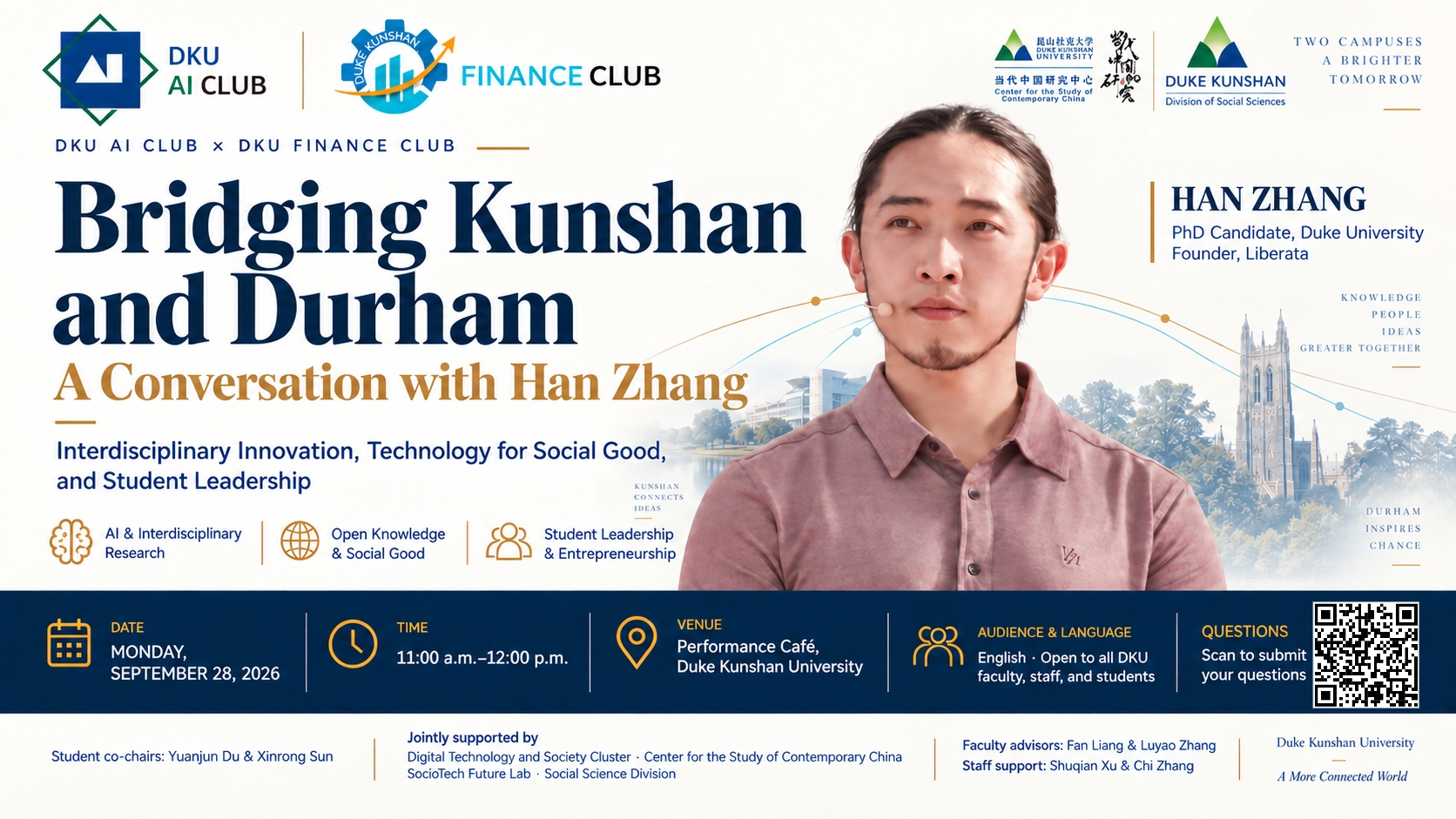
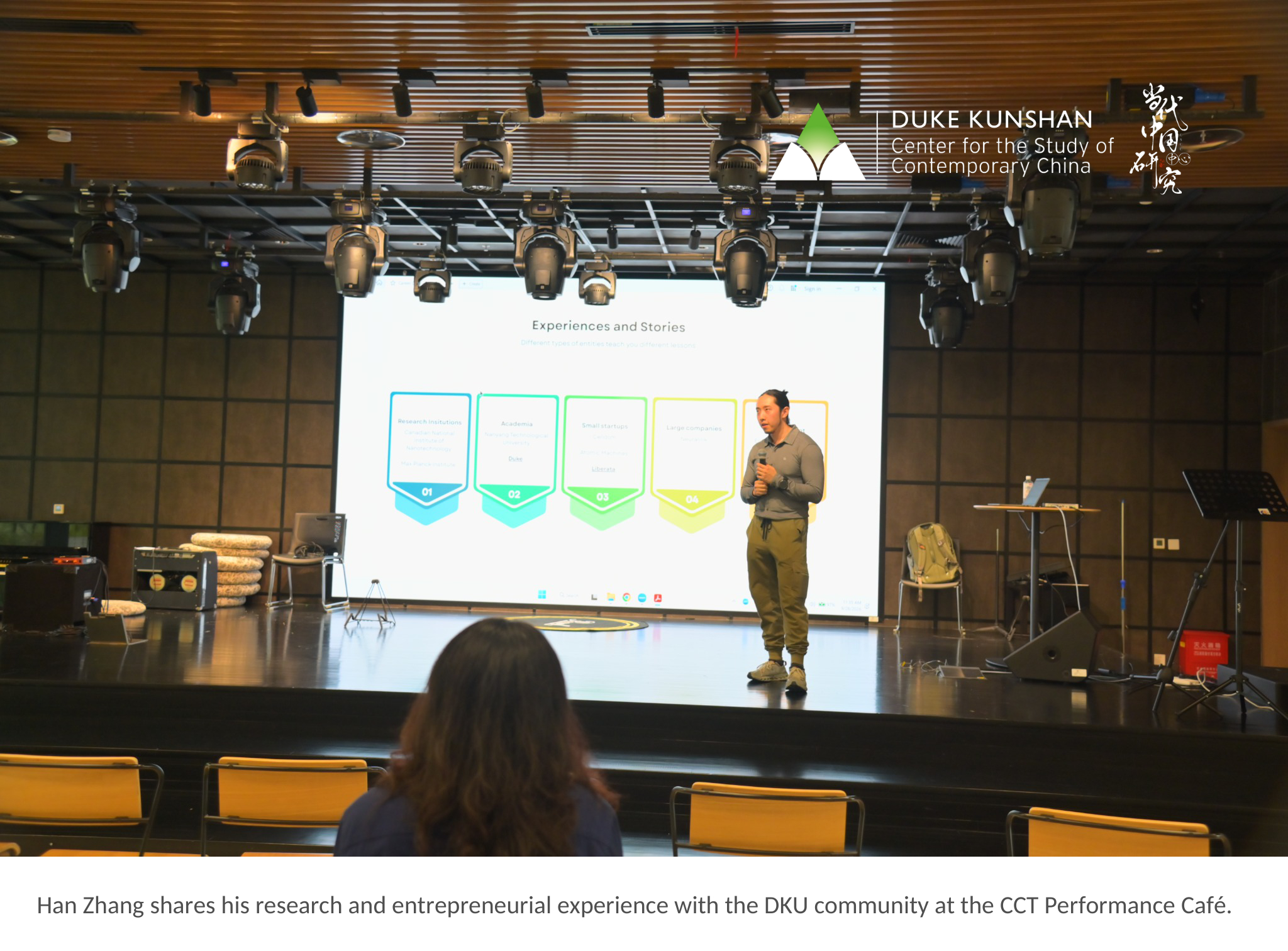
Kunshan, a city in China’s Jiangsu Province near Shanghai, is home to DKU. Durham, in North Carolina in the United States, is home to Duke University. The two cities signed a sister-city agreement on November 14, 2024: a partnership to encourage cultural and educational exchange and cooperation on shared concerns. Alongside the Duke–DKU university partnership, this civic friendship creates opportunities for people in both communities to learn from one another. [2]
Sister-city entrepreneurship connects with open science
Han shared his experience in the September 21–27, 2026 Kunshan–Durham Sister-City New-Generation Entrepreneurs Camp. The camp’s Together for the Future salon asked how a friendship led by city governments can grow through businesses, universities, young people, and residents. Future Duke–DKU exchanges could answer that challenge through student research, founder mentorship, and jointly developed prototypes, sustaining relationships while connecting new ideas with needs in both cities.
Han described his doctoral path as an incubator for researching questions underlying a venture. He emphasized thoughtful choices of research problems and advisors, grounding entrepreneurial research in an unresolved real-world need. His experience connects scholarly depth with developing an innovation that people can use.
Han’s research combines artificial intelligence with metamaterials, whose engineered structures give them unusual properties. Computing helps explore designs; engineering evaluates their physical possibilities. His startup experience introduced him to computer vision, software that interprets images, for counting cells in microscope images. He also learned about finance, logistics, and organizational dynamics, connecting technical innovation with sustaining a venture. Liberata brings this willingness to cross disciplines to improving how scientific knowledge is shared and evaluated.
Liberata seeks to make scholarly publishing freely accessible to readers and authors while giving clearer recognition to the work that makes research trustworthy. Peer review means asking knowledgeable researchers to assess a study; replication means checking whether its findings can be reproduced. Both matter to the public because decisions based on science depend on evidence that others can scrutinize. Yet these contributions can receive less recognition than publishing a new result.
Liberata grew through Duke’s Bass Connections program, which brings students and faculty from different disciplines together for research. Its team includes DKU students, extending the universities’ connection. Contribution shares, records of each person’s portion of a project’s work, can reward reviewing and checking findings. The initiative pairs computational innovation with an incentive and sustainability question: how can publishing support the people who make accessible knowledge trustworthy? [3]
Student leadership brings the exchange into campus life
Yuanjun Du hosted the opening, and he and Xinrong Sun co-chaired the event. Professors Andrew Cheon, Mengtian Chen, Fan Liang, and Luyao Zhang joined the conversation, bringing faculty perspectives into the exchange. Han discussed entrepreneurial experiences in China and the United States and offered guidance to students considering their own ventures or an opportunity to contribute to Liberata.
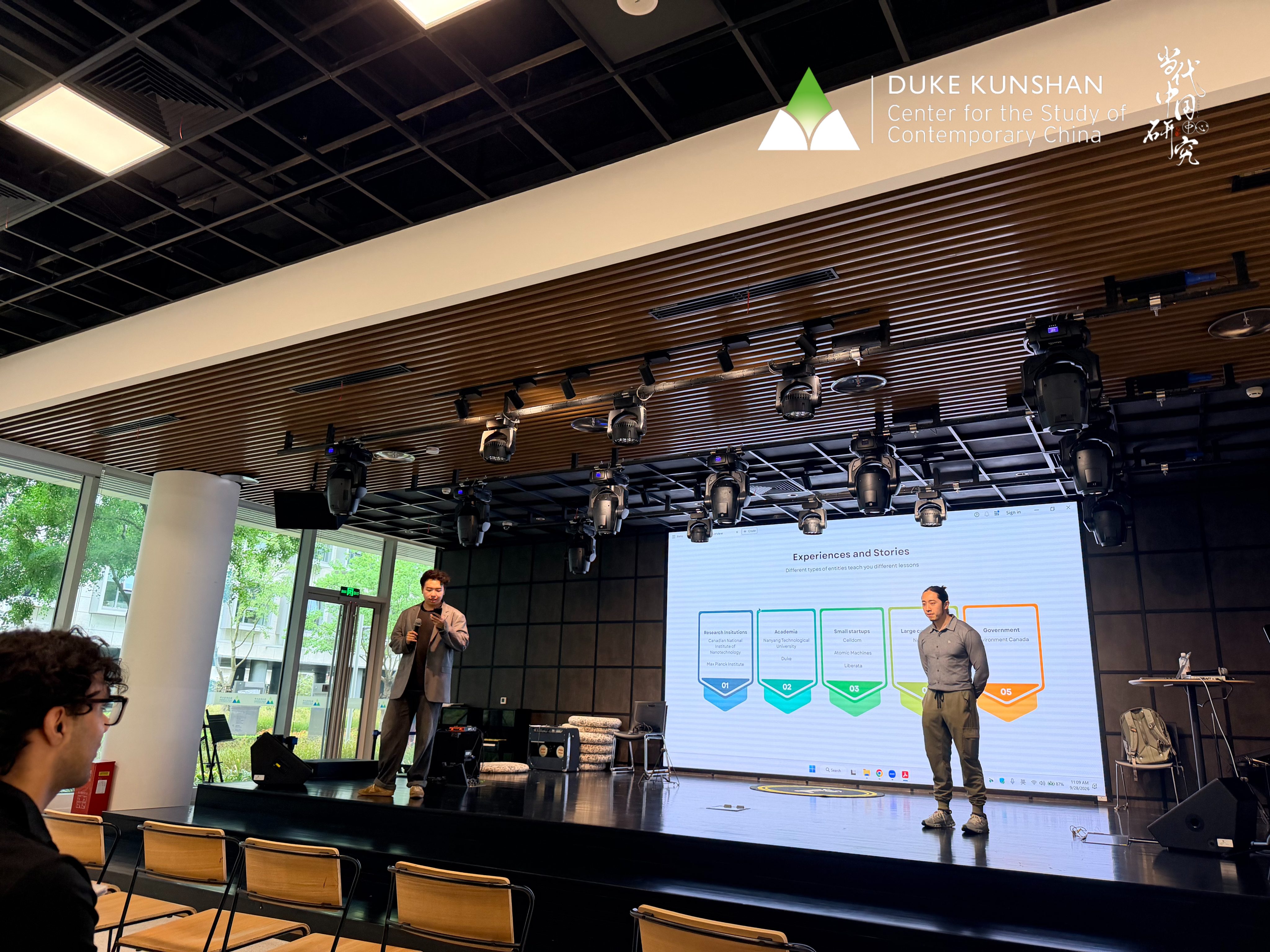
Han encouraged students to build strong foundations and learn why the world works as it does, drawing on physics, mathematics, and the humanities. He connected bringing different perspectives together with original ideas and strategic leadership. Early-career exploration, including conversations with people beyond one’s own field, can help students develop independent judgment about their direction. For Duke and DKU students, this gives exchanges across Kunshan and Durham a purpose: widening the perspectives and relationships from which innovation can grow.
Yuanjun on hosting the opening
Yuanjun’s role as opening host brought student leadership into the Duke–DKU exchange. Hosting such a conversation involves making research approachable and giving students across disciplines a shared starting point. His contribution illustrates how friendship between Kunshan and Durham can create occasions for students to connect research, entrepreneurship, and public value.
“I wanted the opening to show that the friendship between Kunshan and Durham grows through people and the communities they build. Our Finance Club is one small example, growing by drawing on Duke while building something of its own here. Having just returned from Duke’s campus in Durham, I felt how much our two universities can give each other. Hosting Han’s visit showed me that research and entrepreneurship reach further when they cross between us, and I hope for more shared research, student exchange and joint activities.” – Yuanjun Du, Class of 2027
Student-hosted exchanges give the sister-city relationship a continuing place in university life. Yuanjun and Xinrong connected campus interests with a founder working across disciplines and national settings. Informal conversations offered a starting point for further contact. Future exchanges could bring student projects into discussions with researchers and entrepreneurs from both cities, extending leadership from organizing an event to developing a collaboration.
A classroom symposium turns ideas into research
After the public event, Han joined Prof. Luyao Zhang’s COMSCI/ECON 206, Computational Microeconomics. The interdisciplinary course incubates undergraduate research on how computational methods can improve economic welfare, or people’s well-being. Students critically examine and build on ideas from Nobel laureates in economics and Turing Award recipients in computing, testing assumptions and developing questions at the frontier of research. Han’s emphasis on strong foundations and perspectives across fields resonates with students’ work connecting established ideas with original research questions.
The course joins strategic thinking, which examines how people respond to one another; social choice, which asks how communities combine different preferences; and mechanism design, which studies how rules shape incentives and outcomes. Together, these perspectives help students investigate when choices serving individual interests can also support common goods, such as accessible and trustworthy knowledge. Economists examine incentives and welfare, computer scientists develop and test algorithms, and behavioral scientists question how closely actual decisions follow a model. Wider social and institutional perspectives help ask whose needs a design serves.
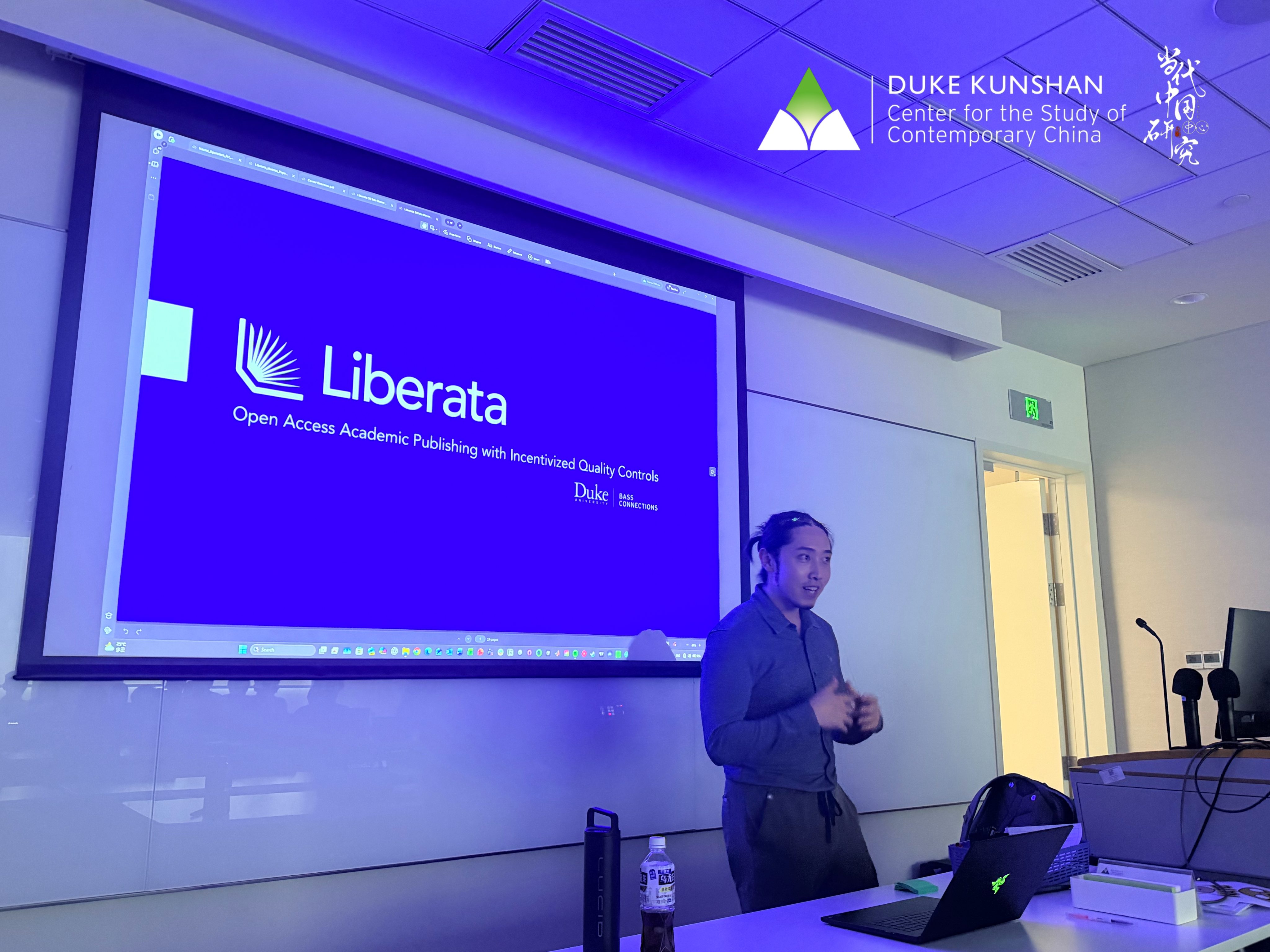
In the immersive classroom symposium, students pitched and defended their capstone research projects, which bring together learning across the course, and received Han’s questions and feedback. Liberata provided a practical setting in which to discuss the value of their ideas. Han also selected the classroom’s Liberata Frontier Prize, recognizing the potential of student research to contribute to the frontier of open science.
The symposium is a pedagogical innovation within the course’s Theory–Practice–Research–Innovation pathway: students study ideas, apply them, investigate unresolved questions, and refine a contribution. Presenting and defending a project asks students to explain assumptions, justify design choices, and identify evidence that could challenge a claim. Feedback can then guide revision. Research on active learning and feedback that helps students direct their own learning supports this design. [4, 5] Its purpose is to cultivate independent judgment and global leadership through work that others can question, test, and build on.
Liberata gives capstone research a practical setting
During the public Q&A, Han emphasized deep technical understanding and the ability to think through new products. That advice connects with the subsequent classroom symposium, where students explained how their proposals worked and why they mattered. In the classroom, his questions brought a founder’s perspective to developing capstones. Applying an idea to Liberata linked its theoretical contribution with a user, an incentive problem, and a practical purpose. The dialogue encouraged students to clarify assumptions and identify the evidence needed to evaluate their proposal, giving them directions for refining research and prototypes.
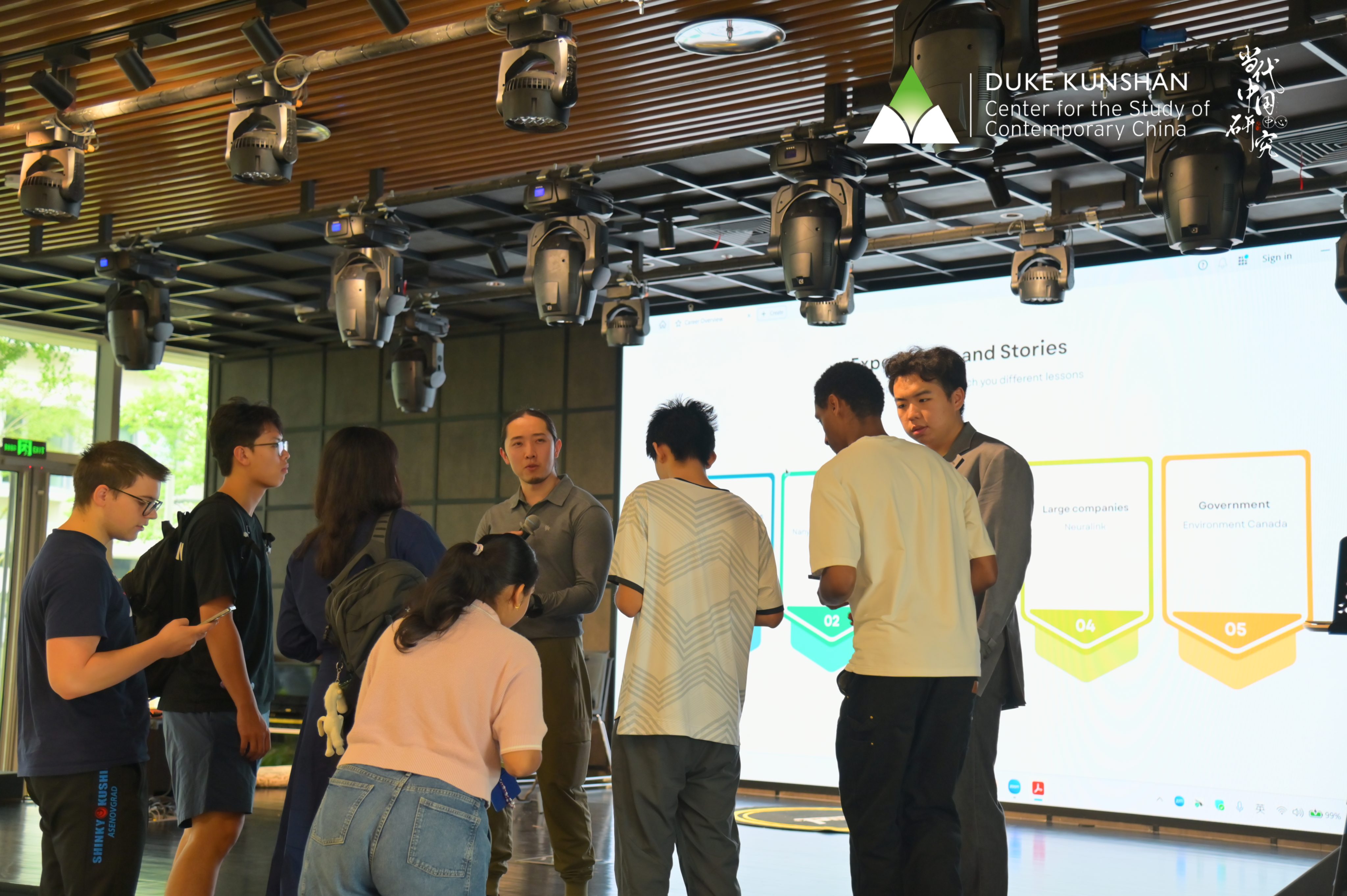
Concrete application scenarios include matching manuscripts with suitable reviewers, assigning fair recognition to different research contributions, and motivating independent checks of published findings. Liberata’s work on contribution shares, reviewer selection, and review and replication marketplaces makes these relevant opportunities for computational and economic research. [3] For a capstone, an application might involve testing how a matching or reward rule changes participation, checking for unfair advantage, or comparing ways to recognize work that conventional authorship overlooks.
These applications connect the course’s common-good perspective with open science. Researchers make choices in pursuit of personal and professional goals, while trustworthy knowledge depends on contributions that benefit others. Students can investigate whether a proposed mechanism makes useful reviewing or replication worthwhile for individuals, and whether its collective effects are fair and sustainable. Connecting research with this unresolved practical need requires algorithms, economic incentives, and actual human behavior to inform the design of trustworthy and sustainable open publishing.
The exchange was reciprocal. Students’ pitches offered Han fresh ideas about how their innovations could address Liberata’s application challenges; his feedback helped them strengthen the connection between a research contribution and the people it could serve. Their role was to contribute ideas as emerging researchers, while learning from a founder working on related problems. This shared ground gives the symposium value as a starting point for further mentoring, collaborative research, and jointly developed prototypes.
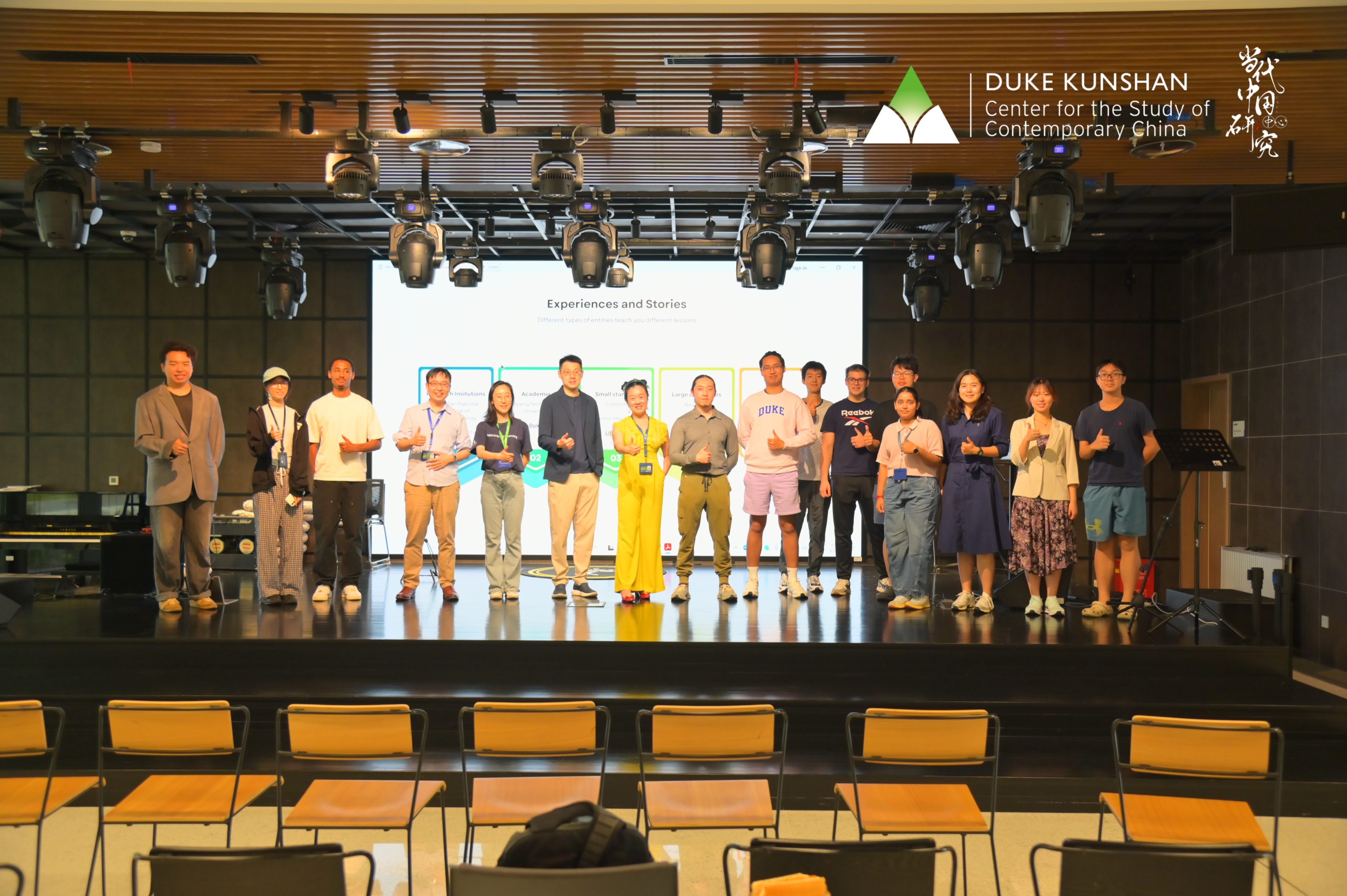
Xinrong’s perspective on learning and leadership
As an event co-chair and a student in Computational Microeconomics, Xinrong Sun experienced both the public conversation and the classroom symposium.
“Han’s discussion of Liberata made me think more deeply about what it takes to make scientific knowledge open and trustworthy. I began to see that useful AI tools also depend on incentives that recognize the people who review, test, and improve research. This connection between technology and human collaboration stayed with me as both a student in Computational Microeconomics and an AI Club president. Bringing different disciplines and cultures into conversation is something I hope our club can continue through shared projects and closer exchanges between Duke and DKU.” – Xinrong Sun, Class of 2029
Han’s visit showed how Duke–DKU scholarly exchange can give lasting substance to Kunshan–Durham friendship through student leadership, research, and entrepreneurship. We look forward to collaborations connecting Computational Microeconomics capstones with Liberata’s open-science challenges through prototypes, further mentoring, and research students can test and share. Future sister-city entrepreneurship programs could extend these relationships across universities, founders, and local communities.
Sources and further reading
[2] Duke on the sister-city agreement
[3] Liberata and Duke Bass Connections
[4] Freeman and colleagues on active learning
[5] Nicol and Macfarlane-Dick on feedback
Written by: Yuanjun Du and Xinrong Sun
Hosted by: DKU AI Club and DKU Finance Club
Jointly supported by: Digital Technology and Society Cluster, Center for the Study of Contemporary China; SocioTech Future Lab, Social Science Division
Student co-chairs: Yuanjun Du and Xinrong Sun
Faculty advisors: Profs. Fan Liang and Luyao Zhang
Staff support: Shuqian Xu and Chi Zhang