

By Violet Nguyen, Class of 2028
Tanannum Azad Arufa is a student from the class of 2029 from Bangladesh majoring in Computation and Design with a track in Computer Science. She is the lead student researcher on “A Systematic Review of Gamification in Education: ‘Seriousness’ Framing and Evidence of Impact Across Learning Contexts,” a CSCC Faculty-Student Collaborative Project Grant recipient supervised by Joseph Arthur Davies, Senior Lecturer of English Language and Assistant Director for Graduate English for Academic Purposes at DKU’s Language and Culture Center.
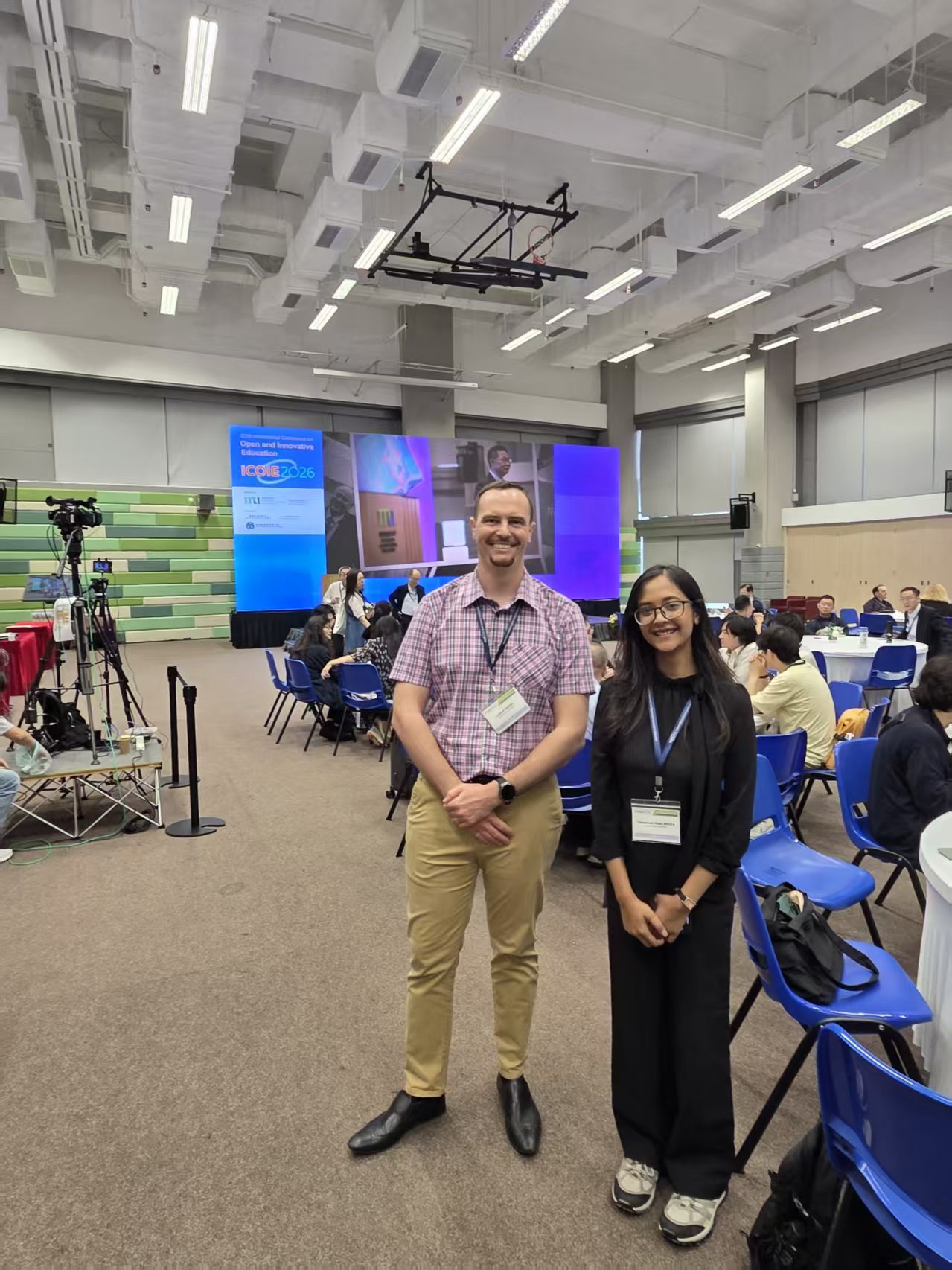
Before joining DKU, Tanannum took two gap years to work with children in community-based educational settings and develop her own initiative focused on making learning more accessible and engaging. Her experiences led her to explore gamification as a potentially low-cost way of supporting student engagement and learning. At DKU, she developed this interest into a systematic review of research on gamification in education with Professor Joseph Davies. Their research examines not only whether gamification improves learning, but also what makes a gamified educational experience pedagogically meaningful and credible to students, educators, and other stakeholders. Their paper has since been accepted for presentation at the 2026 International Conference on Open and Innovative Education (ICOIE) in Hong Kong. We sat down with Tanannum and Professor Davies separately to talk about where the idea came from, what the research found, and what it was like to present it at an international conference.
Tanannum Azad Arufa
What first got you interested in gamification and education?
Growing up, access to education wasn’t easy for me, so once I had it, I wanted to make it a little easier for others. I spent a lot of time working with children in communities near my home whose families could not afford to keep them in formal education. What surprised me was these were incredibly curious children who were constantly asking questions about the world around them.
A lot of them were in government or NGO-run schools, but I noticed that many didn’t really feel connected to what they were learning. If a student is learning through everything immediately around them, it is difficult to suddenly put a textbook from the traditional curriculum in front of them and expect a physics law or the Pythagorean theorem to feel relevant.
That made me start thinking about how learning could be connected to the world they already understood. Instead of teaching budgeting from a textbook, for example, we set up a little market where students had to buy and sell things and negotiate prices. We used familiar games like Ludo and carrom to teach basic concepts, and built activities around situations they could actually imagine themselves being in.
That was really where my interest in gamification started. I wasn’t initially thinking, “I’m going to research gamification.” I was trying to figure out how to make learning feel more immediate and meaningful to students. I ran the initiative for about two years with a team of around 40 people, and while the work we were doing was impactful, it wasn’t research-backed yet and that’s when I had considered doing research in the field of gamification.
How did that informal work turn into a formal research project with Professor Davies?
In December of my first year, I sat down with a blank document and wrote out the questions I had been thinking about. From there, I began exploring the existing scholarship and researchers working in related areas. That led me to Professor Joseph Davies, whose work in higher education assessment and feedback literacy connected closely with the direction I wanted to take the project.
I reached out and told him about the larger project I hoped to build eventually, but also that I wanted to begin with something more foundational. One of the gaps I saw in the literature was that discussions of gamification often focused on which game elements to use, without always asking why they worked, when they worked, or why they sometimes failed. I wanted to bring those different studies together and look beyond individual game elements to see if there were any broader patterns across the research. That was really what led me to a systematic review.
Can you walk us through what doing a systematic review actually looked like?
It was much more structured than just searching for papers and reading the interesting ones. We followed a PRISMA-guided systematic review process. I searched databases including Scopus, Web of Science, and Google Scholar, looking at research published between January 2010 and March 2026. The initial search gave me around 1,200 records. I then screened them by title and abstract, followed by full-text assessment, and after applying our criteria, 40 studies were ultimately included in the review.
Professor Joe’s background is in feedback literacy, so working with him meant I received a lot of detailed feedback throughout the process. He also helped me stay focused when different findings in the literature started pulling me in different directions.
What I’m most proud of is the framework that came out of the synthesis. Rather than saying, “This game element worked here,” or “That one failed there,” we tried to identify broader design conditions that might explain why gamification works in some educational contexts and struggles in others.
For someone who’s never heard of “gamification,” how would you explain what your research found?
Gamification is essentially the use of game design elements in something that isn’t itself a game. In education, that includes elements like points, badges, levels, challenges, narratives, progress systems, or collaborative activities.
One of the things our review found is that simply adding game elements does not automatically make learning more effective which is also known as “Shallow Gamification”. For example, giving students points for completing tasks or placing them on a leaderboard may be motivating for some students, but those elements can become less meaningful when they are disconnected from what students are actually learning. If instead you give someone a badge for the way they articulated an idea in an essay, say, how well they reasoned through a specific issue, that sticks with them, because it’s tied to a real skill and real feedback, not just “best essay.” In that case, the game element communicates something about the learner’s actual progress or achievement.
Competition is another example. A leaderboard might motivate students who enjoy competition, but it can discourage others. It’s called the “Leaderboard Loser Effect”. So it’s not really about whether a game element is “good” or “bad.” It’s about how it’s designed, what purpose it serves, and who the learners are.
How does your research connect to what’s happening at DKU and in China more broadly?
After we finished the research, we really wanted to share the findings with the faculty at DKU. DKU has already been experimenting with different forms of gamified and innovative learning, including narrative-based activities and simulations, and I think the Common Core courses are a really interesting example.
Through the Center for Teaching and Learning, we held a seminar for faculty and staff. What I loved about it was how diverse the room was. We had academic advisors, professors from STEM and non-STEM fields, and even faculty teaching courses like Kunqu joining us because they were interested in thinking about how these ideas could work in their own classrooms. A lot of the professors told us they were already doing things that felt intuitively right but the research gave them a way to think about those choices more deliberately.
DKU is also interesting because we’re working within a Chinese educational environment while having a very internationally oriented curriculum. That raises a bigger question that how do these approaches change when they move across different educational cultures? I’d really like to explore that rather than assuming something that works in one context will automatically work in another.
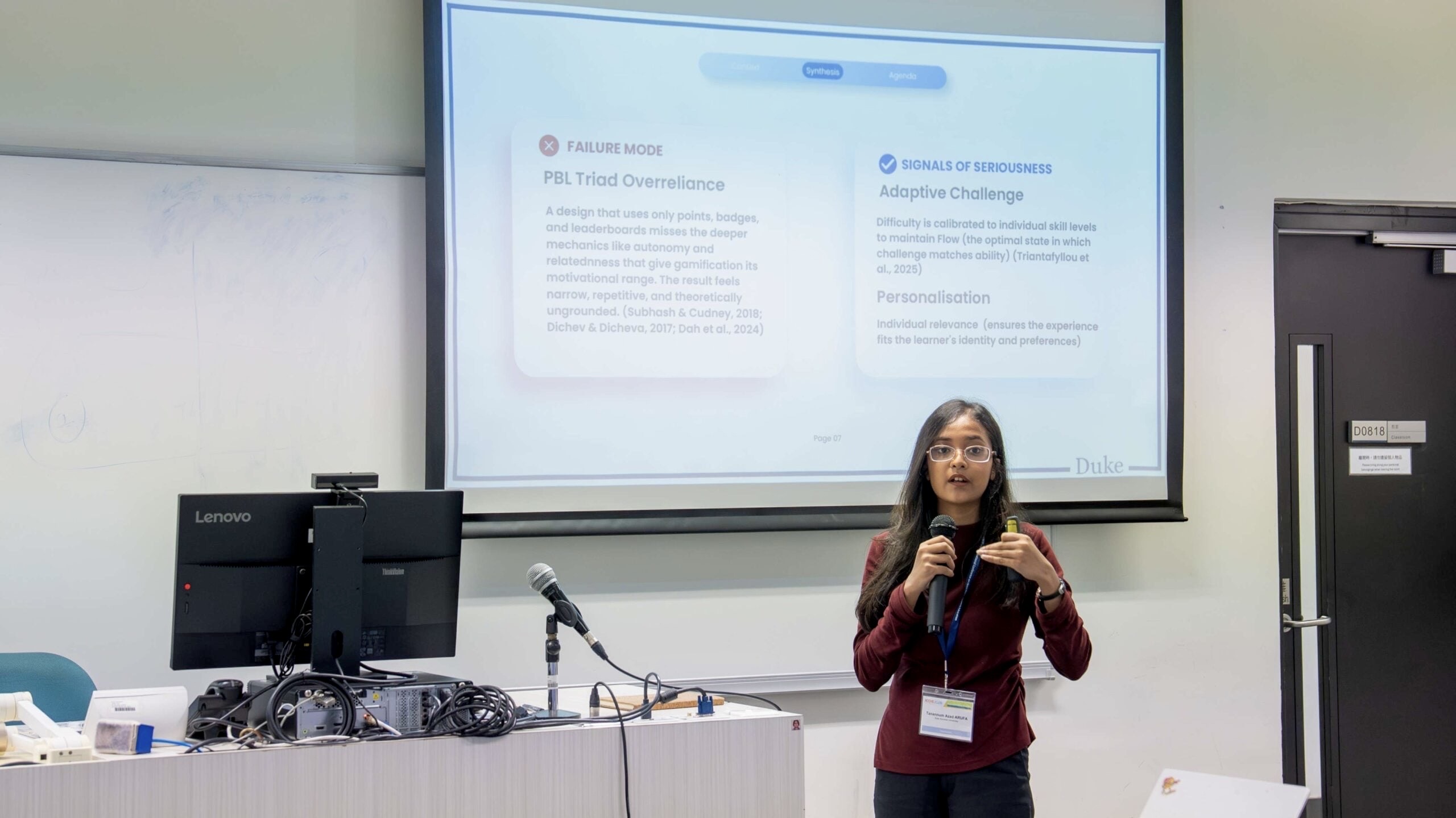
What was it like presenting at ICOIE in Hong Kong, which was your first time presenting internationally?
I was very nervous. It was my first time presenting research internationally, and it was also my first time traveling solo outside of mainland China. I had also never been to Hong Kong before, so there was a lot happening at once.
The conference itself ended up being much broader than I expected. ICOIE 2026 was really focused on open and innovative education, so there were conversations about AI, educational technology, student engagement, learning design, curriculum innovation, and a lot of different ways universities are changing how they teach. There were so many speakers whose work I was excited to hear about. Prof. Graham Kendall gave a keynote speech on AI and universities. I actually remember him particularly because I had connected with him on LinkedIn before the conference after finding out that he was going to be a keynote speaker. He was incredibly insightful, and it was nice to finally meet him after having connected online.
But probably the most incredible part for me was meeting Professor David Carless. Professor Joe had mentioned his work on feedback literacy to me many times, and I knew how influential his research had been in the field. So getting to actually meet him at the conference and then have dinner with him was something I genuinely didn’t expect.
During the conference, I made a point of asking questions at the talks I attended, which helped me get to know people and feel more comfortable in the room. So by the time I presented the next day, I already felt like I had some familiarity with the people around me. I was still nervous walking up, of course, but once I started talking, it felt natural. I was able to connect my findings to some of the conversations and ideas about gamification that had come up earlier in the conference, and everyone in the room seemed genuinely engaged.
What’s next for the research, and for you?
I’m studying computer science, and for graduate school I’m hoping to pursue engineering, but I don’t see education and technology as separate things. I want to keep working at that intersection and figure out how we can turn research into more tangible solutions.
I still run the initiative I started in Bangladesh, although it is less active while I am at DKU, and I would like to bring what we have learned from this research back into that work. Longer term, I’d like to explore how evidence-based gamification can be adapted to different educational contexts, including community-based and non-formal learning, and eventually work with educational organisations and NGOs to see how those ideas can actually be put into practice.
Professor Joseph Davies
What drew you to Tanannum’s project, and what has your role been?
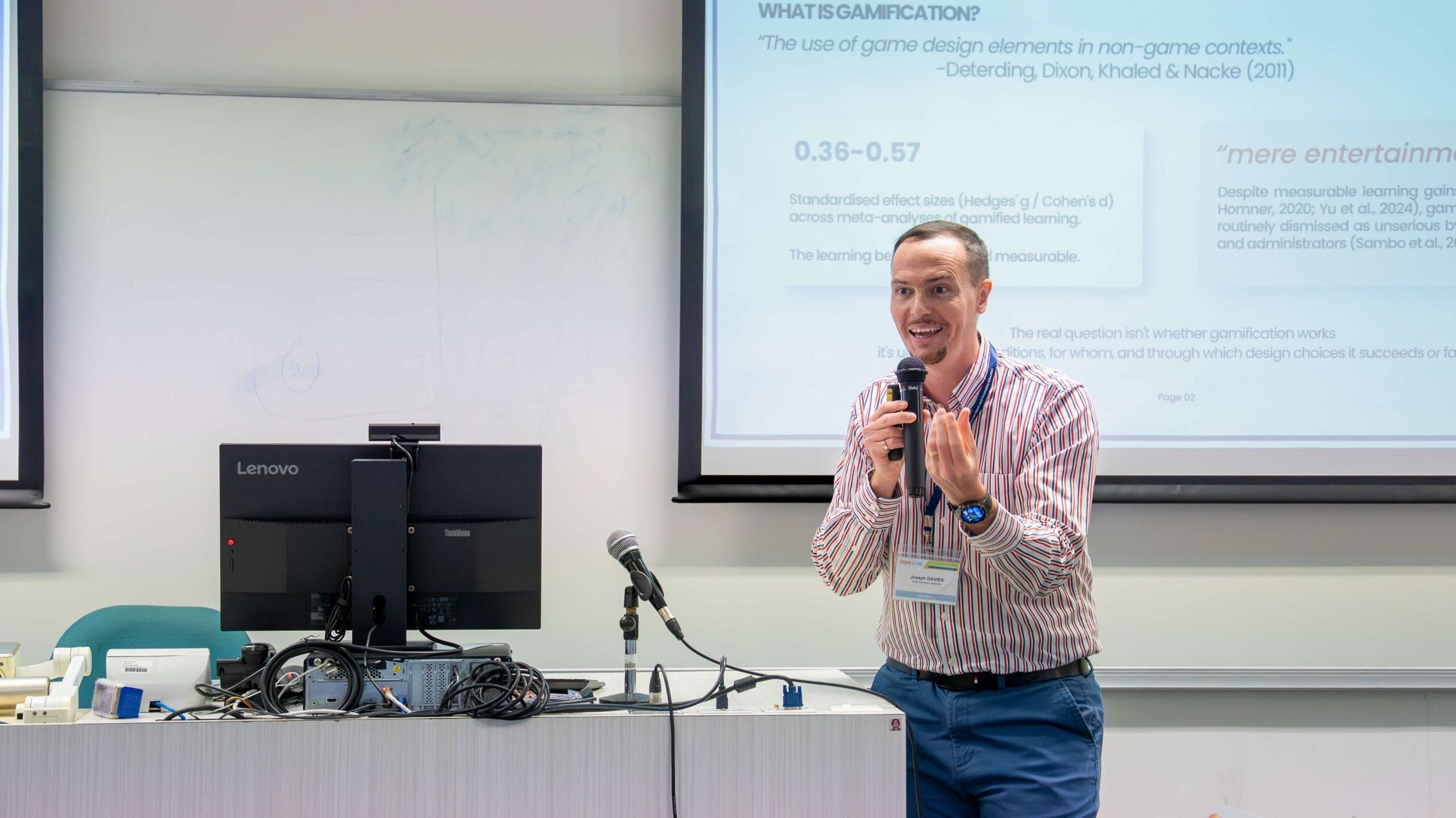
She came to me because she had an idea of using gamification to enhance education in Bangladesh, particularly because it could potentially be a simple, low-tech approach in settings with limited infrastructure and financial support. My own research is in feedback and assessment, and I saw a nice overlap with my work at DKU’s Institute for Global Higher Education. What I appreciated was that if she wanted to change education, she first needed to understand the literature. She wanted to read the research, understand the landscape, and figure out why gamification succeeds or fails before trying to implement it. That’s how we collaborated. I acted more as a guide and mentor. The idea and direction were already hers.
Why is gamification often dismissed as “not serious enough” for formal education?
I think it comes from the perceptions of different stakeholders. Learning is not only between teachers and students. Parents are very important stakeholders as well. If a parent asks their child what they did at school and hears “we played lots of games,” they probably don’t assume learning happened, even if those games were pedagogically well designed. It is the same with policymakers and curriculum developers who are focused on testing and memorization rather than application, which in a lot of cultures, China for example, is deeply tied to what “good education” is understood to mean. Our research tries to give the wider education community reasons why gamification should be legitimized, but it’s also honest about where gamification fails. We developed what we call the “Signals of Seriousness” framework, with 11 features that can help educators think through those challenges. We wanted the research to become a practical tool: if an educator wants to try gamification and has a particular problem, they can ask whether one of these signals can help address it.
What makes this question particularly interesting in the Chinese educational context, and at DKU specifically?
China has a deeply rooted, high-stakes assessment culture centered on the gaokao, which involves a lot of accuracy and memorization, but not as much application. In that context, gamification can easily look like a waste of time to parents who would rather see their child studying for the exam. So our argument is about under what conditions gamification could actually support gaokao preparation or help with memorization and internalization of content, rather than compete with it. I lead the Pedagogical Research and Practice Lab at DKU’s Institute for Global Higher Education, and Tanannum is joining this year as a research assistant, so we’re hoping to bring this work into DKU directly and experiment in that hybrid American-Chinese context to see where gamification can actually amplify learning.
What surprised you in conversations with DKU faculty, compared to what the literature shows?
Talking with faculty here is a much more practical, hands-on conversation than the literature. A lot of DKU faculty are already doing something that looks like gamification, but they’re often not communicating to students why they’re doing it, and they’re not tracking whether it’s actually improving learning outcomes. We’d love to build a community of practice at DKU where people share what’s working and what isn’t. There is also a fair critique from some corners of our liberal arts community: that gamification leans on extrinsic motivation, when liberal arts education is supposed to cultivate intrinsic motivation and love of the subject. Tanannum and I actually address that directly in the paper: real gamification should be sustainable. If you remove the gamified element and the student stops engaging, that’s a problem. We think that pushback is a good challenge for our context, and we welcome it.
What was the conference in Hong Kong like, and how was the paper received?
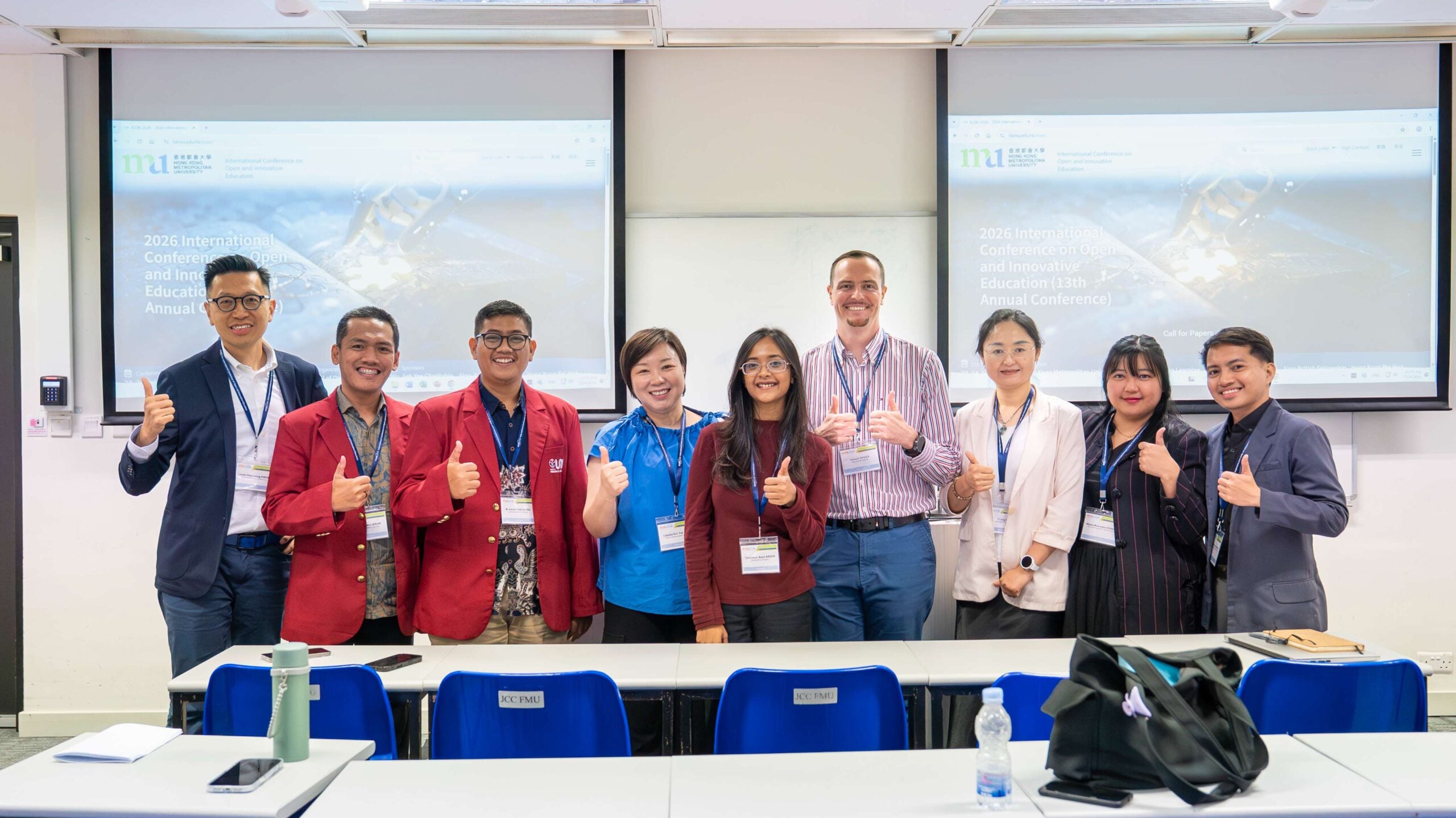
It was great. We presented at the International Conference on Open and Innovative Education, and even though a lot of the other papers were AI-focused, we ended up in a room with other gamification scholars from several different countries. The feedback was really good, people appreciated that this wasn’t just a literature review but a tangible tool for practitioners. What struck people most was that Tanannum completed this as a first-year student. I had to keep reminding the room that this was her paper. People were genuinely shocked, and it says a lot about her ability. My own research background is in feedback, and the leading scholar in that field, David Carless from the University of Hong Kong, was there. We had dinner with him, and he was extremely impressed with her. She did DKU proud.
How did the mentorship actually work, day to day?
We’ve been working together for about nine or ten months now, since around the end of 2025. It started as Tanannum’s independent undergraduate study, so we met once a week in person, plus email, WeChat, and a shared Box folder where I could see her notes and progress even between meetings. As we got closer to the conference, we met more often to prepare for the presentation. I also helped point her toward ICOIE. As faculty, part of the mentorship is knowing which conferences are reputable and which will put you in front of the right scholars, and this one fit our focus on innovative and open education well.
What’s next for the project?
Our first priority is getting the paper published, that would give the work more weight and validation before we reach out further. After that, I want to connect with NGOs here in China through my community-based learning work; I have a connection with the Amity Foundation, which has a large network of schools, and we’re particularly interested in low-income areas where gamification doesn’t have to mean AI or VR. Tanannum and I also have a follow-up project in the works, combining this with another line of my research on how classroom participation gets assessed and evaluated, which I’ve approached through a gamified lens myself. And I just want to acknowledge the CSCC for the funding and support thatt made this possible. We’re grateful, and we hope to keep building on it.