

By Eric-Ștefan Duma, Class of 2028
On August 28, Professor Shiyu Bo presented his research at Duke Kunshan University’s Economic Seminar. Professor Bo, who holds a PhD in Economics from the London School of Economics, studies development economics, political economy, and urban economics, with a particular focus on China. His presentation, titled “Beyond Performance and Patronage: Generational Labels and Left-Digit Bias in Chinese Political Selection,” examined whether seemingly small differences in officials’ birth dates can affect their career advancement through a phenomenon known as left-digit bias.
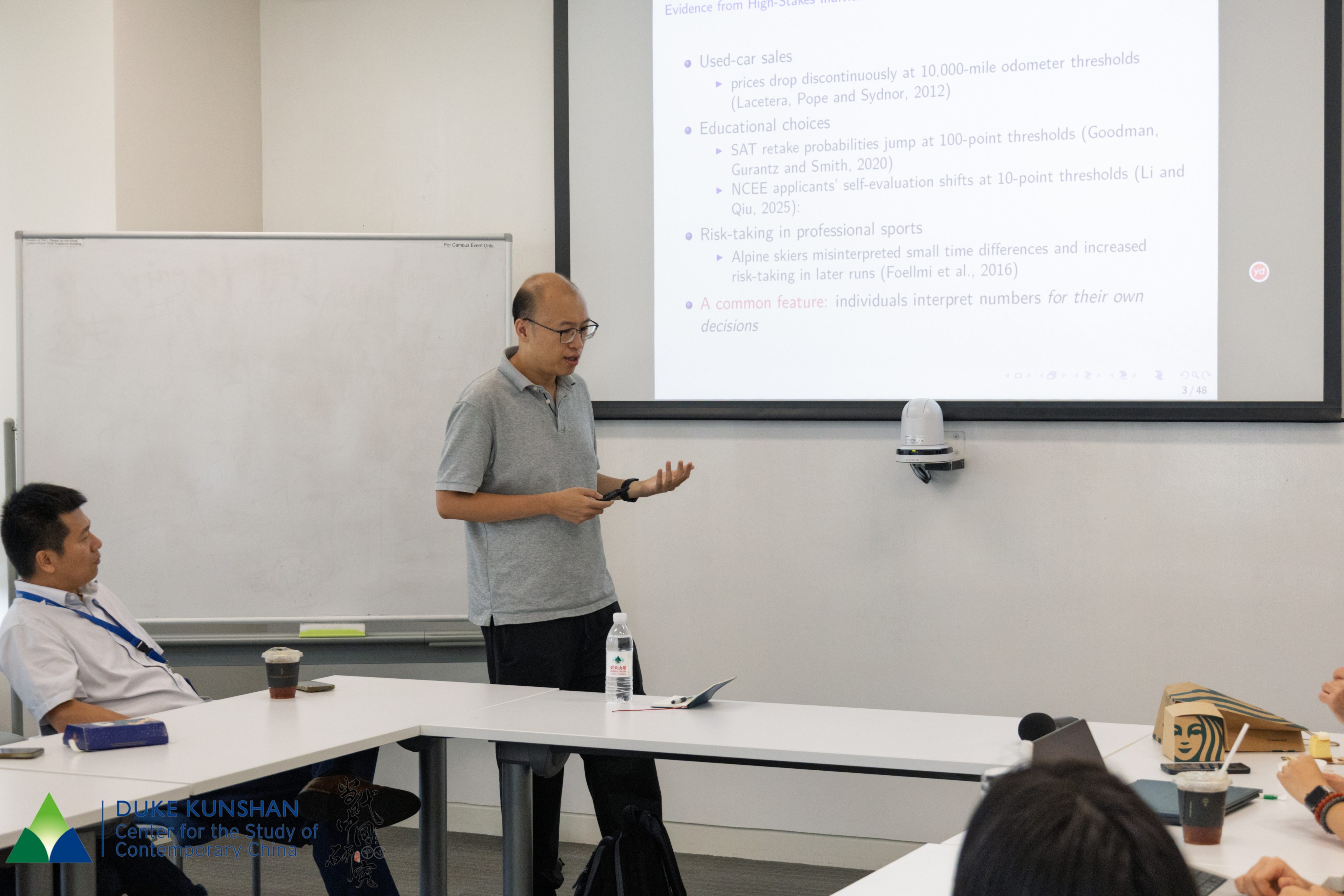
Left-digit bias refers to the tendency for people to place disproportionate weight on the leftmost digit of a number. For example, people may perceive a difference between values that cross a salient numerical threshold, even when the actual difference is small. Such effects have been observed in a range of settings, including used-car prices, exam scores, and sports performance.
Professor Bo’s research asks whether a similar phenomenon may affect the promotion of Chinese local government officials. More specifically, the study examines whether birth dates that place officials in different generational categories, such as the 1960s, 1970s, or 1980s, may influence their promotion prospects.
To investigate this question, the authors use the Chinese Political Elite Database, which contains information on the birthdays and career trajectories of more than 4,000 Chinese officials. Their analysis finds evidence that officials born after 1970 reach deputy-bureau and full-bureau ranks at younger ages than officials born after 1960.
The authors consider two possible explanations for this pattern. The first is an ability narrative, which suggests that officials born in the 1970s may differ in characteristics that help them advance more quickly. The second is a patronage narrative, which suggests that differences in political connections may contribute to faster career advancement among these officials. However, the observed effect appears to be limited to promotions within the bureau-level hierarchy and does not extend to appointments as the principal executive of a prefecture-level jurisdiction.
The seminar provided an opportunity to explore how behavioral biases and generational labels may interact with political institutions and career advancement in China.
This event was jointly organized by the Duke Kunshan University Division of Social Sciences and the Center for the Study of Contemporary China.