
By Violet Nguyen, Class of 2028
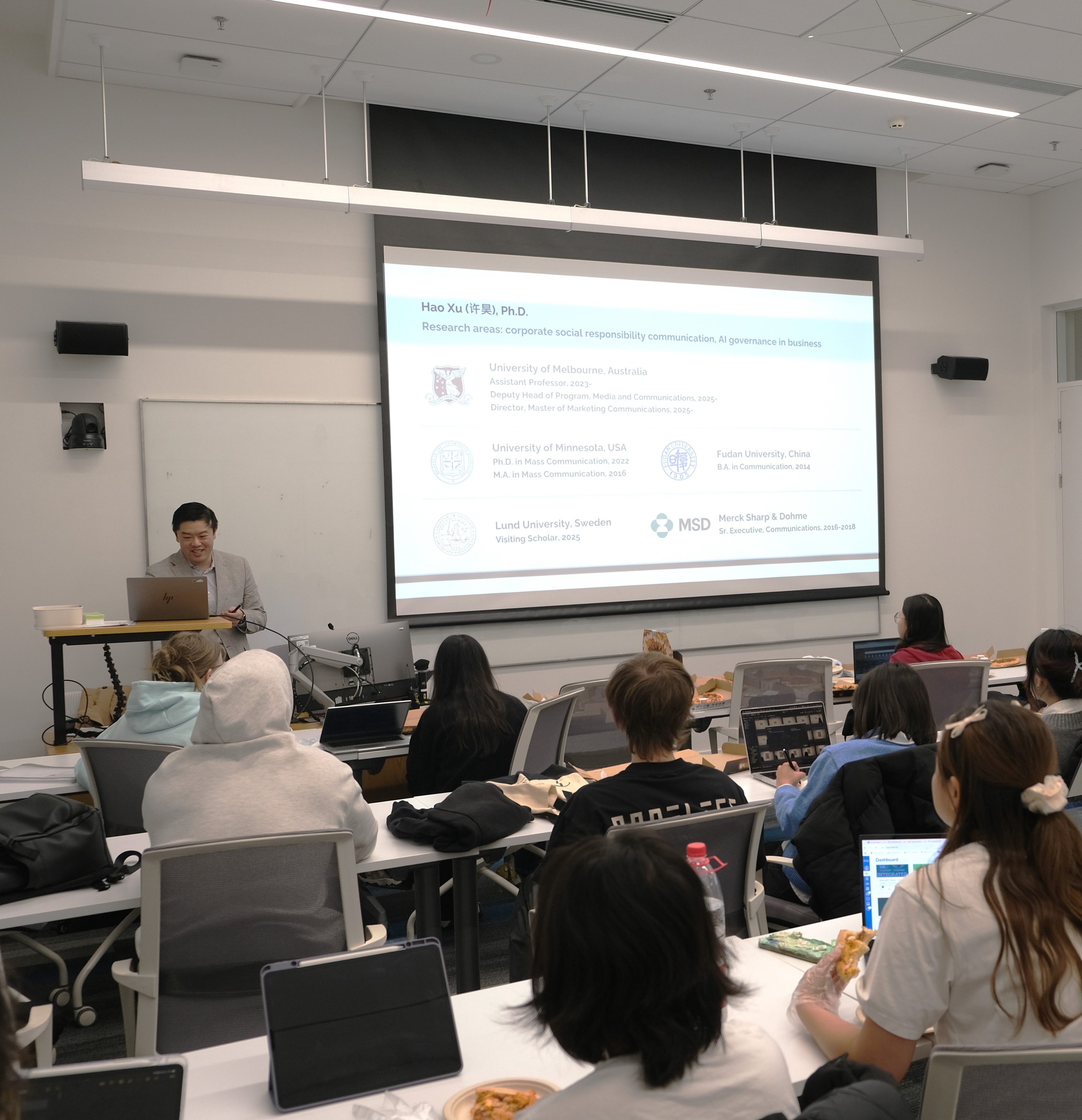
On November 25, 2025, the Center for the Study of Contemporary China (CSCC) and the Division of Social Sciences hosted Dr. Hao Xu, Assistant Professor in Media and Communications at the University of Melbourne, for an engaging research talk on corporate social advocacy (CSA). Drawing on empirical studies conducted across the United States, Australia, and the Asia-Pacific, Dr. Xu examined how corporations navigate contested social and political issues, and how publics evaluate such involvement. His talk highlighted the complex interplay between authenticity, value alignment, and stakeholder perception in shaping the outcomes of advocacy initiatives.
Dr. Xu opened by situating CSA within a broader trend in public relations and strategic communication. Over the past decade, corporations have faced increasing pressure from consumers and employees to take public stances on issues such as racial justice, climate change, and discrimination. Unlike traditional corporate social responsibility efforts focused on widely accepted goals like philanthropy or education, CSA involves explicit engagement with polarizing topics. This shift creates both opportunities for build stronger relationships with stakeholders and significant reputational risks, raising the central question of Dr. Xu’s work: how do publics interpret and respond to corporate advocacy efforts?
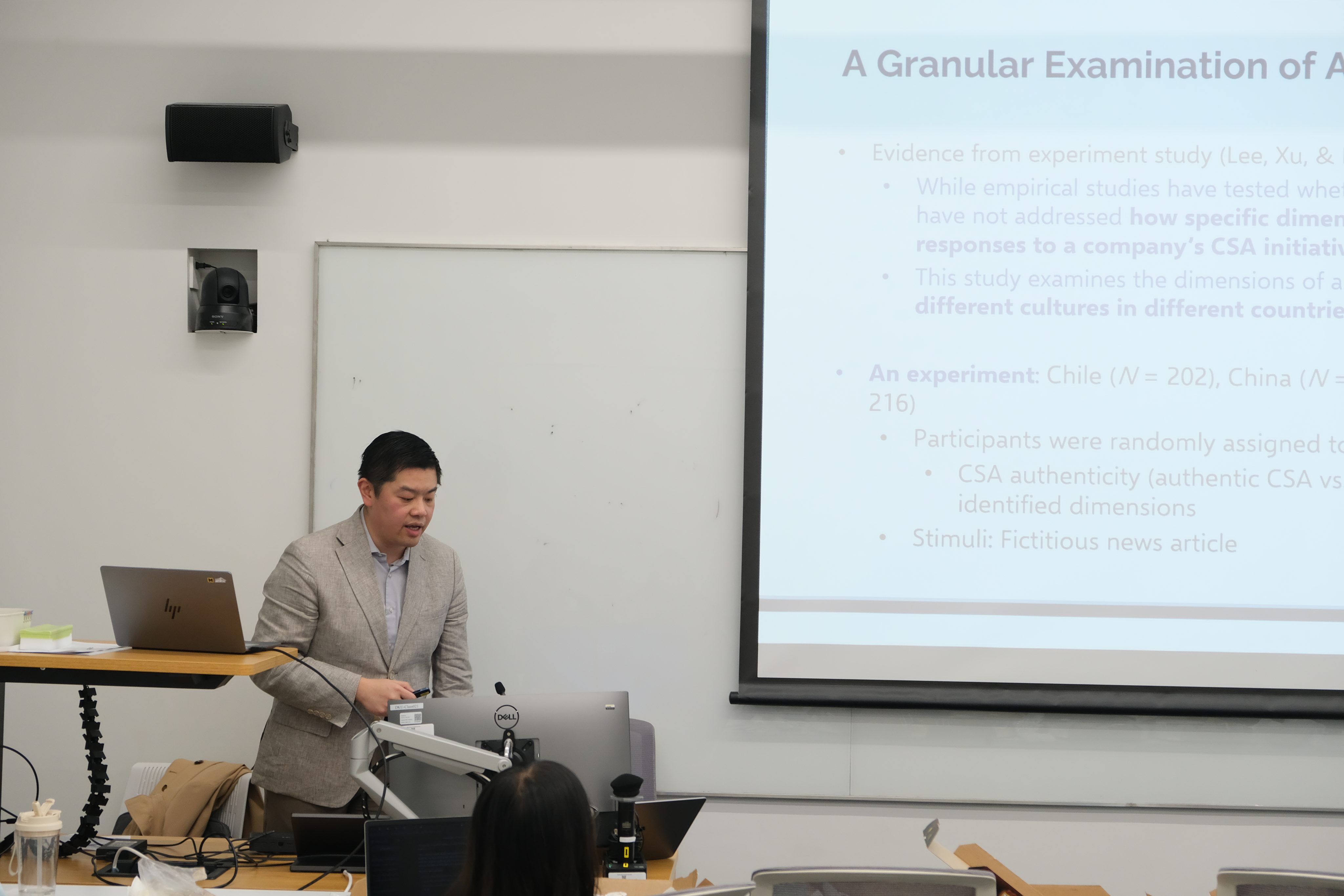
One of Dr. Xu’s core findings is that ideological alignment strongly shapes public reactions. When a company’s stance aligns with individuals’ beliefs, audiences respond more positively and are more likely to support the brand. However, when corporate positions conflict with personal values, negative reactions intensify. Importantly, the effects were strongest among individuals with strong ideological identities, suggesting the increasing politicization of corporate reputation.
Beyond ideological fit, Dr. Xu emphasized the strategic consistency companies demonstrate when engaging in CSA. Companies that take clear, coherent positions across multiple issues tend to reinforce their value identity, which strengthens supportive reactions but also deepens hostility among opponents. In contrast, inconsistent and selective advocacy often weakens impact and can trigger skepticism, as audiences perceive the company as opportunistic and insincere. Another study revealed that alliance strategies, such as establish new relationships or terminates existing ones with suppliers, collaborators or partners to align with their stance, are visible to the public and subject to their evaluation.
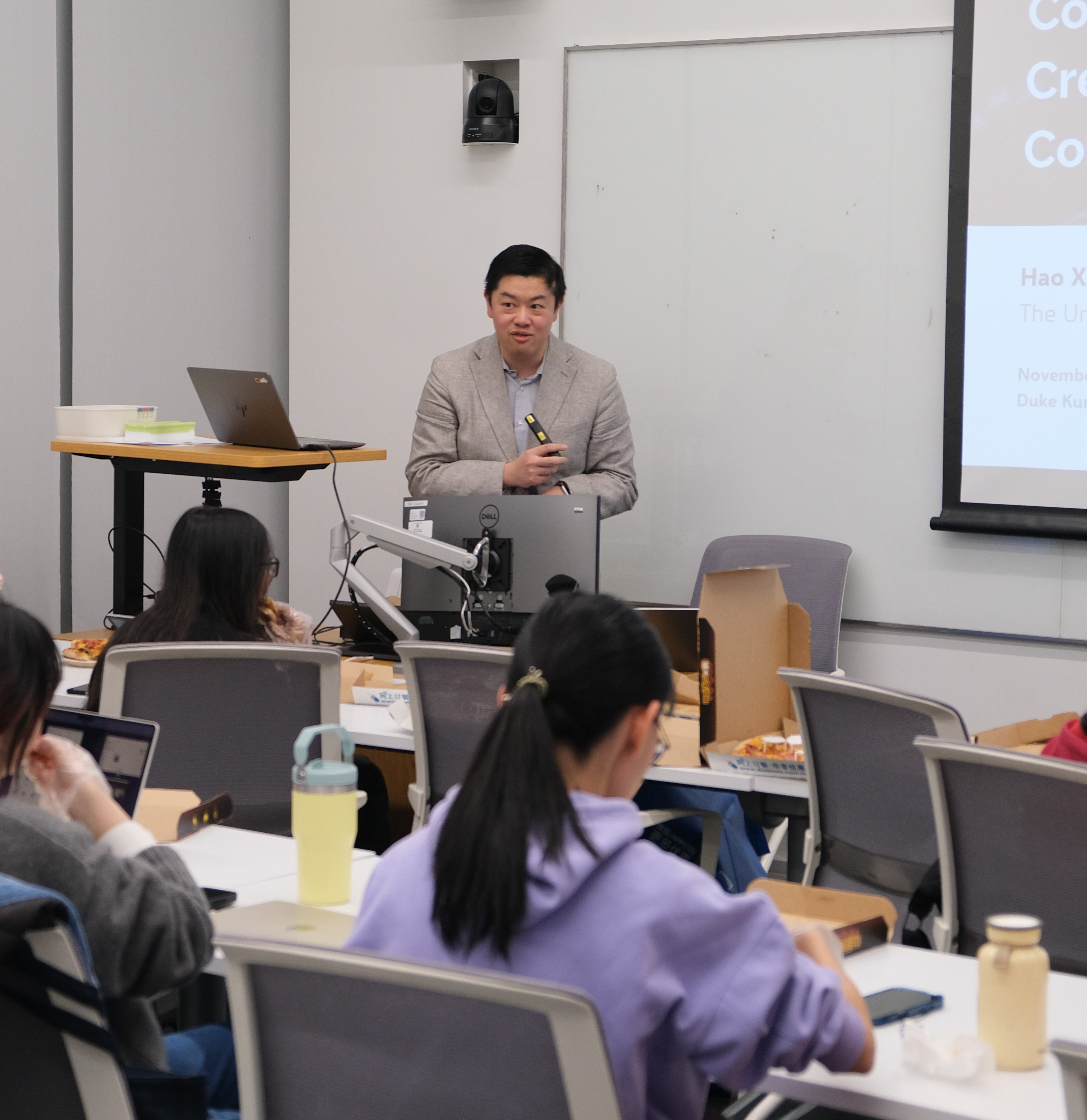
A growing focus of Dr. Xu’s research concerns authenticity, a theme widely discussed in industry and academic circles. Dr. Xu identified four elements that shape whether audiences view advocacy as genuine: alignment with core values, perseverance in the face of reputational risk, meaningful social impact, and consistency between words and actions. Importantly, he noted that these expectations differ across cultural contexts. In China and Chile, for example, audiences place greater emphasis on tangible societal contributions, whereas in the United States, perseverance in the face of backlash is viewed as a stronger indicator of authenticity. These differences suggest that multinational corporations cannot simply adopt a one-size-fits-all advocacy strategy.
Dr. Xu concluded by noting that CSA is becoming more complex as political climates shift. With declining support for corporate activism in some regions and rising geopolitical tensions globally, companies must navigate increasingly polarized social environments while seeking to remain socially relevant and trusted. He emphasized the need for future research to better understand cultural variation and the evolving roles of corporations in public life.
This event was organized by the Digital Technology and Society Cluster under the Center for the Study of Contemporary China and the Division of Social Sciences.