
By Violet Nguyen, Class of 2028
On April 14 2026, the CSCC and its Digital Technology and Society Cluster hosted Dr. Yuanyuan Qu, Associate Professor of Sociology and Anthropology at Minzu University of China, for a thought-provoking book talk titled Becoming Digital Citizens: Disability, ICTs, and Citizenship in Contemporary China. Drawing on extensive empirical research, Dr. Qu examined how disabled individuals in China engage with digital technologies to navigate social exclusion, assert their rights, and reshape the meaning of citizenship in a rapidly digitalizing society.
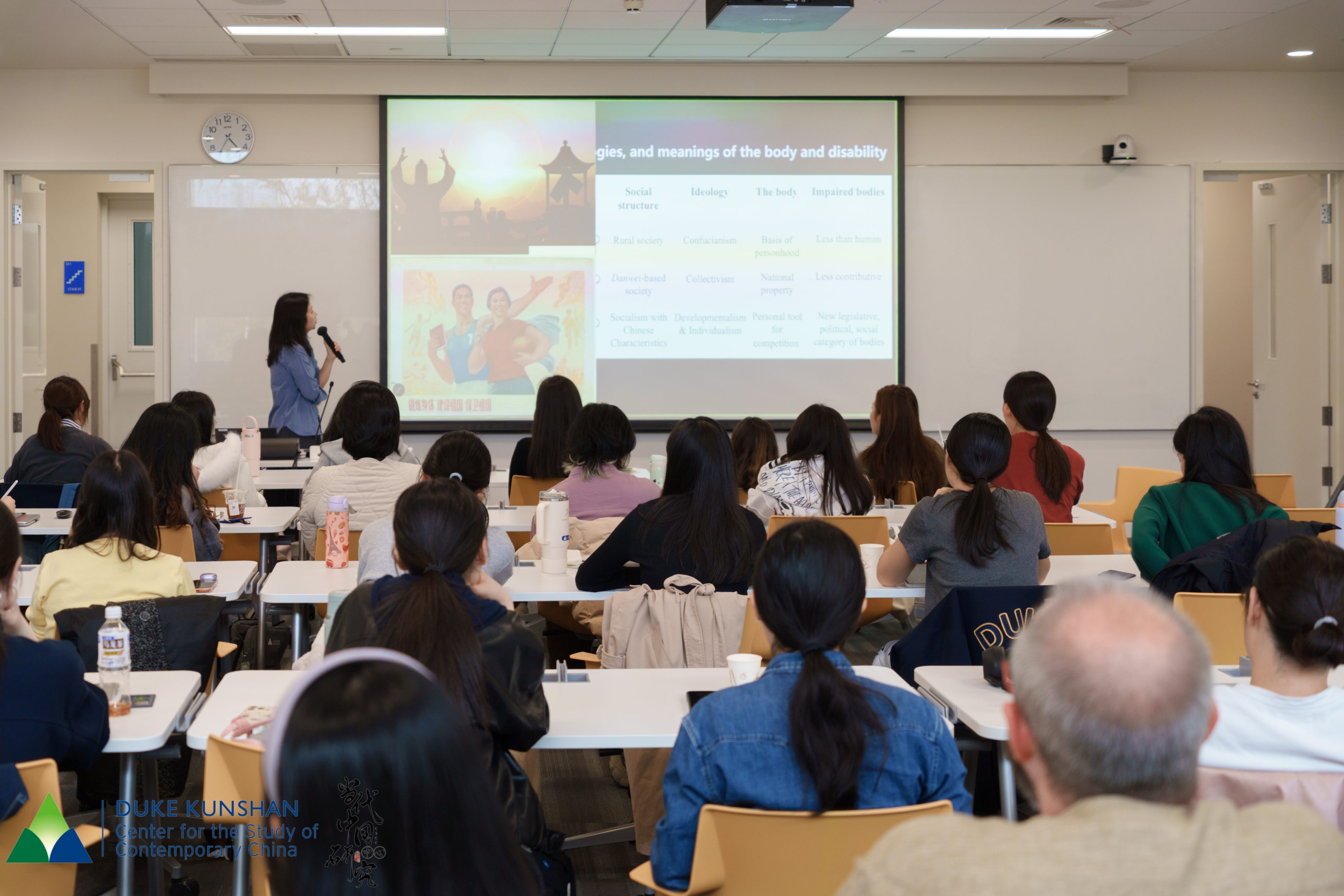
Dr. Qu opened by situating her research within disability studies, explaining the foundational distinction between “impairment” and “disability” as a socially constructed condition imposed through barriers in the built environment and social institutions. This perspective aligns with the “social model” of disability, which shifts attention away from individual limitations and toward the structural conditions that produce exclusion. Using the example of inaccessible infrastructure, Dr. Qu illustrated how disability emerges not simply from physical conditions but from the failure of society to accommodate diverse bodies.
She then turned to the specific context of China, tracing how understandings of the body and disability have shifted across historical periods: from Confucian ideals of bodily wholeness in traditional society, to collectivist and productivity-centered norms during the socialist era, to the more individualized but still statist citizenship of the reform and opening-up period. The official definition of disability in China, codified in law in 1991, remains highly medicalized, centering on organ function and “abnormality.” Despite this narrow definition, nearly 83 million people in China are classified as disabled, which is roughly 6.3% of the population. Dr. Qu described the citizenship status of disabled people in China as “blocked.” While laws and official discourse position disabled people as equal members of society deserving of rights and special care, these promises are rarely fulfilled in practice. Disabled people are largely excluded from political representation, marginalized in a labor market that prioritizes workability, and rendered invisible in public life.
The core of Dr. Qu’s talk focused on how digital technologies and the internet have created new spaces for participation and agency. She demonstrated how disabled individuals use online platforms to form communities, share everyday experiences, and challenge dominant representations. Early internet forums and contemporary social media spaces enable users to connect with others facing similar challenges, transforming isolated personal struggles into collective identities.
In the economic realm, Dr. Qu explored how digital platforms have opened new, although limited, employment opportunities. Many disabled individuals engage in forms of digital labor such as online customer service or game-based work. While these jobs lower barriers to entry, they are often low-paying and labor-intensive, raising concerns about the reproduction of marginalization within the digital economy. Nevertheless, participation in digital work allows individuals to claim social value and assert their role as contributing members of society, which carries particular significance in a context where citizenship is closely tied to productivity.
Dr. Qu also highlighted the emergence of digital activism and political participation. Through blog posts, online discussions, and coordinated campaigns, disabled individuals have raised awareness about inequality and advocated for policy changes. She provided the example of an online movement that successfully pushed for reforms allowing people with certain physical disabilities to obtain driving licenses. This case illustrated how digital engagement can evolve from individual expression into collective action, demonstrating the potential of online spaces to generate tangible social change.
Beyond economic and political participation, digital platforms have also enabled the reconfiguration of disability identity and culture. Disabled creators and organizations are increasingly producing their own narratives that challenge stereotypical media portrayals and reclaim control over representation. However, Dr. Qu noted that these developments also bring internal tensions, particularly around issues of authenticity and commercialization, reflecting the complex dynamics of visibility in the digital age.
In conclusion, Dr. Qu emphasized both the transformative potential and the limitations of digital technologies. While online spaces have expanded opportunities for visibility, participation, and advocacy, they do not fully resolve structural inequalities. Instead, digital practices represent an ongoing process through which disabled individuals negotiate their position within society and gradually reshape the meaning of citizenship from the ground up.