

By Zihan Chen, Class of 2026
On November 28, 2025, the CSCC Governing China Cluster hosted Songpo Yang, a Ph.D. candidate in the Department of International Relations at Tsinghua University, for a captivating lecture on the subtle influence of facial appearances in China’s bureaucratic selection processes. Yang’s presentation challenged the notion of purely rational, merit-based bureaucracies by revealing how intuitive judgments of external traits shape career trajectories in authoritarian systems.
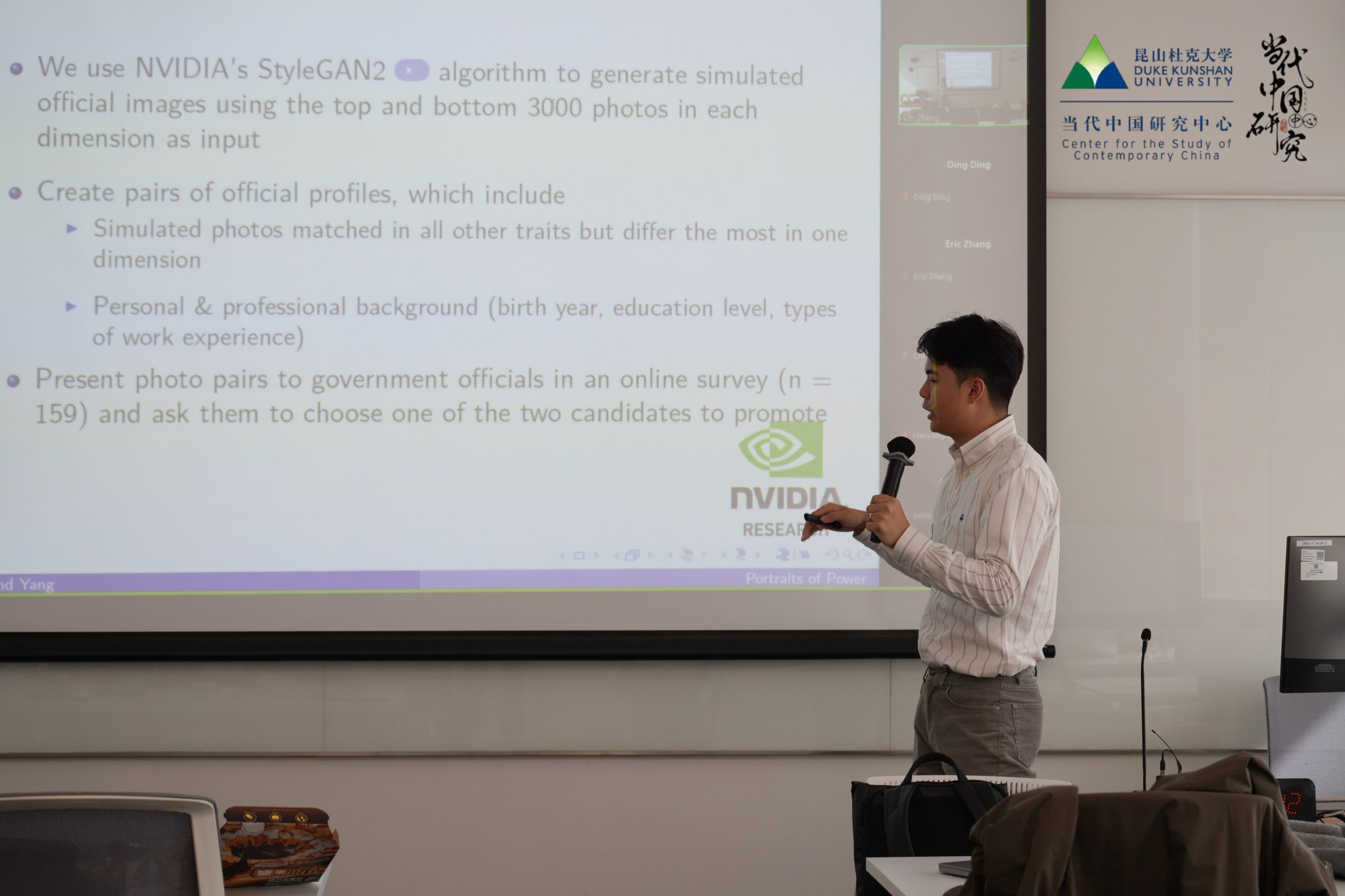
He began by framing bureaucracies as epitomes of modern rationality, where selections are presumed to hinge on rules, performance, and connections. Yet, he argued, instinctive assessments of candidates’ appearances often underpin these decisions, extending beyond electoral contexts to civilian hierarchies like China’s vast officialdom. To test this, the researchers developed a novel AI-based algorithm trained on human-labeled facial images to generate scalable ratings for four key perceptual traits: competence, trustworthiness, attractiveness, and aggressiveness. Applied to over 4,000 mid- and senior-level Chinese officials, the model predicted human judgments with high fidelity, enabling rigorous analysis of how these traits correlate with promotions (to higher ranks) and purges (disciplinary actions like corruption charges).
The core findings, vividly illustrated through regression tables and survival curves from the paper, demonstrated that officials perceived as more competent, trustworthy, and less aggressive consistently enjoy superior promotion prospects—up to a 10–15% higher likelihood—and reduced purge risks compared to peers. Warmth-related traits (trustworthiness and non-aggressiveness) proved particularly prized in higher-stakes advancements, such as from prefecture to deputy provincial levels, and were more influential for male candidates, reflecting gendered biases in selection. Attractiveness showed a nuanced “moderate beauty” premium: appealing but not overly imposing looks correlated with gains, while extremes yielded diminishing returns. These patterns held robustly across robustness checks, including controls for facial similarity to top leaders, image quality metrics, and alternative rating methods (median vs. mean human scores).
To gauge causal impact, Yang also highlighted conjoint experiments conducted with real government officials, where participants chose promotion candidates varying randomly across traits, performance metrics (e.g., GDP growth), and connections (e.g., elite university ties). As a result, facial warmth and competence rivaled these traditional factors in sway, while high-rated officials climb ranks faster and evade purges longer. Clustered by birth city for standard errors, these challenge meritocratic and guanxi (relation-based) theories, suggesting impressions form a “tacit domain” in institutional workings, potentially sustaining public trust through curated leadership images.
Yang also addressed broader implications, noting how such biases might reinforce regime stability by favoring approachable figures amid economic pressures, yet risk entrenching inequalities. The lecture sparked animated Q&A discussions on AI ethics in social science, cross-cultural parallels, and policy reforms for fairer selections. Enriched by the paper’s appendices, Yang’s accessible delivery blended technical rigor with anecdotes while demystifying a provocative intersection of psychology, AI, and politics, inviting attendees to reconsider the “faces” behind China’s power.
After the lecture, students and faculty continued with conversation with Yang, proposing that adding historical figures could deepen comparative insights and that the methodology could be extended to other research areas. Their exchange highlighted the broader relevance of Yang’s approach for studying decision-making across different contexts.
This event is part of the Guest Lecture Series of the Governing China Cluster under the Center for the Study of Contemporary China.