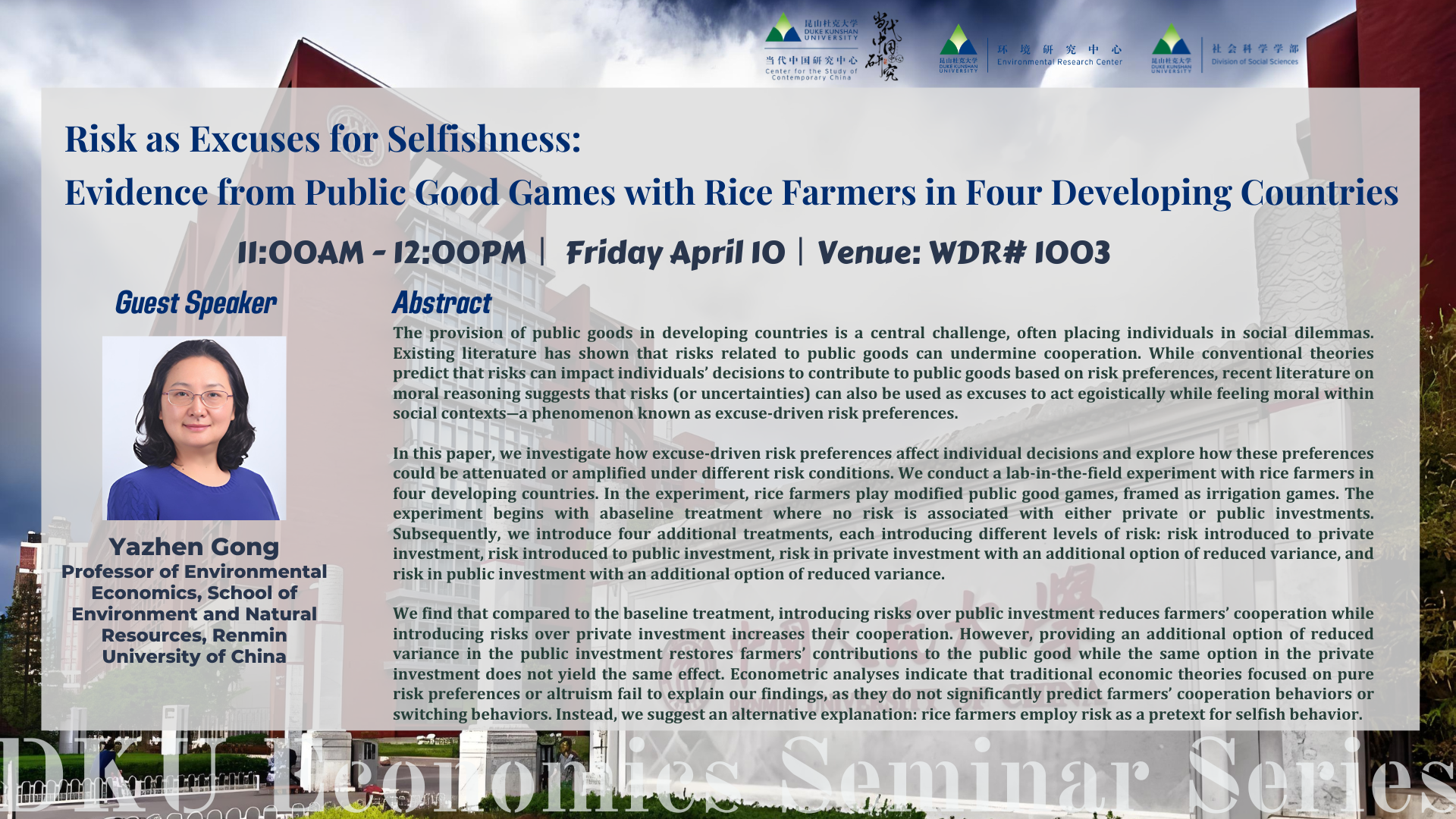

Time: 11AM – 12PM, Friday, April 10
Venue: WDR 1003
Guest Speaker: Yazhen Gong, Professor of Environmental Economics, School of Environment and Natural Resources, Renmin University of China
Abstract:
The provision of public goods in developing countries is a central challenge, often placing individuals in social dilemmas. Existing literature has shown that risks related to public goods can undermine cooperation. While conventional theories predict that risks can impact individuals’ decisions to contribute to public goods based on risk preferences, recent literature on moral reasoning suggests that risks (or uncertainties) can also be used as excuses to act egoistically while feeling moral within social contexts―a phenomenon known as excuse-driven risk preferences.
In this paper, we investigate how excuse-driven risk preferences affect individual decisions and explore how these preferences could be attenuated or amplified under different risk conditions. We conduct a lab-in-the-field experiment with rice farmers in four developing countries. In the experiment, rice farmers play modified public good games, framed as irrigation games. The experiment begins with a baseline treatment where no risk is associated with either private or public investments. Subsequently, we introduce four additional treatments, each introducing different levels of risk: risk introduced to private investment, risk introduced to public investment, risk in private investment with an additional option of reduced variance, and risk in public investment with an additional option of reduced variance.
We find that compared to the baseline treatment, introducing risks over public investment reduces farmers’ cooperation while introducing risks over private investment increases their cooperation. However, providing an additional option of reduced variance in the public investment restores farmers’ contributions to the public good while the same option in the private investment does not yield the same effect. Econometric analyses indicate that traditional economic theories focused on pure risk preferences or altruism fail to explain our findings, as they do not significantly predict farmers’ cooperation behaviors or switching behaviors. Instead, we suggest an alternative explanation: rice farmers employ risk as a pretext for selfish behavior.
Speaker’s bio:
Dr. Yazhen Gong is a professor of environmental economics within the School of Environment and Natural Resources, Renmin University of China. She served as the position of Vice President of the Asian Association of Environmental and Resource Economics (AAERE) during 2023-2025. She is currently a board member of the Chinese Association of Environment and Resource Economists (CAERE). Dr. Gong obtained her doctoral degree from University of British Columbia and her master’s degree from University of the Philippines.
Her primary research area is environment and natural resource economics, with a specific emphasis on the economic dimensions of natural resource and environmental governance. She possesses extensive proficiency in conducting household surveys and field experiments aimed at investigating human behaviors related to natural resource management and environmental protection. Her works has been published in high-quality economics journals such as Journal of Environmental Economics and Management, Land Economics, Ecological Economics and Agricultural Economics, as well as interdisciplinary journals including PNAS and Climatic Change.