
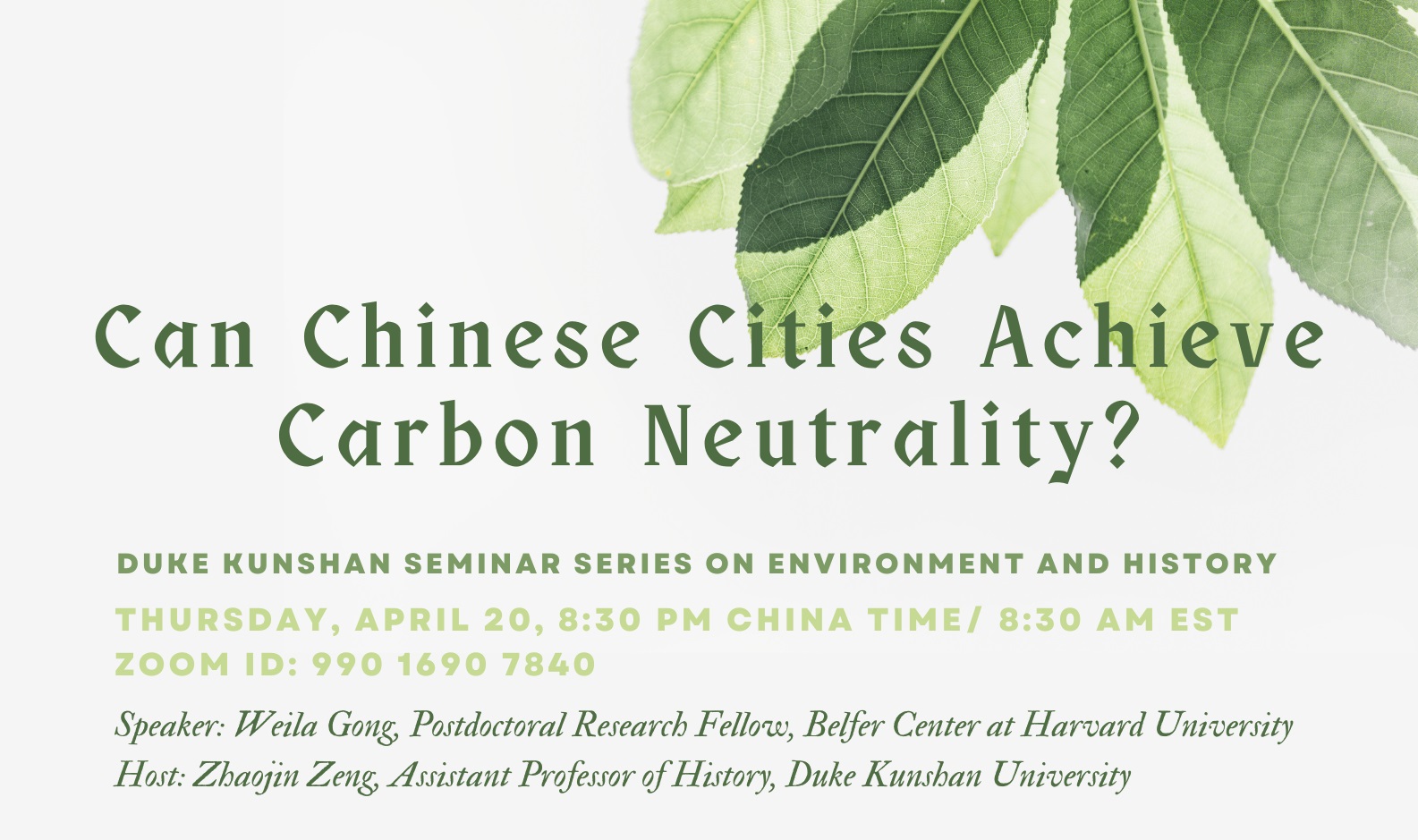

Date and time: 8:30 PM BJT (8:30 AM EST), Thursday, April 20
Speaker: Weila Gong, Postdoctoral Research Fellow, Belfer Center at Harvard University
Host: Zhaojin Zeng, Assistant Professor in Economic and Business History, Duke Kunshan University
Zoom ID: 990 1690 7840
Abstract:
As the world’s largest carbon emitter and arguably the most important player in addressing climate change, China plays a particularly important role in influencing global efforts to deal with climate change as well as the overall direction of low-carbon energy transitions around the world. Cities account for 85 percent of the country’s total carbon emissions. Yet, in addition to the well-known importance of national climate and environmental policy implementation, local governments have engaged in a wide range of policy experiments that will have a major impact on China’s ability to achieve its carbon neutrality goals. These include low-carbon province and city experimental programs, carbon emissions trading systems, green finance, green building, low-carbon pilot communities, and low-carbon pilot industrial parks. Local areas and regions, however, are pursuing low-carbon energy transitions with varying levels of commitment and different implementation strategies. This talk explores why Chinese cities have taken such divergent approaches to low-carbon energy transitions.
Biography:
Weila Gong is a Postdoctoral Research Fellow with the Belfer Center’s Environment and Natural Resources Program and the Science, Technology, and Public Policy Program at Harvard Kennedy School. Her research explores comparative climate and environmental policy and politics, with a focus on China’s low-carbon energy transition, low-carbon cities, and greening the Belt and Road Initiative (BRI). Gong’s book project, “Climate Leadership in Chinese Cities,” examines why some Chinese cities are doing better than others in initiating and implementing low-carbon policy experiments. Her work has appeared in the journal China Quarterly. Gong holds a Ph.D. in Political Science from the Technical University of Munich’s School of Governance. She also holds a Master’s degree in International Relations and a Bachelor’s degree in History from Sun Yat-sen University, China.
This event is organized by the Environmental Research Center and the Center for the Study of Contemporary China.