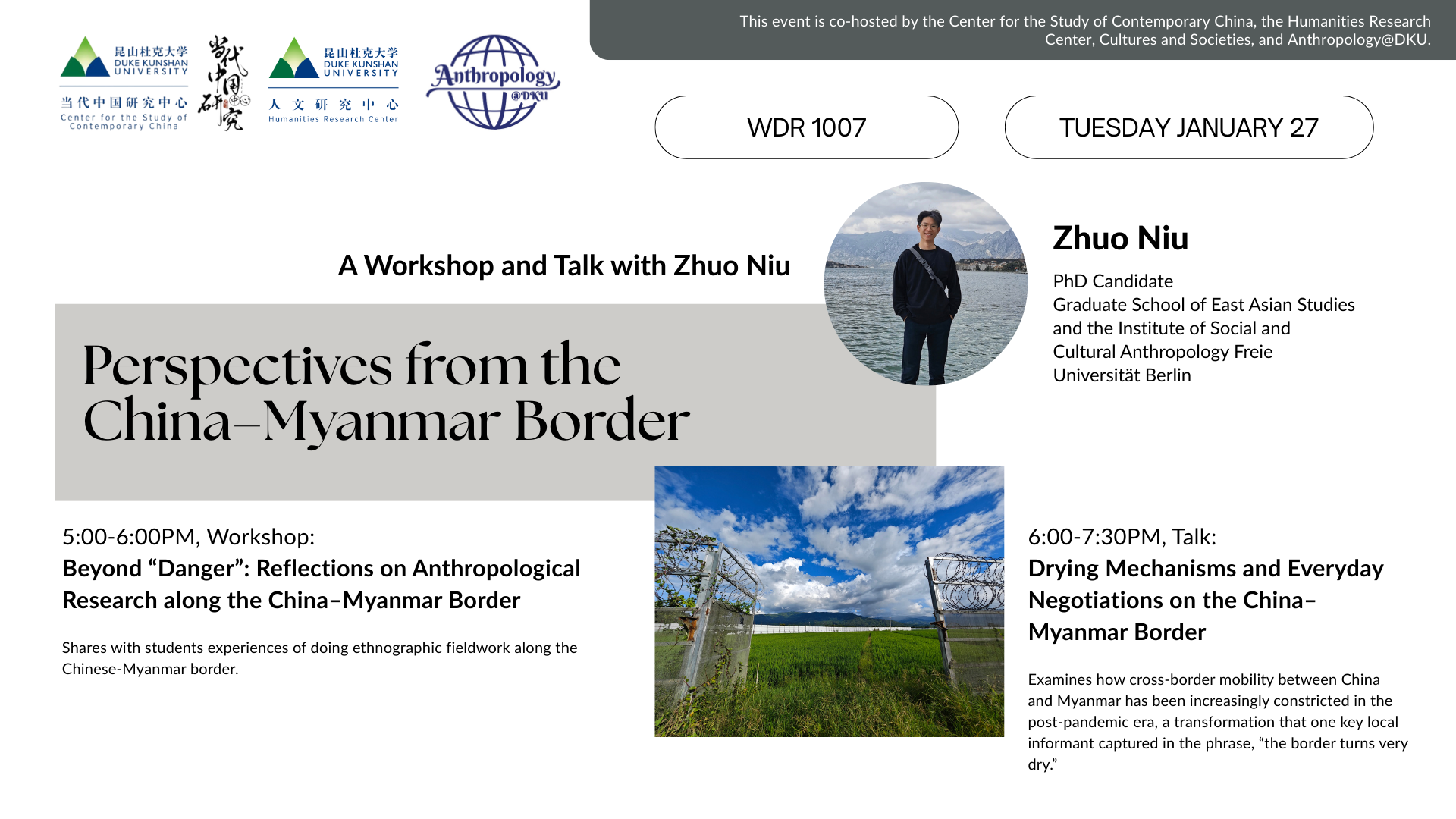
Time: 6:00-7:30PM
Date: Tuesday January 27
Location: WDR 1007
Speaker: Zhuo Niu, PhD candidate at the Graduate School of East Asian Studies and the Institute of Social and Cultural Anthropology, Freie Universität Berlin
This event is co-hosted by the Center for the Study of Contemporary China, the Humanities Research Center, Cultures and Societies, and Anthropology@DKU.
Abstract:
Borders are commonly analyzed through the lens of porosity, namely, the flow of people, goods, and exchanges across territorial lines. In this talk, I shift the focus to an inverse yet equally critical process: drying. Drawing on extensive fieldwork in a major border city on the China-Myanmar frontier, I examine how cross-border mobility has been increasingly constricted in the post-pandemic era, a transformation that one key local informant captured in the phrase, “the border turns very dry.” Essentially, this “drying” is not a singular policy event but the result of layered “drying mechanisms.” These mechanisms entail, first, the material reconfiguration of border infrastructures during and after the pandemic; second, evolving documentation regimes that selectively filter migrant mobility; and third, administrative extensions that pull border governance deeper into post-entry social and economic life, particularly in labor management.
Speaker’s Bio:
Zhuo Niu is a PhD candidate at the Graduate School of East Asian Studies and the Institute of Social and Cultural Anthropology, Freie Universität Berlin. His doctoral research examines post-pandemic border transformations along the China–Myanmar border, with a focus on infrastructural and regulatory changes as well as local narratives and everyday practices of mobility. His broader research interests include borders, mobility, migration, labor, the COVID-19 pandemic, China, and post-coup Myanmar. Prior to his PhD, he completed two master’s degrees in anthropology and cultural studies at KU Leuven, both graduating magna cum laude.