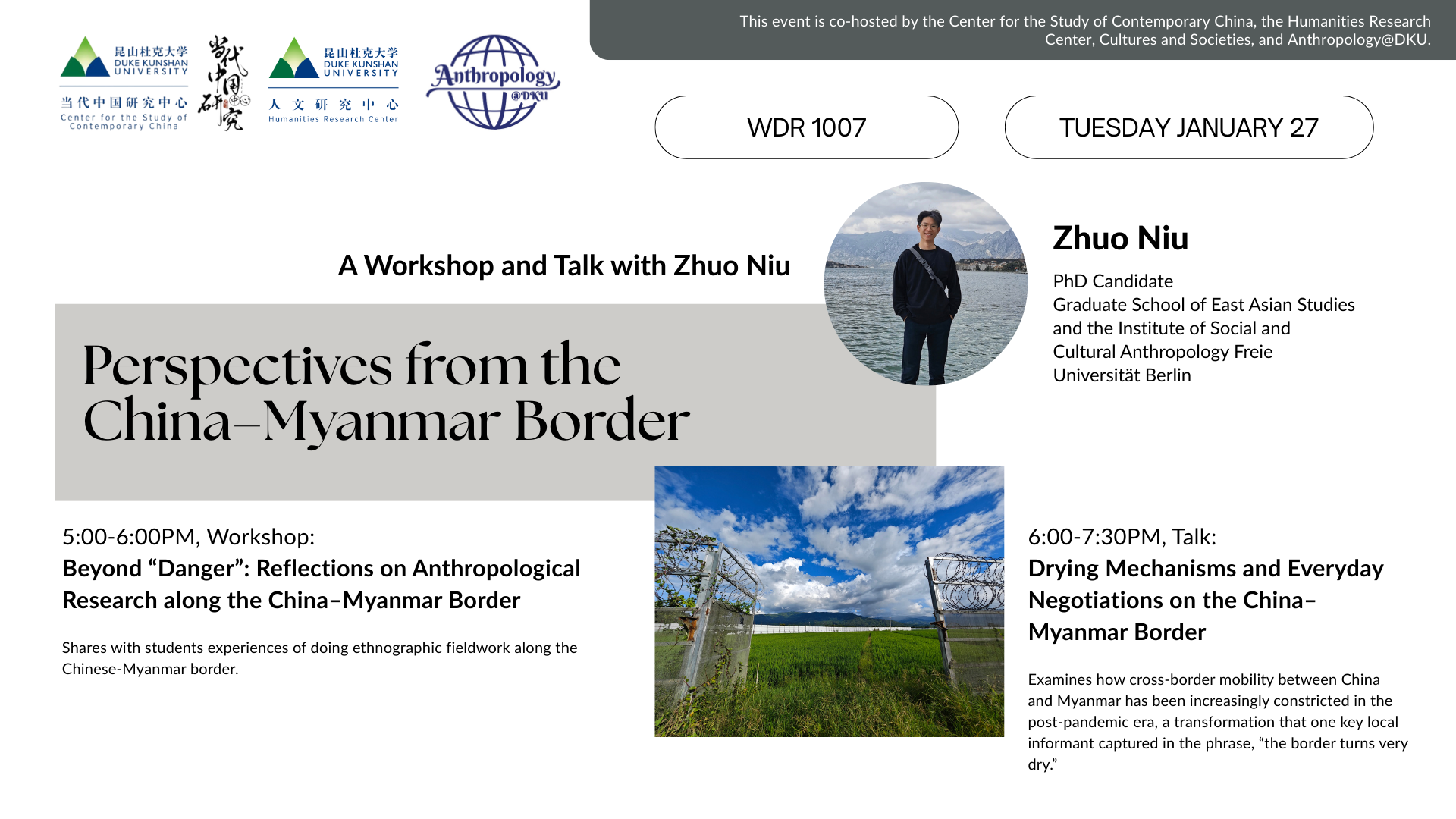

Time: 5:00-6:00PM
Date: Tuesday January 27
Location: WDR 1007
Speaker: Zhuo Niu, PhD candidate at the Graduate School of East Asian Studies and the Institute of Social and Cultural Anthropology, Freie Universität Berlin
This event is co-hosted by the Center for the Study of Contemporary China, the Humanities Research Center, Cultures and Societies, and Anthropology@DKU.
Abstract:
In recent years, the China–Myanmar border has frequently been portrayed on social media as a “dangerous” region, particularly northern Myanmar, which is seemingly often associated with telecom fraud, armed conflict, and instability.But what does it actually mean to conduct fieldwork, namely, long-term, immersive qualitative research, in such a borderland context? This workshop draws on my doctoral fieldwork conducted in a border city in Yunnan Province. Over ten months of research, I employed anthropological methods to examine cross-border movements of people and goods, local economic dynamics, and migrant labor markets. Contrary to popular representations, my research experience suggests that “danger” is often a secondary reproduction of stereotypes. The more persistent challenge lay in how, as an outsider-researcher with few pre-existing local connections, one could establish initial social relationships and build a viable research base.
The workshop centers on three interrelated methodological issues. First, it reflects on the positionality of the outsider-researcher, framing fieldwork as a process of social learning, emotional labor, and ethical negotiation rather than mere data collection. Second, it conceptualizes sensitivity as a relational and shifting condition, demonstrating how access to people, places, and information is shaped by interlocutors’ perceptions and broader political and commercial environments. Third, it explains the adoption of a micro multi-sited fieldwork, showing how fragmented access, unstable field relations, and spatial mobility required methodological flexibility. Overall, the workshop highlights how reflexivity and an ethics of care become central to conducting research in such a border region.
Speaker’s Bio:
Zhuo Niu is a PhD candidate at the Graduate School of East Asian Studies and the Institute of Social and Cultural Anthropology, Freie Universität Berlin. His doctoral research examines post-pandemic border transformations along the China–Myanmar border, with a focus on infrastructural and regulatory changes as well as local narratives and everyday practices of mobility. His broader research interests include borders, mobility, migration, labor, the COVID-19 pandemic, China, and post-coup Myanmar. Prior to his PhD, he completed two master’s degrees in anthropology and cultural studies at KU Leuven, both graduating magna cum laude.

Duke Kunshan University 苏ICP备16021093号