

By Violet Nguyen, Class of 2028
On February 3, 2026, the CSCC Digital Technology and Society cluster hosted Dr. Ning Leng, Assistant Professor at the McCourt School of Public Policy at Georgetown University, for a thought-provoking lecture on state–business relations in China. Drawing on her recently published book “Politicizing Business: How Firms Are Made to Serve the Party-State in China”, Dr. Leng explored why tensions between the Chinese state and private firms persist despite decades of market-oriented reforms.

Dr. Leng began by addressing a widely held view in existing literature: that since the 1990s, the Chinese state and private sector have developed a relatively stable and cooperative relationship. She outlined efforts introduced by the state to improve the business environment, including legal reforms, administrative streamlining, and anti-corruption efforts. At the same time, private firms have actively adapted to China’s political context by cultivating ties with government officials, joining the Communist Party, participating in representative institutions, and contributing to state-led initiatives.
However, Dr. Leng pointed out that this apparent stability is often disrupted by sudden state crackdowns on private firms. Recent regulatory actions targeting sectors such as technology, education, and finance have renewed debate over whether the Chinese state is becoming more hostile toward private enterprise. Dr. Leng argued that such interventions are not new, nor do they signal a fundamental reversal of policy. While large, nationwide crackdowns largely stopped after the private sector was formally recognized in the constitution in 1993, the state has continued to intervene in specific industries when political interests are at stake.
A key concept in Dr. Leng’s research is the “politicization of business.” She explained that firms in China are often expected to provide political support to the state, in addition to producing economic value. One important form of this support is participation in what she called “visibility projects.” These are large and highly visible projects, such as infrastructure or urban development initiatives, that help local officials demonstrate competence and gain recognition from higher-level authorities. Drawing on empirical examples, Dr. Leng demonstrated that these projects often prioritize speed and symbolic value over efficiency or long-term sustainability.
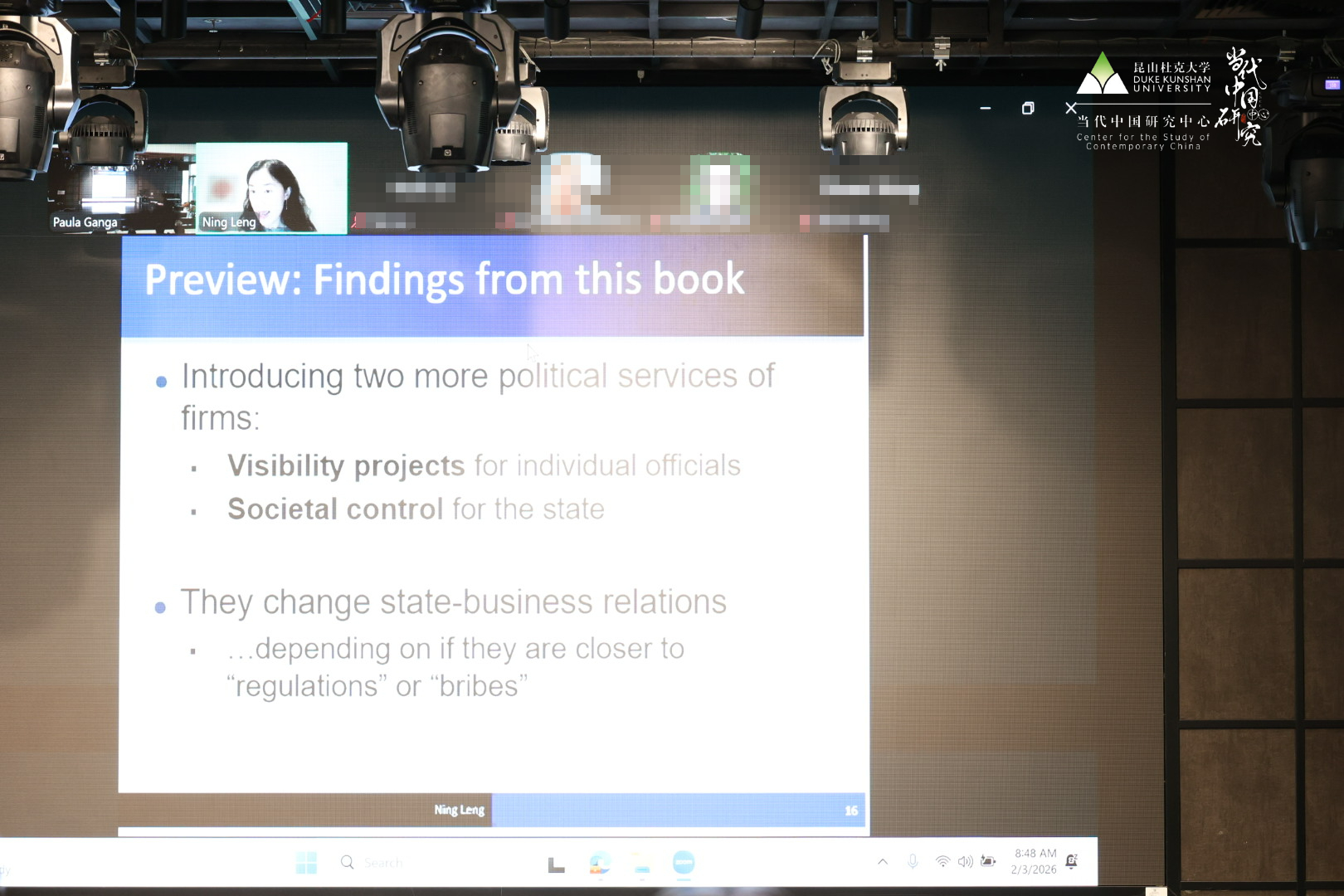
Dr. Leng noted that while local governments benefit politically from these projects, firms are often required to bear the financial costs. This arrangement places private enterprises at a disadvantage, as they face budget constraints and limited access to state support. State-owned enterprises, by contrast, are better able to handle losses due to access to credit and government backing. As a result, private companies often struggle to survive in sectors where visibility projects become common.
To illustrate this dynamic, Dr. Leng compared China’s urban bus sector with the solid waste management industry. In the bus sector, growing demands for expensive and unnecessary upgrades placed heavy pressure on private operators. When private firms resisted or failed to comply, local governments increasingly replaced them with state-owned enterprises. In contrast, private firms were more likely to remain in the waste management sector, especially when governments relied on negotiation and compensation to address public opposition.
Dr. Leng also discussed the role of firms in maintaining social stability, especially in politically sensitive industries where public protests are common. Depending on whether local governments believe protests can be resolved through financial compensation or require coercive enforcement, they may favor private firms or large state-owned enterprises. These choices further shape who is able to operate in politically sensitive sectors.
The talk concluded with a discussion moderated by Dr. Andrew Cheon, during which participants reflected on the broader implications of Dr. Leng’s research for understanding China’s political economy. Overall, the lecture highlighted how political incentives, rather than the market alone, play a central role in shaping state–business relations in China.