

Report by: Zihan Chen | Photography by: Yiwen Chen
On April 10, 2026, the CSCC hosted Dr. Sophie Ping Sun, Associate Professor at the Chinese Academy of Social Sciences and visiting scholar at the University of Oxford, for a lecture titled Food Delivery Workers and Their Algorithmic Labor in the Platform Economy. The event drew on Dr. Sun’s decades of interdisciplinary research on the platform economy, digital labour, AI and social development, as well as her influential book Transitional Labour: Food-Delivery Workers in the Platform Economy of China. Through ethnographic fieldwork and first-hand data collection, Dr. Sun’s talk unpacked the dual nature of algorithms as both technical systems and social power structures, while centering the lived experiences of food delivery workers navigating platform governance in contemporary China.
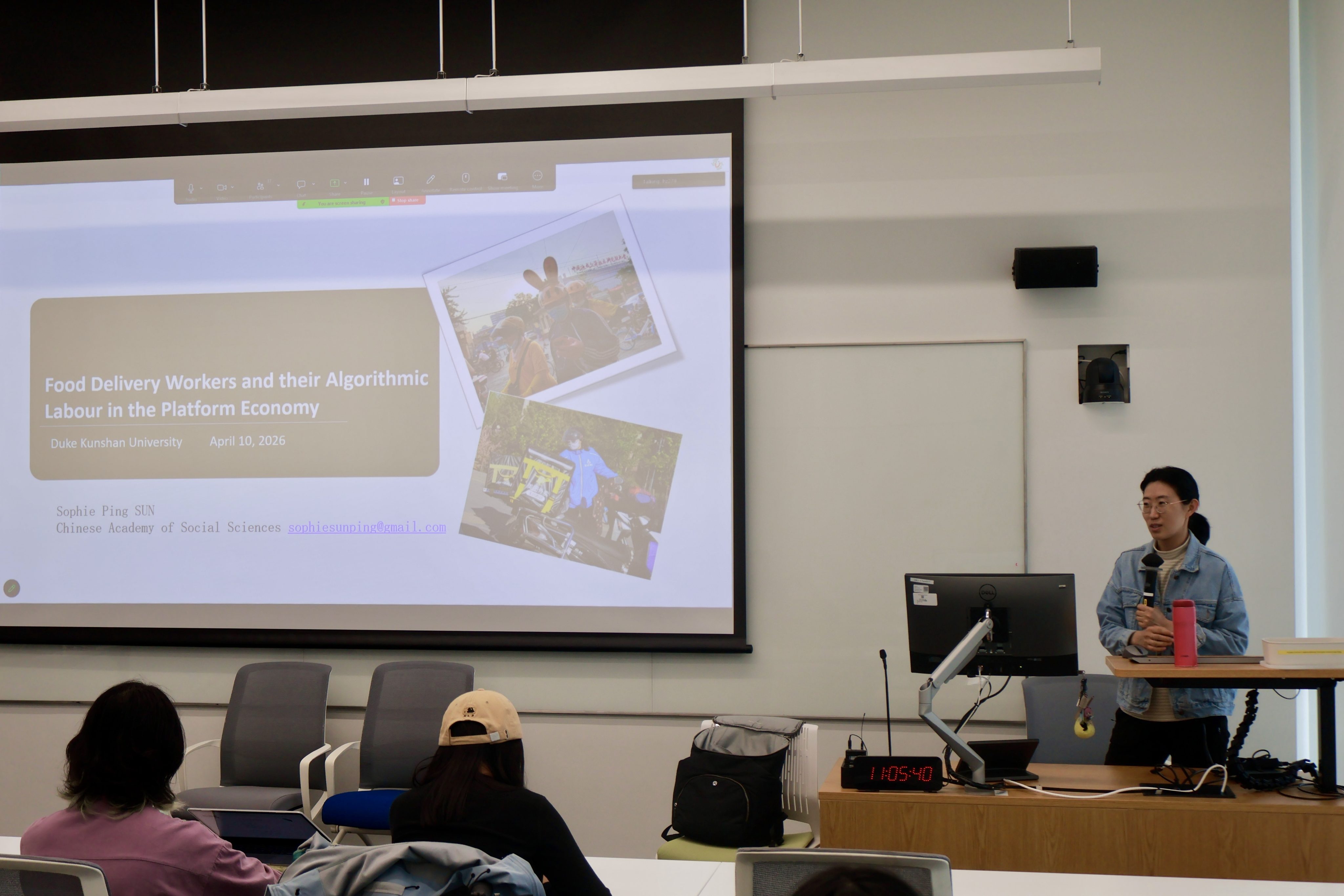
Dr. Sun opened her lecture with a foundational framing of algorithms, starting from their core definition in computer science as a structured series of coded instructions that transform raw data into predictable outcomes, a concept she analogized to a recipe that guides step-by-step actions to complete a task. She situated algorithms as one of the three core pillars driving the development of artificial intelligence, alongside data and computing power, and grounded this technical definition in its material foundation: the transistor, the tiny electronic component that forms the binary on-off system of 0s and 1s that underpins all chip operations. Noting that the density of transistors on a single chip defines computing capacity and sits at the center of global technological competition, Dr. Sun moved beyond purely technical framings to argue that algorithms carry profound social weight, mediating nearly every dimension of daily life through digital platforms, and operating as both a technical method for problem-solving and a system that shapes power relations between platforms, workers, consumers, and the state. To open the “black box” of algorithmic governance, she outlined the dual ethnographic methodology guiding her decade-long research: direct analysis of the internal programming and system design built by engineers and data scientists, and observation of the external, real-world manifestations of algorithms in the daily labor of food delivery workers, whose work is entirely structured by platform algorithmic systems.
Dr. Sun anchored her analysis in the scale and structure of China’s food delivery industry, one of the largest and most mature platform economies in the world, noting that the sector serves more than 500 million online users across the country, processes an estimated 1 billion orders each day, and employs roughly 15 million delivery workers across the three dominant market players: Meituan, Taobao Flash Sale, and JD. She traced the evolutionary trajectory of the industry’s core scheduling system, the algorithmic brain that underpins all delivery operations, through four distinct stages of development. The earliest stage relied entirely on manual human matching, where orders were paired with workers through handwritten notes and human coordination, before evolving into a system model that used basic computer algorithms to automate and accelerate order assignment. This was followed by a cloud-based model, where algorithmic models could be uploaded to a shared cloud system, allowing for cross-city sharing and iterative refinement to improve efficiency, before arriving at the current AI-driven model, a self-learning system that is continuously fed by data generated by delivery workers’ daily labor, becoming increasingly autonomous, smart, and efficient over time.
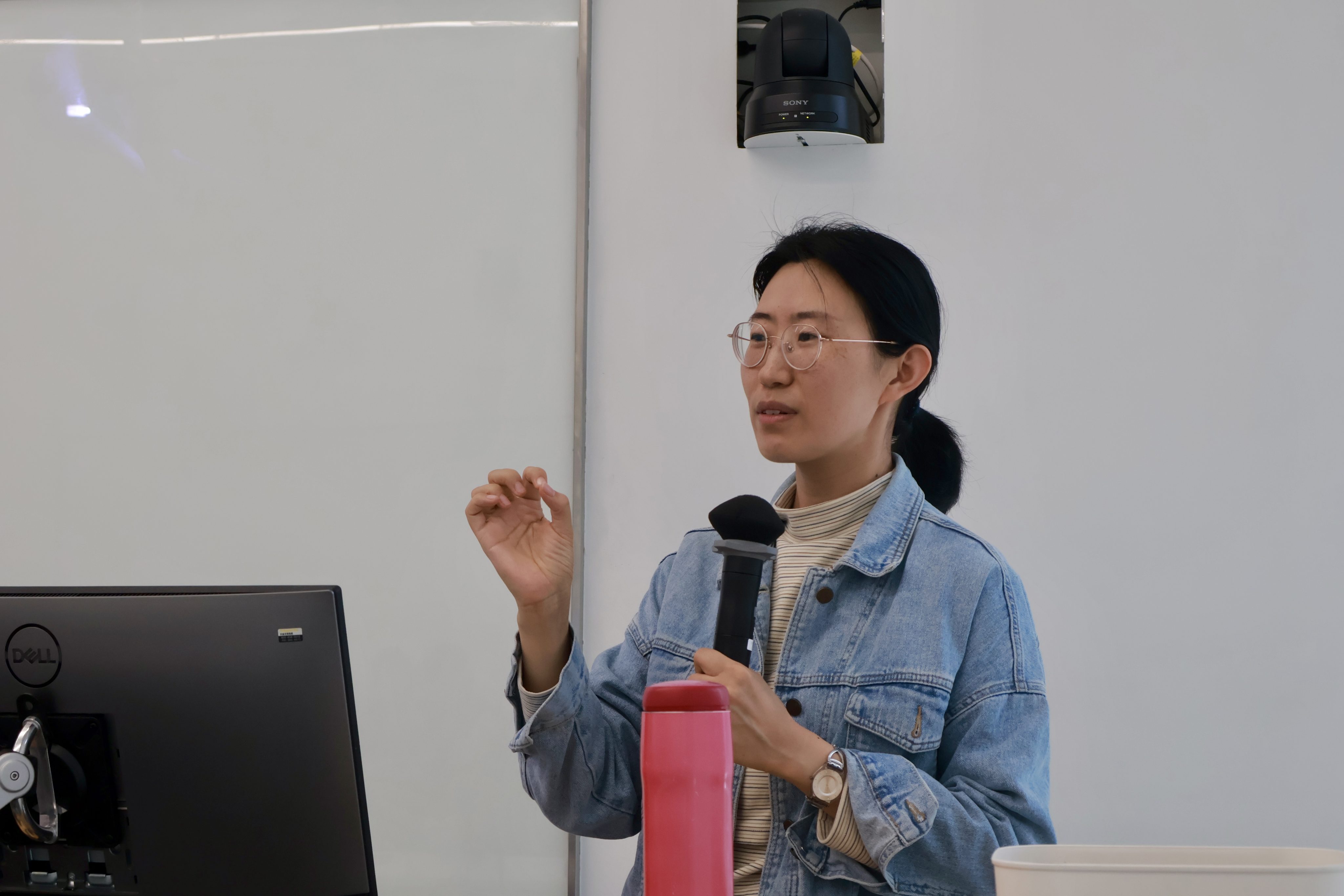
Drawing on ten years of immersive fieldwork, which included in-depth interviews with delivery workers, platform staff and industry stakeholders, large-scale questionnaire surveys, home visits to workers’ hometowns, and first-hand delivery experience completed in rotation by her 10-person research team, Dr. Sun shared her core research findings on how algorithms shape delivery workers’ labor and daily lives. She noted that while the industry has an exceptionally low barrier to entry, requiring only app registration and a brief online training course with no in-person interview or managerial vetting, this accessibility comes with the erasure of individual subjectivity, as workers are reduced to invisible bytes or coded dots within the platform’s surveillance system. Every stage of the delivery process, from order acceptance to food pickup and final delivery, is tracked and visible to both the platform and end consumers, creating a fully surveilled labor process that prioritizes acceleration and efficiency above all else, framing delivery workers as the “invisible human infrastructure” of Chinese society. She further detailed how platforms deploy gamified labor management systems to structure work, ranking workers into tiered categories from ordinary to silver, gold, and diamond “knights”, with points accumulated for each completed order translating to level upgrades and exponentially higher per-order subsidies, creating a competitive, game-like labor environment that incentivizes longer working hours and higher order volumes. Dr. Sun also addressed the mandatory emotional labor required by platform rules, which enforce strict scripts for customer interaction, prescribed gestures for food handoff, and detailed protocols for customer communication, a requirement that creates significant discomfort for the majority of rural-born male workers who are unaccustomed to such delicate, regulated emotional performance. Compounding this pressure is the widespread anxiety and safety risk created by unforgiving time constraints, with workers often juggling 10 or more orders in a single half-hour window during peak hours, leading to frequent traffic violations and accidents. Finally, Dr. Sun highlighted the frequent failures of the platform’s AI system, what she termed “artificial idiocy”, including flawed route planning that ignores geographic barriers like rivers and overpasses, inaccurate time estimates that only calculate straight-line distance rather than accounting for real-world obstacles like high-rise elevators and shopping mall layouts, and reverse order assignments that force workers into dangerous, inefficient routes.
Crucially, Dr. Sun emphasized that delivery workers are not passive victims of algorithmic control, but active agents who have developed their own cultures, coping strategies, and forms of resistance to navigate and even subvert platform systems. She detailed the rich subculture that has formed among delivery workers, including dedicated WeChat groups where workers share practical information about housing, second-hand equipment, and school enrollment for their children, as well as region-based “laoxiang” networks that bring together workers from the same hometowns for mutual support and collective aid. Workers have also developed their own unique jargon to describe their labor, alongside coded language to warn peers about police checks and restricted access areas. She also noted the formation of offline support communities among female delivery workers, who make up a small minority of the workforce, with some workers also using livestreaming platforms like Kuaishou and Douyin to raise their visibility, earn supplementary income, and advocate for their rights, even using social media as a tool to push back against unfair platform policies and demand better working conditions.
The lecture concluded with a lively Q&A session, where Dr. Sun addressed audience questions on the unique culture and language of delivery workers, the ways in which algorithms shape workers’ consumption habits and social relationships beyond their labor, and the platform’s revenue and data utilization models. She elaborated on how the piece-rate structure of delivery work creates addictive cycles that push workers to take on longer hours, with many organizing their work and social lives around daily earning targets, and how workers’ own mobility data is used by platforms to refine and improve mapping and time estimation systems. In her closing remarks, Dr. Sun proposed “algorithmic making and remaking” as a critical new direction for future research on technology and digital labor, arguing that the ongoing negotiation between platform algorithms and workers’ organic, on-the-ground adaptations is a core site of social change in the digital economy. She closed by encouraging students to step outside of campus to conduct immersive fieldwork, to engage directly with the lived realities of delivery workers and other marginalized digital laborers, and to bring critical sociological thinking to the study of technology and society.
This event is part of the Guest Lecture Series of the Cluster for Gender and Global China and Digital Technology and Society Cluster under the Center for the Study of Contemporary China.