Why do so many people experience urgency, pressure, and anxiety when navigating the housing market? What makes homeownership feel like a necessity rather than a choice? In Anxious Homes: Inflexible Demand and China’s Housing Market (Cornell University Press, 2026), Prof. Mengqi Wang draws on fieldwork in Nanjing, to examine how the idea of gangxu (刚需), or “inflexible demand,” has shaped people’s aspirations, anxieties, and everyday decisions around homeownership. Far beyond a financial investment, housing emerges as a key site where questions of family, gender, migration, citizenship, and belonging are negotiated.
At a time when China’s property market is undergoing profound transformation, the book offers a timely perspective on the enduring power of homeownership aspirations. It demonstrates how housing functions not only as an economic asset, but also as a life investment deeply intertwined with marriage, migration, education, family responsibility, gender expectations, and the pursuit of security in urban life.
In this interview, Prof. Wang discusses the origins of the project, the significance of gangxu, the insights gained through ethnographic research, and what readers can learn about housing, markets, and everyday life in contemporary China.
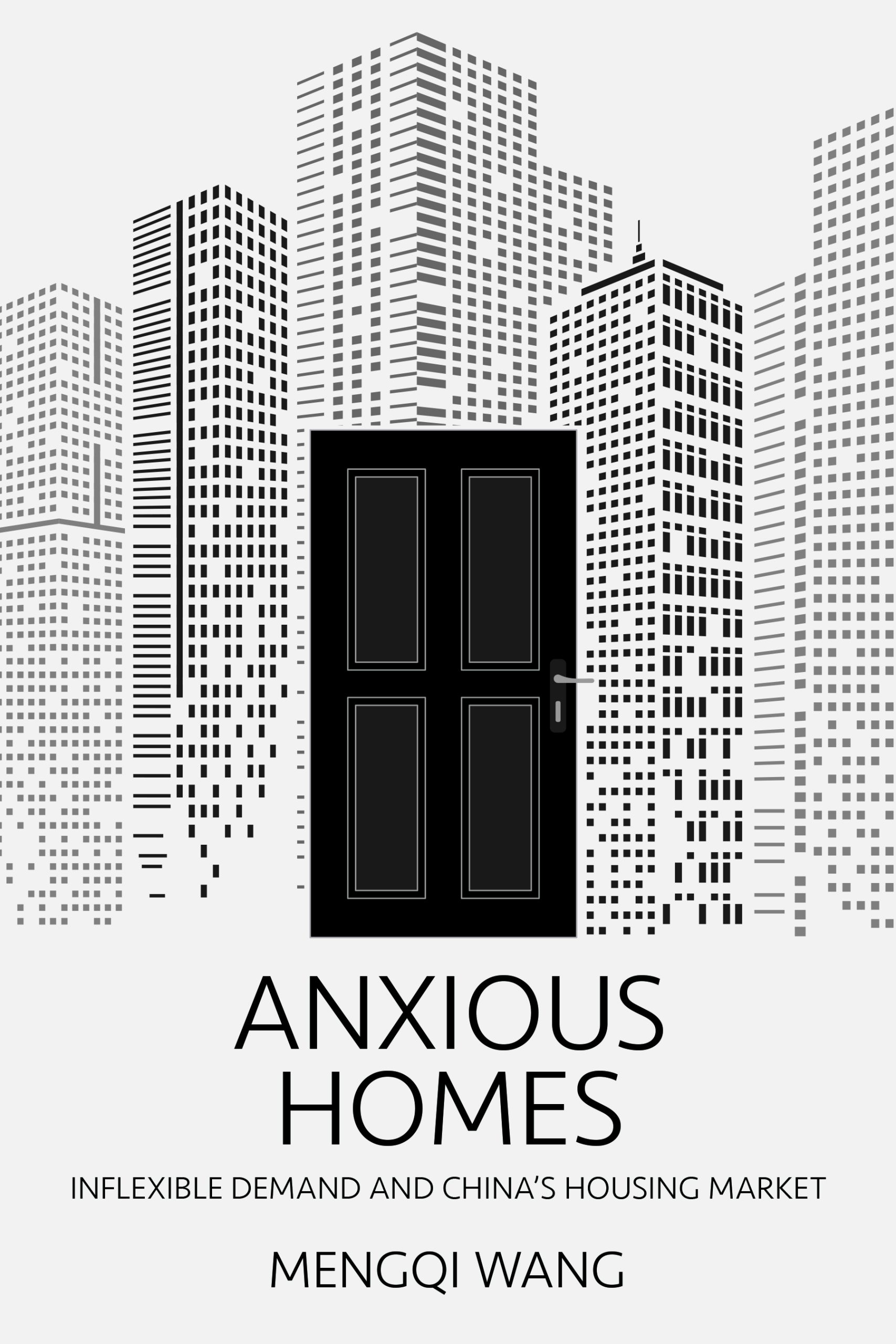
To begin, could you briefly introduce the central argument of “Anxious Homes”? What does the title “Anxious Homes” capture about the emotional, social, and economic world of China’s housing market?
Anxious Homes traces the multiple yet interconnected uses of the vernacular concept of inflexible demand—known as gangxu/刚需 in Chinese—in an emerging housing market in East Nanjing, through ethnographic fieldwork conducted with market actors there from 2012 to 2015. It argues that the formation of China’s urban real estate economy, as well as its homeownership discourse, paradoxically relies on the hegemonic understanding of the home as an inalienable property essential to all urban citizens. It shows how, under the imperative of home-buying, actors struggle with a sense of urgency to reach their homeownership dream, and how a sense of anxiety drives urban accumulation in the process.
A key concept in your book is “gangxu”, or “inflexible demand.” How should readers understand this term beyond its common use in the real estate market? How does “gangxu” become a way of defining homeownership as necessary, rather than simply desirable?
The book is about the common uses of this term in China’s housing market. Readers in China probably have an intuitive sense of what gangxu means in everyday life; for these readers, the book asks them to pause and reflect on what the word captures (what do people mean when they talk about having an inflexible demand for a home of their own) and what the word does (what actions are enabled and justified when people invoke the concept). For all readers, including those not familiar with the concept, the book shows under what conditions various actors, including developers, brokers, homebuyers, and government officials, come to embrace the concept. Tracing inflexible demand, the book challenges the Eurocentric conceptualisation of homeownership as an exclusive right to a property. It argues that in the inflexible demand market of housing in China, homeownership signifies, rather, a further inclusion of citizens within the state.
Your book connects housing to marriage, family responsibility, migration, gender expectations, and urban belonging. How does the pursuit of homeownership become tied to these broader life expectations? In particular, how do young migrants and their families experience housing not only as a financial decision, but also as a social and moral obligation?
Buying a home has never been a simple financial decision in China and elsewhere. In my ethnography, I show how buying a home was a life event tied to marriage preparations and decisions to build a family in the city. In my book, I show how the act of home-buying as well as the discourse of gangxu/inflexible demand is highly gendered and partakes in the transformation of gender and familial values in China.
As an ethnographic study, your book looks closely at real estate agents, developers, homebuyers, and everyday market interactions. What can fieldwork reveal that statistics, policy analysis, or market reports might miss? Could you share one fieldwork moment or observation that especially shaped your understanding of the housing market?
Economic anthropology is the discipline that believes that culture and people are central to the economy, instead of numbers and statistics. This is not to say that statistics, policy analysis, or market reports with figures and predictions do not matter; but that, to get a deeper and more concrete understanding of the economy, one needs to get to the human level. This means that we recognize that human beings are oftentimes not rational individuals trying to maximize their benefit; instead, we are emotional and cultural beings acting according to social norms while being constrained by institutional factors. I think of the migrant homebuyers who had to buy a property in Nanjing because they hoped to enroll their daughter in the local public school, which requires a local hukou that can only be obtained through homeownership. Their story is important because it shows the human factor driving people to buy homes and to view homeownership as an inflexible demand for living in the city.
Your fieldwork examined China’s housing boom, while the book is reaching readers during a very different moment in the property market. How do you hope people read “Anxious Homes” today? What do you hope DKU students and general readers take away from the book when thinking about housing, markets, family expectations, and everyday life in contemporary China?
I think the discourse of inflexible demand is still alive today and people are still debating whether buying a home is a hard necessity. I hope people can see and also take into account the multiple roles that housing plays in our life, not just as a financial investment but more like a life investment. More importantly, housing is a condition for human survival not a need to be exploited for capital gains.