
By Violet Nguyen, Class of 2028
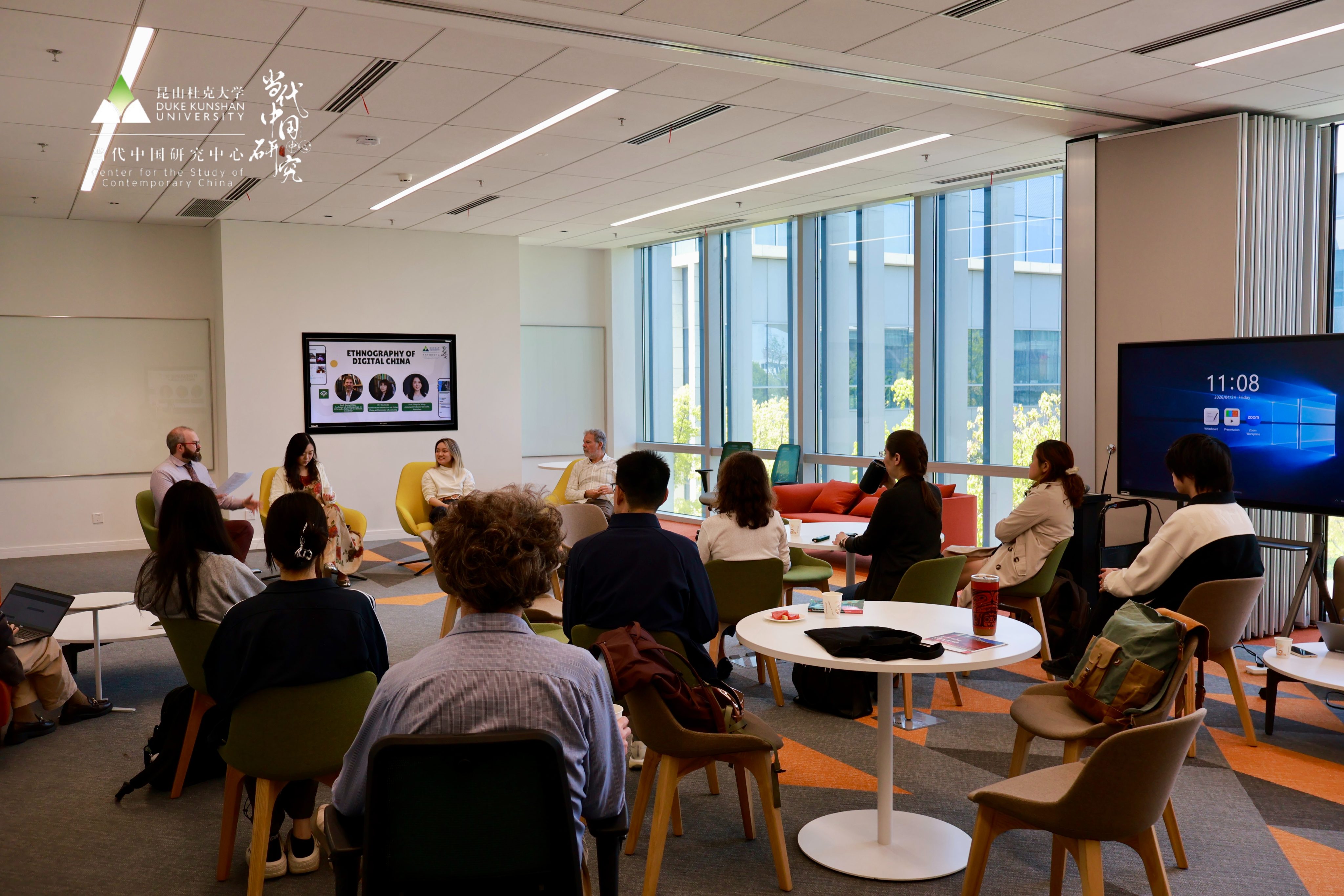
On April 24 2026, the CSCC workshop “Ethnography of Digital China: Methodology Workshop with Anthropologists” brought together three scholars, Daniel Miller – Professor of Anthropology at UCL, Xiaolin Li – Postdoctoral researcher at University of Antwerp and Ningxin Wang – Media anthropologist and ethnographer at CUHK Shenzhen, to reflect on how ethnographic methods can be adapted to study digital life in contemporary China.
Prof. Miller opened the conversation by challenging what he described as an outdate distinction. Drawing on his long engagement with digital anthropology, he argued that such the binaries between the “virtual” and the “real” world obscure more than they reveal. For him, the task of ethnography is not to isolate the digital world as a distinct domain, but to understand how it becomes embedded in ordinary life. He illustrated this with methodological examples, such as systematically examining every app on a person’s smartphone to uncover patterns of actual use, rather than relying on what people say they do.
Research Li extended this perspective by focusing on the relationship between digital techonologies and material culture. Her work moves beyond studying users to include the production side of digital systems, particularly within tech companies. By conducting fieldwork with engineers and product managers, she showed how algorithms and platforms are not neutral but shaped by human decisions and social contexts. At the same time, her research on topics such as menstruation and digital tracking highlighted how intimate experiences are mediated through both physical and digital tools. She used method like object elicitation, which means asking participants to discuss personal items, to show how material and digital dimensions can be studied together rather than separately.
Prof. Wang focused on digital fandom and youth culture in China, offering a vivid account of multi-sited ethnography that spans both online and offline spaces. By participating directly in fan communities, she gained access to internal dynamics that are often misrepresented in public discourse. Her work highlighted the importance of empathy and positionality, particularly in contexts where fan communities are stigmatized. At the same time, she raised significant ethical challenges, including how to protect participants in environments shaped by surveillance and cyberbullying. Her reflections made clear that digital ethnography often involves navigating not only methodological complexity but also real risks for both researchers and participants.
A key point of discussion across the panel was ethics. While Prof. Wang emphasized caution and the need to anonymize and protect vulnerable participants, Li introduced a more ambivalent perspective, noting that some interlocutors actively want their experiences to be visible and recognized. Prof, Miller added another dimension by questioning universalized ethical frameworks, arguing that researchers should remain attentive to local understandings of privacy and representation rather than imposing external standards. Together, these perspectives underscored that ethics in digital ethnography is not fixed, but must be negotiated in context.
The conversation also touched on emerging issues such as artificial intelligence, particularly its growing role in everyday life and work in China. Rather than focusing on the capabilities of AI, the speakers emphasized how people creatively incorporate these tools into their social and professional practices, reinforcing the anthropological focus on human agency.
Overall, the workshop demonstrated that digital ethnography in China requires methodological flexibility, sensitivity to cultural and political contexts, and a willingness to rethink established concepts. By grounding their approaches in lived experience, the speakers collectively argued for an anthropology of the digital that remains firmly rooted in the study of human life.