

By Violet Nguyen, Class of 2028
In the global imagination, “Made in China” is often linked to cheap, fast, and sometimes counterfeit goods; and to the nameless workers who make them. But what about the people in between? The small-scale entrepreneurs who are neither wage workers nor secure capitalists, who run household workshops out of urban villages, and who dream of freedom admist precarious circumstances?
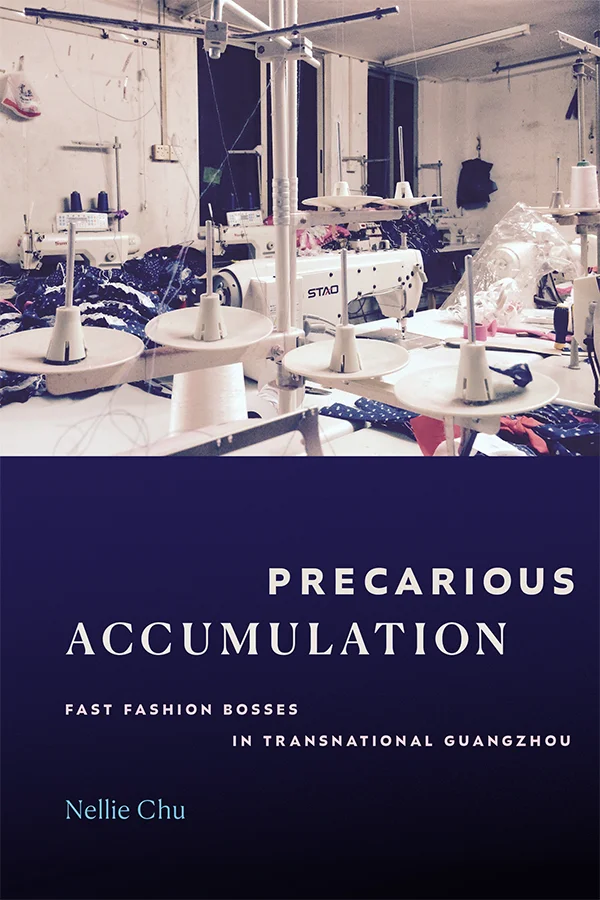
Nellie Chu, Assistant Professor and cluster lead for the Cluster for Gender and Global China at the Center for the Study of Contemporary China, spent years embedded in Guangzhou’s fast fashion industry — one of the world’s most dynamic hubs of transnational commodity production. Her recently published book, Precarious Accumulation: Fast Fashion Bosses in Transnational Guangzhou, tells the story of rural Chinese migrants, West African and South Korean traders who navigate the high-speed, low-margin world of just-in-time garment production.
Drawing on long-term ethnographic fieldwork in urban villages and household assembly workshops, Chu introduces the figure of the “migrant boss” (laoban) and the concept of precarious accumulation to show how aspirations for economic freedom collide with dispossession, racialized policing, and the constant threat of ruin. The book also highlights how global supply chains are shaped by cultural identities, social networks, and unequal power relations. Taken together, these stories offer a different way of understanding entrepreneurship as a process shaped by both aspiration and uncertainty.
Could you start by telling us what drew you to study migrant entrepreneurship and the fast fashion industry in Guangzhou?
I began this project with a different question in mind. I was interested in how the “Made in China” label became associated with cheap or counterfeit goods in global markets, and how that perception shaped the lives of the people involved in producing and circulating those products. I imagined I would be hanging out with counterfeiters and factory workers in clandestine settings because often, people outside China see those who exchange these products as criminals or very dubious characters.
But after I arrived in Guangzhou and began my fieldwork, I realized these were ordinary people, just like you and me. They didn’t care whether the goods they were manufacturing and selling were fake or real. They were more concerned about their economic livelihoods. Over time, as I spent more time in factories and wholesale markets, I realized that many of them aspired to become entrepreneurs, to become “laoban”. Listening to their stories and aspirations ultimately shifted the direction of my research toward understanding their everyday lives and their pursuit of economic mobility.
Your book centers on the figure of the laoban, or migrant boss. What makes this figure so important, and how do you conceptualize “bosshood”?
What’s interesting about the term laoban is that it is widely used in everyday life in Guangzhou to refer to themselves and to each other. It’s a term that carries a sense of respect and recognition. In my book, however, I use it more analytically to describe a particular condition that sits between wage labor and full-fledged capitalism. “Laoban” are not wage workers in the traditional sense as they’re not being paid by the hour, but they’re also not secure capitalists.
These are people who are self-employed and take on the risks of their own business ventures, yet the conditions of their labor often mirror the work that factory workers do. They have to answer to bigger bosses or clients, just like a wage earner answers to a boss. But they’re not earning an hourly wage. Their profits come in and out unpredictably. In some ways, they’re free like a full-fledged entrepreneur; in other ways, they’re constrained like a wage worker. There aren’t many concepts to describe that in-between space. For me, “laoban” captures it perfectly, especially in Guangzhou’s fast fashion industry.
You introduce the concept of “precarious accumulation” as a central framework in the book. How does this differ from more conventional understandings of entrepreneurship?
Entrepreneurship is often associated with ideas of freedom, autonomy, and the ability to accumulate wealth through one’s own efforts. The assumption is that if you start your own business, you don’t have to answer to anyone else, and the profits you earn are the result of your own merits. What I try to show is that this narrative does not hold for many small-scale entrepreneurs. Their businesses are highly uncertain, and there is no guarantee that they will be better off after starting them. In fact, they often take on more risk and experience greater instability.
Precarity is usually associated with wage labor – low wages, lack of security, and limited upward mobility. What I argue is that this sense of insecurity also extends to entrepreneurship itself. By linking precarity with accumulation, I want to highlight how the pursuit of profit is deeply entangled with uncertainty, especially for small-scale migrant entrepreneurs. I’m not talking about the Steve Jobs or Elon Musk type of entrepreneurs. I’m talking about small migrant-run businesses. They are still driven by the goal of accumulation but they have to take on a lot more risk and operate with very little security. So “precarious accumulation” is about that tension: the aspiration to accumulate wealth, and the reality of instability and uncertainty that comes with it.
Your book follows not just rural Chinese migrants but also West African and South Korean migrants. You write about racialized violence driven not just by the state but by the market. Can you explain that?
Instead of treating rural Chinese migrants and transnational migrants as completely separate groups, I trace how they encounter one another and form relations of exchange. In those encounters, there come misunderstandings, cultural differences, inequality, discrimination, and sometimes even violence.
Fashion itself is tied to cultural categories such as race, ethnicity, and gender, and these categories shape how people are perceived and treated. Our bodies become sites where these meanings are mapped onto us. But those categories can also be used in violent ways.
I write about racialized violence not just between consumers and producers, but among all the parties in supply chains, such as officials, peasant landlords, property managers. It’s not only the state doing this work. Non-state actors also take up violence to protect property rights and rental income. The market itself becomes an impetus for racialized violence.
Your work also examines how race, identity, and belief shape economic life, particularly among transnational migrants. What did you find in this regard?
I approach cultural identity as part of the practices of accumulation. For West Africans, religious belief is a core component of how they make meaning out of their capitalist enterprises. Prosperity is a reflection of their devotion to God, so accumulating wealth is not just about making money, it’s also about demonstrating faith and devotion. For South Korean migrants, ethnic networks are key. Their connections with Korean Chinese communities in Guangzhou help facilitate their business activities and their position within the supply chain.
But it’s not strictly functionalist; it is not simply that culture is used for the sake of economic gain. These beliefs and identities are deeply intertwined with how people understand what it means to be a boss and how they pursue accumulation. Culture and economy are really inseparable in these contexts.
One of the most striking concepts in the book is stalled mobility. In your chapter on the Wong family — a migrant family running a small workshop from their home — they describe their labor as “free,” even though they’re clearly struggling. Did they themselves recognize this contradiction?
I raised that question to Mrs. Wong, with whom I had a closer relationship. What surprised me is that, regardless of all the hardships and difficulties they faced as bosses, she still would rather be her own entrepreneur.
I saw how uncertain their business was. They lived in a makeshift bed on the second floor of their factory space, which was hardly a stable or legitimate floor plan. They made many sacrifices. But they still believed that being their own boss was somehow better than having a boss. Part of it has to do with the sense of autonomy: the autonomy to choose which order to take, to step away from an order if a conflict comes up. To some extent, it’s a kind of blind belief in entrepreneurial freedom. After COVID, many of them were forced to give up their businesses. It wasn’t voluntary. The Wong family’s factory closed. They had no choice but to return to wage work. But even then, they still believed in that idea of freedom through entrepreneurship, to the extent of irrationality.
This is where anthropology comes in handy. An anthropologist can take a more neutral look at these contradictions and paradoxes that the person themselves may not be fully aware of. The Wong family would say, “I’m free, I’m a laoban,” while working 10 or 12 hours alongside their wage workers, doing the same type of labor. My job is to analyze deeply how those paradoxes came about and why they made sense to the person uttering those words.
You completed most of your fieldwork before COVID. How did the pandemic change or accelerate the dynamics you observed?
I think COVID intensified many of the vulnerabilities that migrant entrepreneurs were already facing. Migrants were already in a very precarious position, and the pandemic made it much worse. Restrictions on movement made it difficult for migrants to travel, change jobs, or maintain their businesses. At the same time, increased policing and instances of discrimination, particularly against African migrants, further exacerbated their precarious situation. Many businesses were forced to shut down, including those of the people I worked with. In that sense, the pandemic reinforced the central argument of the book: that the process of accumulation for these migrants is deeply precarious and can be easily disrupted.