

By Zihan Chen, Class of 2026
On February 9, 2026, the Geopolitics of the Twenty-First Century (G21) Lab welcomed Lu Yang for a practical and illuminating session on the world of geopolitics consulting. Yang is a Shanghai-based economist at Shui On Land specializing in business and political risk in China. A graduate of the Johns Hopkins School of Advanced International Studies (SAIS), Yang drew on his experience as a political risk consultant in Washington, D.C. and Shanghai to offer an insider’s roadmap for navigating one of today’s most demanding professional fields.
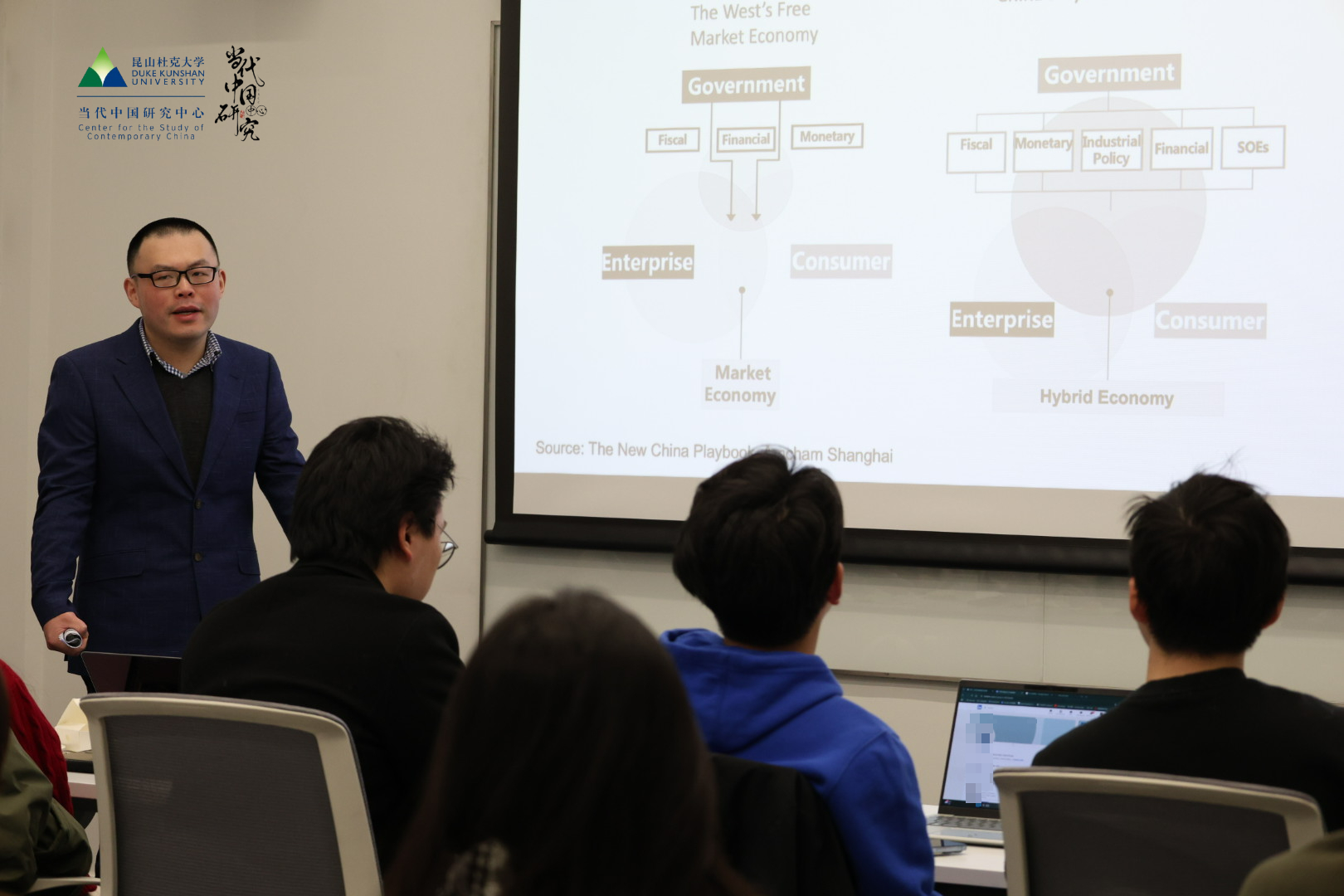
Yang opened by mapping how geopolitical tensions now permeate every dimension of corporate operations. He highlighted supply-chain vulnerabilities (tariffs, export controls, reshoring, sanctions, and logistics security), market challenges (administrative restrictions, level-playing-field issues, consumer boycotts, and strategic reconfiguration), and financial pressures (dollar jurisdiction, foreign exchange volatility, and rising financing costs). Using the 2025 AmCham China Business Report as evidence, he showed that multinational executives rank “geopolitical tensions” as the single greatest obstacle to China’s economic growth, ahead of property-market weakness, population decline, and regulatory overreach.
He then explained the three core missions of geopolitics consultants—Protect, Prepare, and Propel—and illustrated how they deliver value through three service pillars: continuous issue monitoring (breaking US-China developments, Politburo meetings, regulatory actions, reputational risks), tailored consulting projects (market-entry navigation, political risk due diligence, stakeholder mapping of government agencies, think tanks, chambers, and NGOs), and high-level briefings that align headquarters and local teams while resolving transnational management frictions.
Yang walked the audience through the daily practice of the field, covering regional research on China’s elite politics and foreign policy, geo-technology topics such as US-China tech decoupling, the CHIPS Act, the IRA, the Xinchuang initiative, semiconductor geopolitics, and AI governance (“one tech, two systems”), as well as cross-cutting themes in supply chains, ESG, and critical minerals. He stressed that consultants must master rapid, client-relevant writing and the ability to work in multiple languages relevant to the region.
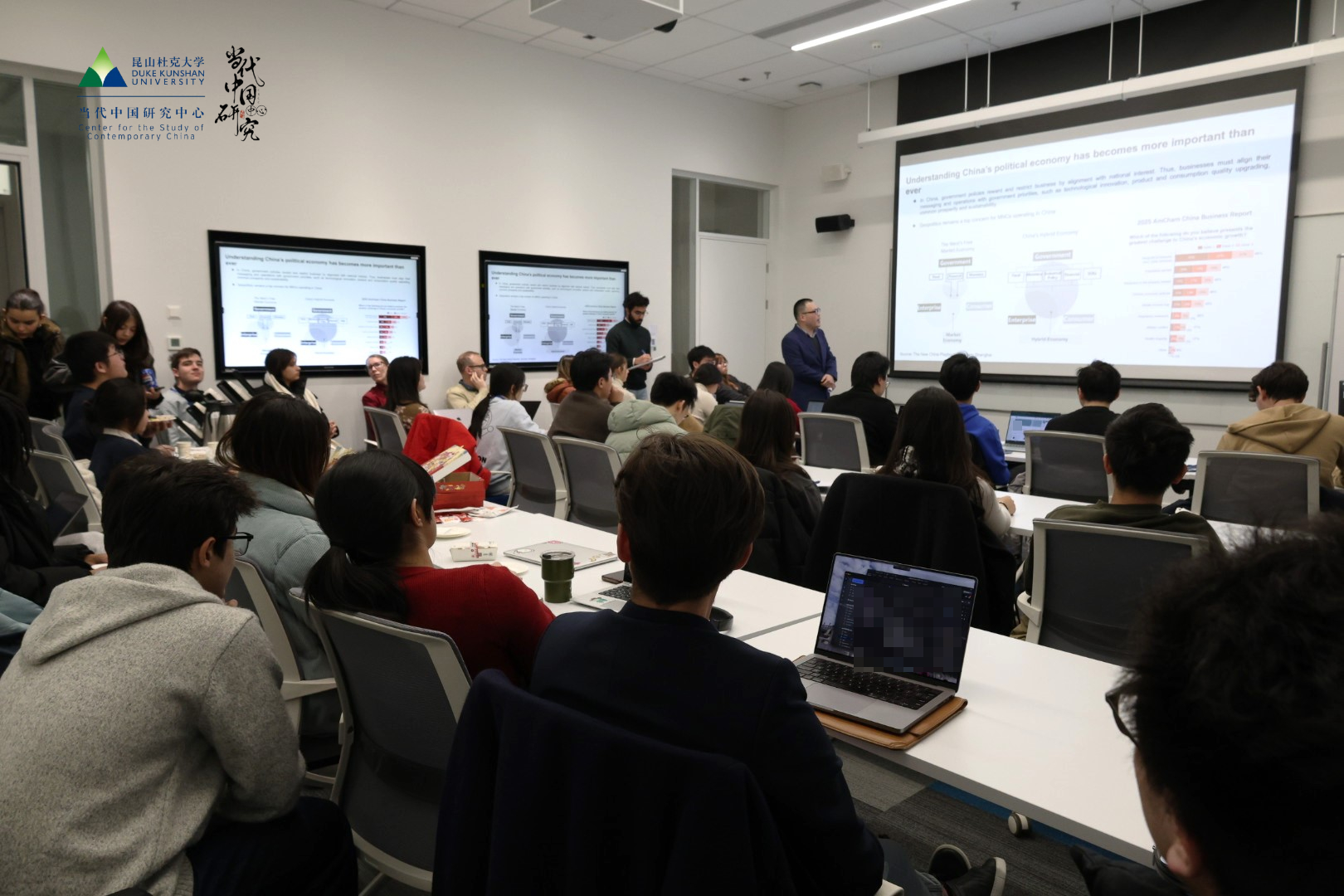
For students interested in entering the field, Yang offered a clear roadmap: most Shanghai-based policy consultancies run off-cycle internships, writing proficiency remains the primary recruitment filter, and hands-on policy research experience (especially the ability to detect subtle shifts in official tone and messaging) is essential. He closed by noting that in today’s environment, businesses that treat geopolitics as a core strategic variable rather than a peripheral risk would gain a decisive competitive edge.
The session was enriched by further discussions and insights. Students proposed questions regarding which industry has the highest demand for consulting, the shock brought by AI tools to the industry, and China’s unique market and policy environment.
This event is part of the Guest Lecture Series of the China and the World Cluster under the Center for the Study of Contemporary China.