
By Zihan Chen, Class of 2026
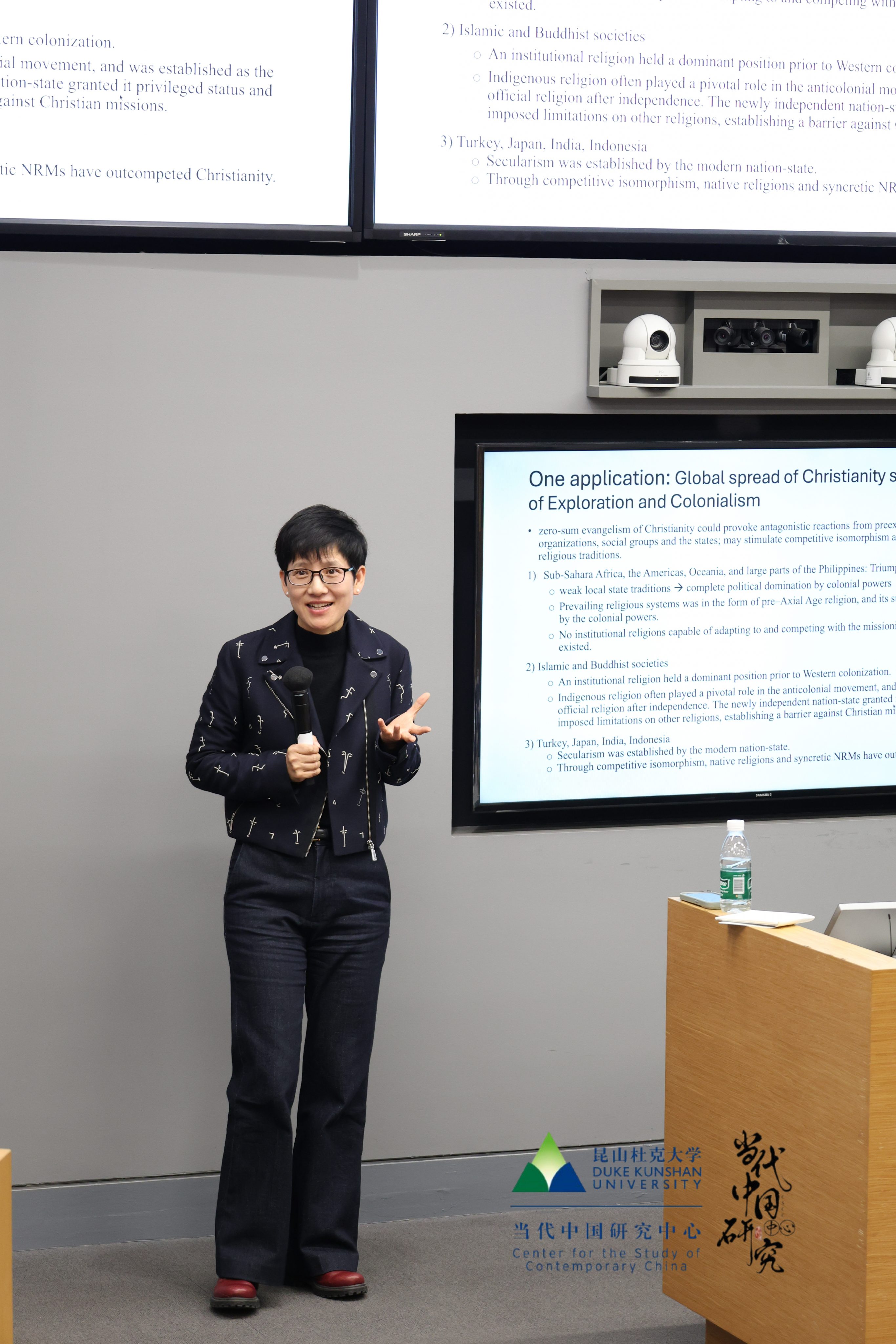
On February 6, 2026, the CSCC Meanings, Identities, and Communities Cluster, in collaboration with the Division of Social Sciences, welcomed Yanfei Sun, Professor at Zhejiang University, for a lecture introducing her recently published book, Religious Change in Post-Mao China: Toward a New Sociology of Religion (The University of Chicago Press, January 2026). Drawing on two decades of fieldwork, archival research, and comparative analysis, Sun presented a fresh “institutions-in-context” framework that places state policies, geopolitical processes, and religious institutional features at the heart of understanding why some faiths surged while others stagnated or transformed in unexpected ways.
Sun began by situating religious change within broader social transformations: the collapse of the Confucian imperial order, Republican-era policy shifts, Maoist-era radical suppression, and the dramatic post-Mao resurgence. She advocated an ecological perspective, viewing religions not in isolation but as part of a dynamic “religious ecology” where each faith’s fortunes are shaped by its relations with others and with the surrounding sociopolitical environment. In late imperial China, this ecology featured porous boundaries, widespread syncretism, and the central role of popular religion anchored in powerful lineage organizations.
The core of the talk examined five empirical cases that illustrate divergent post-Mao trajectories: the Protestantism’s phenomenal rise; the Catholicism’s relative decline; the Territorial cults’ feminization, bifurcation, and selective Buddhification; the New Religious Movements; and the Chinese Buddhism.
Sun’s “institutions-in-context” theory elegantly bridges micro and macro levels: institutional features of each religion (beliefs, practices, organization, networks) interact with contexts shaped by state actions—sometimes unintentionally. Maoist campaigns destroyed lineage power, clearing space for Protestant growth; post-Mao regulatory restrictions created niches that house churches filled adeptly, while official churches faced isomorphism pressures. The framework also illuminates global patterns, such as Christianity’s varying success across colonized regions depending on local state strength and pre-existing religious institutions.
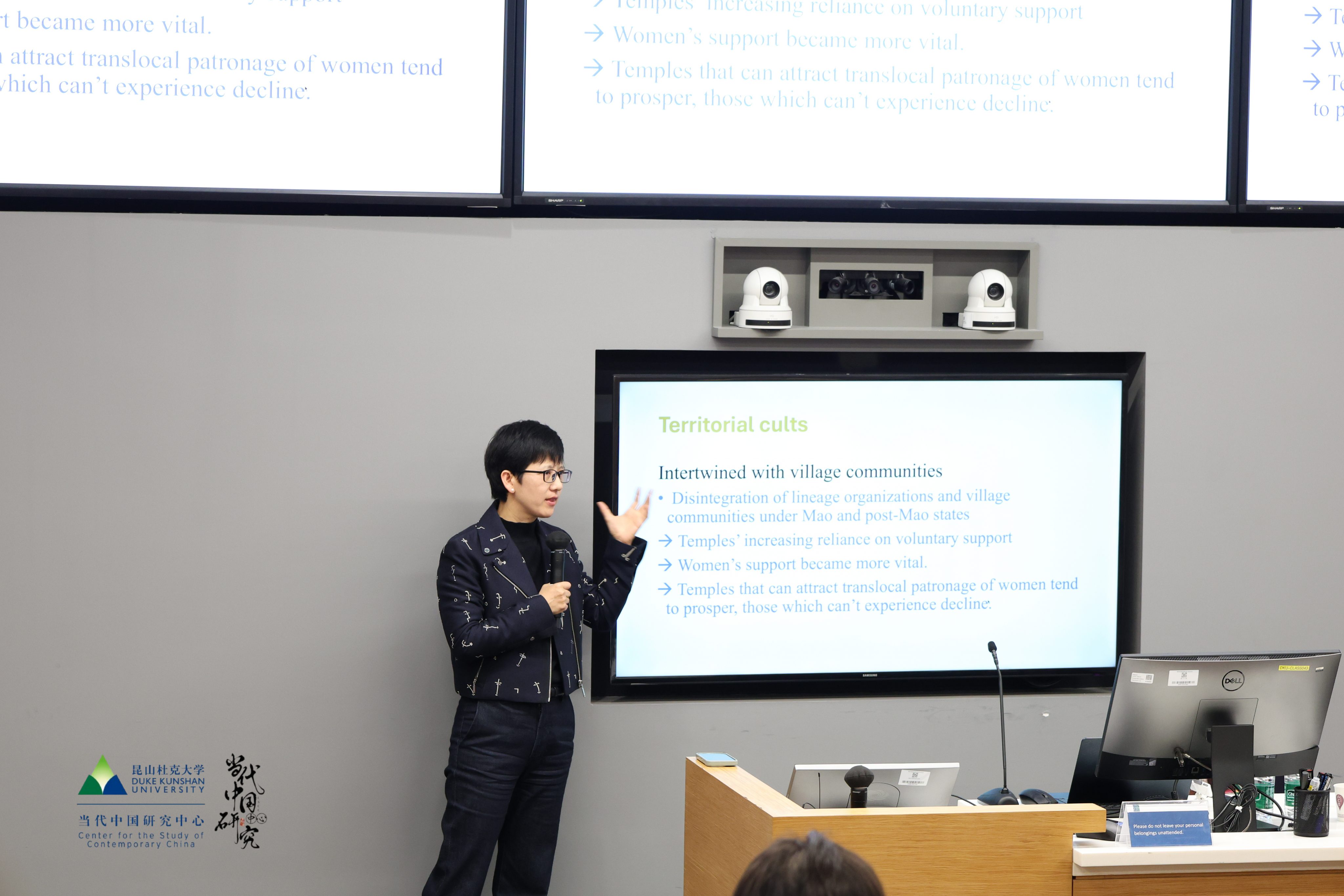
The lecture combined analytical rigor with accessible presentation. Timelines, comparative tables, fieldwork photographs, and firsthand accounts from informants brought abstract sociological concepts vividly to life.
The discussion with the thirty-two student and faculty attendees that followed pushed the framework further. Participants explored whether Sun’s China-centered model might reshape broader theories of secularization and religious competition, and how unofficial religious organizations craft survival strategies under regulatory constraint. More broadly, the session encouraged attendees to reconsider religious change not as linear decline or revival, but as a historically contingent process shaped by institutions, policy environments, and global forces.