

By Zihan Chen, Class of 2026
On February 6, 2026, the CSCC Governing China Cluster, in collaboration with the Social Science Division and the University Colloquium Committee, welcomed Dr. Dingxin Zhao, Dean of the Institute for Advanced Studies in Humanities and Social Sciences at Zhejiang University and Max Palevsky Professor Emeritus at the University of Chicago, for a thought-provoking talk that bridged behavioral economics, neuroeconomics, agent-based modeling, and macro-sociology. Drawing on decades of research and rich empirical observations from China’s post-reform transformations, Dr. Zhao introduced a powerful macro-structural framework inspired by evolutionary biology’s r/K selection theory to explain why individuals and organizations adopt different dominant strategies in different social contexts.
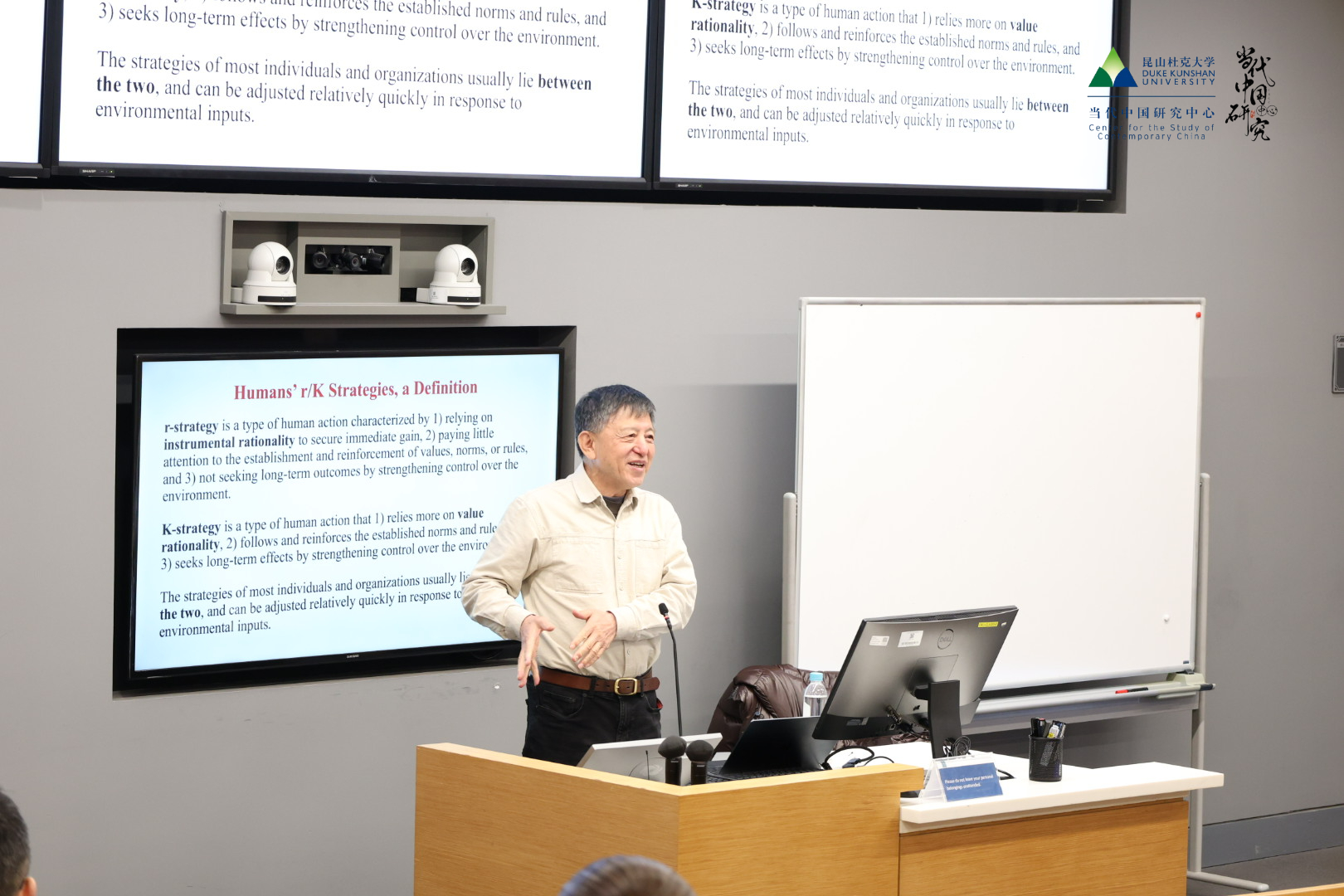
Dr. Zhao began by highlighting persistent empirical puzzles in contemporary China and beyond: Why did Evergrande continue high-leverage, opportunistic expansion even as an industry leader? Why could Wang Jianlin claim in 2017 that “having guts beats Tsinghua or Peking University”? Why did New Oriental succeed amid fierce competition? Why is “involution” so intense? Why did the government initially tolerate chaotic bike-sharing competition in 2018? And why does Europe lag behind the US and China in many emerging industries? These questions, he argued, cannot be fully answered by micro-level decision-making research alone.
He then presented the r/K framework:
– r-strategy (opportunistic): high reproductive/growth rate, focus on immediate gains, instrumental rationality, little emphasis on norms or long-term control, which thrives in unstable, unpredictable environments.
– K-strategy (equilibrium): lower rate, value rationality, adherence to norms and rules, long-term environmental control, which dominates in stable, predictable settings.
Most human actors and organizations fall between these poles and can shift strategies relatively quickly in response to environmental signals. Dr. Zhao demonstrated five isomorphic causal patterns between human strategies and r/K dynamics in other species: (1) environmental inputs (r in unstable settings, K in stable ones), (2) power status (r at lower/mid levels, K at the top), (3) stages of social/market development (r in early “succession,” K in later stages), (4) forms of historical development (r in contexts lacking control over environment, K where actors can reshape institutions), and (5) patterns of industrial development (explosive r-style growth followed by collapse vs. steady K-style expansion).
He further showed how Homo sapiens’ unique capacity for strategic, Lamarckian (positive-feedback) behavior generates novel patterns not seen in other organisms — such as continued r-strategy dominance among powerful Chinese real-estate tycoons, K-goals pursued through r-style implementation in talent programs, and reversed K-to-r succession in Chinese academia. Visuals including keyword-frequency tables from Party Congress reports, market-succession stages, and life-history comparisons underscored the framework’s explanatory power.
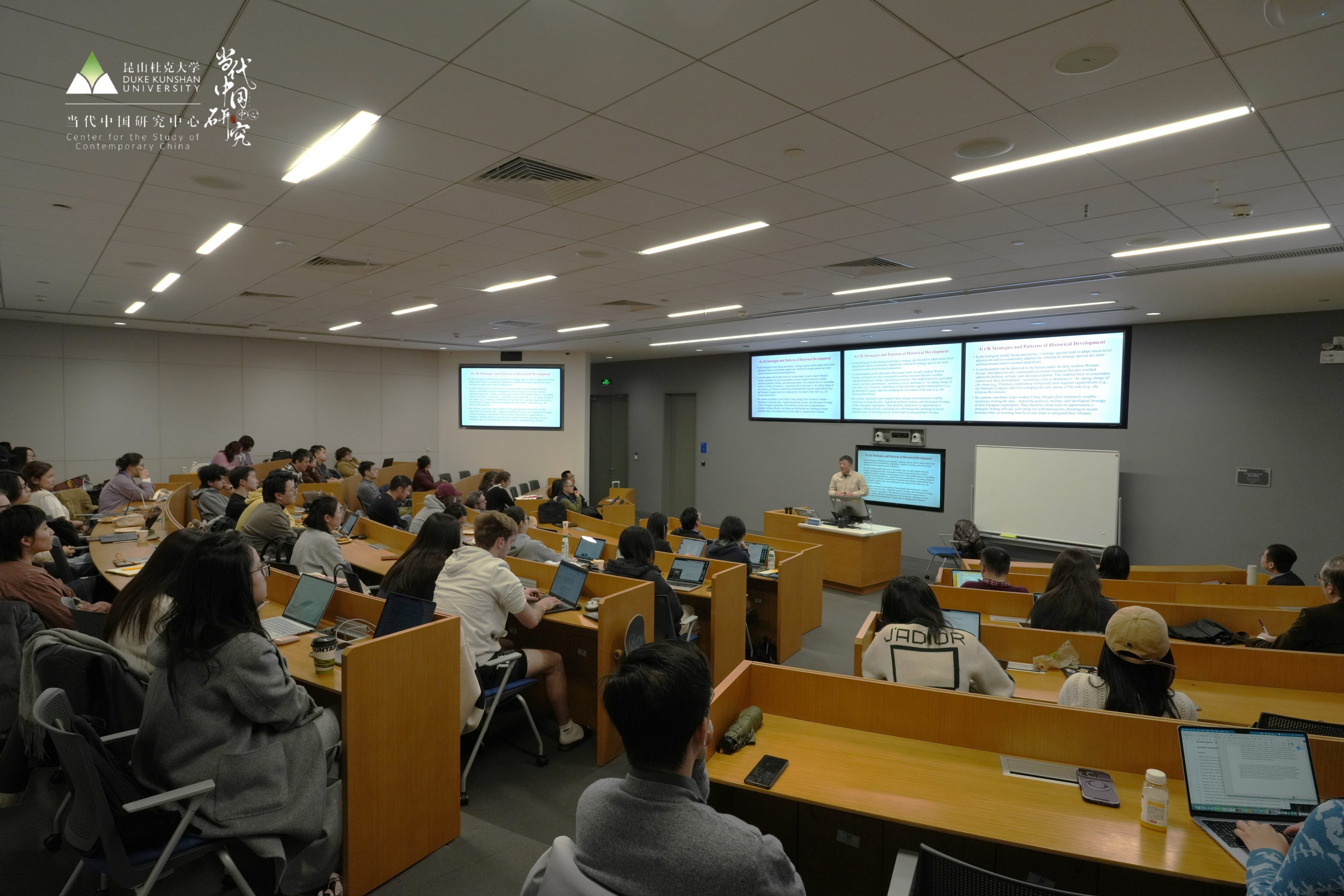
Dr. Zhao concluded by reflecting on the fruits of r-strategies (innovation and disruption, as seen in early bike-sharing or Elon Musk’s approach), effective r/K coordination, and the pitfalls of literal application of r/K theory to humans. He emphasized that humans are fundamentally K-oriented beings who nevertheless retain a strong inclination toward r-strategies even within stable environments, which is a tension that shapes everything from child-rearing “involution” to policy volatility.
The lecture sparked lively discussion with the forty-six student and faculty attendees on the framework’s applicability to current geopolitical and technological shifts, the balance between structure and agency, and its implications for understanding China’s ongoing socioeconomic transformations. Dr. Zhao’s synthesis of micro-level behavioral insights with macro-structural context offered a fresh, integrative lens that enriched both evolutionary biology and the social sciences.