
By Zihan Chen, Class of 2026
On December 18, 2025, the global computer graphics community gathered in Hong Kong for SIGGRAPH Asia 2025, one of the world’s most influential conferences on interactive techniques and emerging technologies. Amidst the technical showcases, two standout Educator’s Forum sessions charted a new path for education in the generative renaissance. Prof. Luyao Zhang from Duke Kunshan University served as co-host of the two sessions and the corresponding author of two associated publications.
These sessions were not merely about using new tools; they were a profound exploration of how AI can foster intrinsic motivation, ethical reasoning, and deep learning. By bridging philosophical inquiry with practical application, the events offered a comprehensive roadmap for the future of learning.
Two Sessions, One Vision: From Reflection to Action
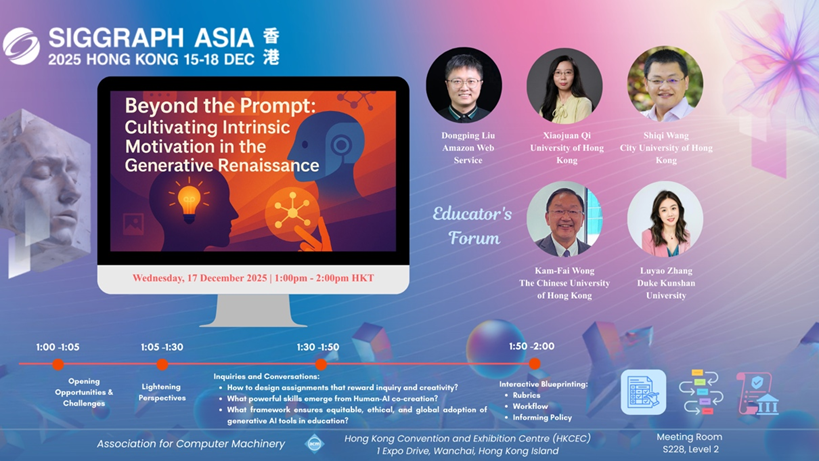
The first session, “Beyond the Prompt: Cultivating Intrinsic Motivation in the Generative Renaissance,” served as a theoretical foundation. Panelists, including experts from Amazon Web Services and top Hong Kong universities, argued that education in the AI age must shift focus from surface-level outputs to the learning process itself.
The associated publication, Beyond the Prompt: Cultivating Intrinsic Motivation in the Generative Renaissance (Liu et al., 2025), outlines the session’s key deliverables: a shared assessment rubric centered on inquiry, a unified human-AI learning workflow, and a draft policy for equitable AI adoption. The consensus was clear: AI should act as a tool for reflection and personal growth, not just a vehicle for polished results.
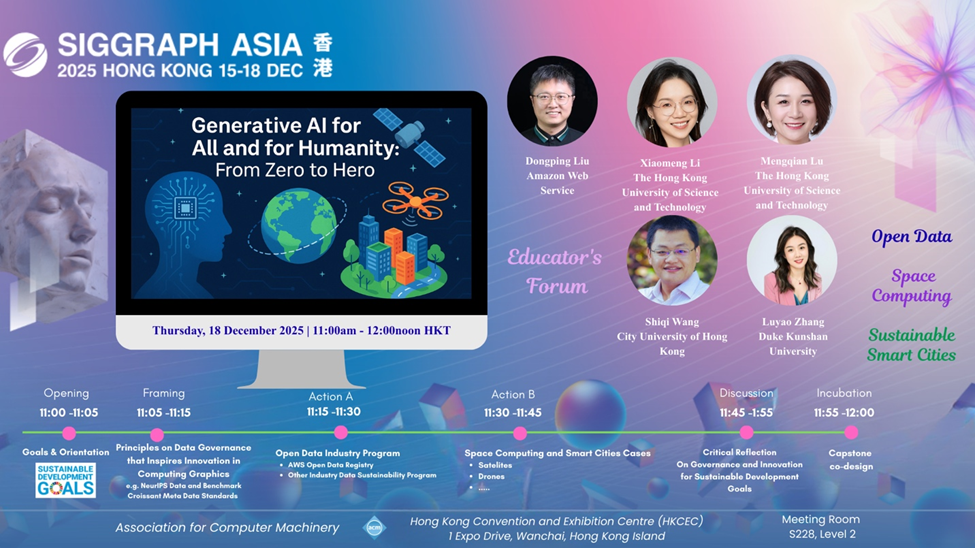
Building on this foundation, the second session, “Generative AI for All and for Humanity,” translated theory into practice. This hands-on tutorial guided participants through the “From Zero to Hero” journey, utilizing open data, space computing, and 3D modeling to address real-world challenges.
The second publication, Generative AI for All and for Humanity (Liu et al., 2025), details how these technical workflows align with the United Nations Sustainable Development Goals. By emphasizing open data practices, the session demonstrated how learners can move from conceptual understanding to creating tangible social impact, such as climate resilience and sustainable urban development.
A Philosophical Bridge: Ancient Wisdom in the Digital Age
My project Bridging Global Perspectives: A Comparative Study of AI Academic Policies in Higher Education—supported by the Center of the Study of Contemporary China (CSCC) Student-Initiated Research and Creative Inquiry Grant at DKU, with Prof. Luyao Zhang, co-lead of the Digital Technology and Society Cluster, as mentor—aligns with the educator’s forum sessions at ACM SIGGRAPH Asia. On April 11, 2025, I curated a panel Academic Policy Discussion on AI Use in collaboration with the DKU AI Club and CSCC Digital Technology and Society Cluster, drawing interdisciplinary participants across all departments. The event featured student discussions that elicited anonymous recommendations on AI ethics and equity, followed by a panel with Chancellor Scott MacEachern and faculty including Dr. Fangfang Yin, Dr. Luyao Zhang, Dr. Donald Snow, and Dr. Andrew Field, all sharing perspectives on the responsible integration of AI. As a core component of my research, this forum refined the project’s direction through stakeholder dialogues—including calls for clearer institutional guidelines—and produced a formal report for DKU leadership.
To advance the project, I engaged in an in-depth interview with Prof. Zhang. A distinctive and compelling dimension of these sessions—elaborated on by Prof. Luyao Zhang in my interview with her, and reflective of her core scholarly insights—lies in their profound philosophical underpinnings, which bridge ancient Eastern and Western thought with contemporary technology.
As Prof. Zhang shared during our conversation, the first session resonates with the Western Socratic tenet of “Know thyself” and the Eastern Confucian principle of self-cultivation. This inward focus, a key insight from her, emphasizes that to wield generative AI effectively, we must first develop a clear and intentional understanding of our own agency and intrinsic motivations.
Prof. Zhang further expounded in our interview that the second session rounds out this conceptual arc by pivoting to the outward sphere of action. Drawing directly from her insights, the session takes inspiration from Nietzsche’s exhortation to “become who you are” and the Ming Dynasty philosopher Wang Yangming’s core doctrine of the “unity of knowledge and action.” As she stressed, this cross-cultural connection underscores a critical truth: genuine understanding is only fully attained when internal reflection manifests as meaningful, purposeful practice—here, the deliberate use of AI to tackle complex global problems.
From Insight to Policy: Inspiring Future Legislation
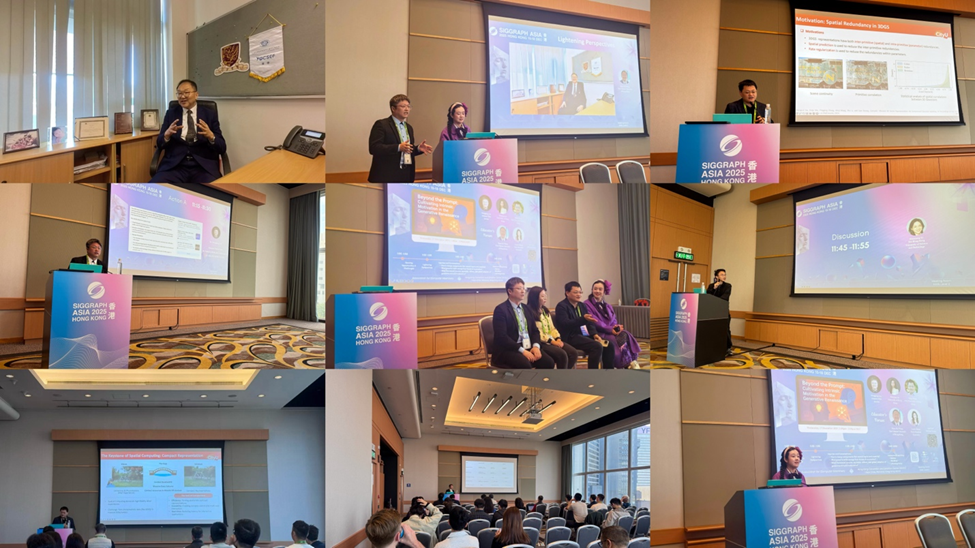
A highlight of the event was an interview conducted by Prof. Luyao Zhang with Prof. Kam-Fai Wong, a renowned AI researcher and member of the Hong Kong Legislative Council. Prof. Wong articulated a human-centric vision where AI serves as a collaborator rather than a replacement. Crucially, he emphasized that “governments must support education… and clear policies to narrow digital gaps and ensure accountability”.
Prof. Wong’s call for forward-looking policy and “fundamental changes in pedagogy and assessment” has directly inspired the next phase of my own research. His insights reinforced the urgent need for structured governance in higher education to balance innovation with responsibility.
Inspired by these rigorous intellectual dialogues—incorporating the UNESCO AI in Education Framework and Professor Wong’s legislative perspectives—I seek to advance this research to drive greater broader impact through:
- Analyze Global Frameworks: Add more samples to the comparative analysis of AI governance documents from China, the U.S., and global institutions to identify ethical priorities and governance models.
- Inform Institutional Policy: Synthesize these findings to propose a conceptual framework for AI policy development specifically for Duke Kunshan University, ensuring our guidelines are adaptable to China’s unique regulatory landscape.
- Foster Dialogue: Prepare a seminar open to DKU community to present the findings while engaging students and faculty in the critical discourse of how we regulate the very tools that are redefining our education.
The sessions at SIGGRAPH Asia 2025 demonstrated that the future of AI in education is not just about code and algorithms; it is about philosophy, policy, and the “unity of knowledge and action”, a future I am eager to help shape.
References:
Liu, Dongping; Li, Xiaomeng; Lu, Mengqian; Wang, Shiqi; Zhang, Luyao. 2025. Generative AI for All and for Humanity: From Zero to Hero with Open Data, Space Computing, and Sustainable Smart Cities. In SIGGRAPH Asia 2025 Educator’s Forum (SA ’25). Association for Computing Machinery, New York, NY, USA. https://doi.org/10.1145/3757372.3771874.
Liu, Dongping; Qi, Xiaojuan; Wang, Shiqi; Wong, Kam-Fai; Zhang, Luyao. 2025. Beyond the Prompt: Cultivating Intrinsic Motivation in the Generative Renaissance. In SIGGRAPH Asia 2025 Educator’s Forum (SA ’25). Association for Computing Machinery, New York, NY, USA. https://doi.org/10.1145/3757372.3771849.
CSCC Event on Academic Policy Discussion on AI Use: